

When a role needs regular driving, or when a business wants to attract senior staff, the transport benefit usually comes down to two options: the company provides a car, or the company pays a monthly car allowance and lets the employee sort out their own vehicle. The company car vs car allowance Singapore question looks simple, but the answer depends on how the car is really used, who carries the risk of Singapore’s high ownership costs, and how each option is treated for tax.
This guide looks at both sides of the table: what the employer gives up and gains, and what the employee should think about before accepting either package. It is general information, not tax or legal advice. Rules from IRAS (the Inland Revenue Authority of Singapore) and LTA (the Land Transport Authority) change from time to time, so always confirm the current position with them or with a qualified tax adviser.
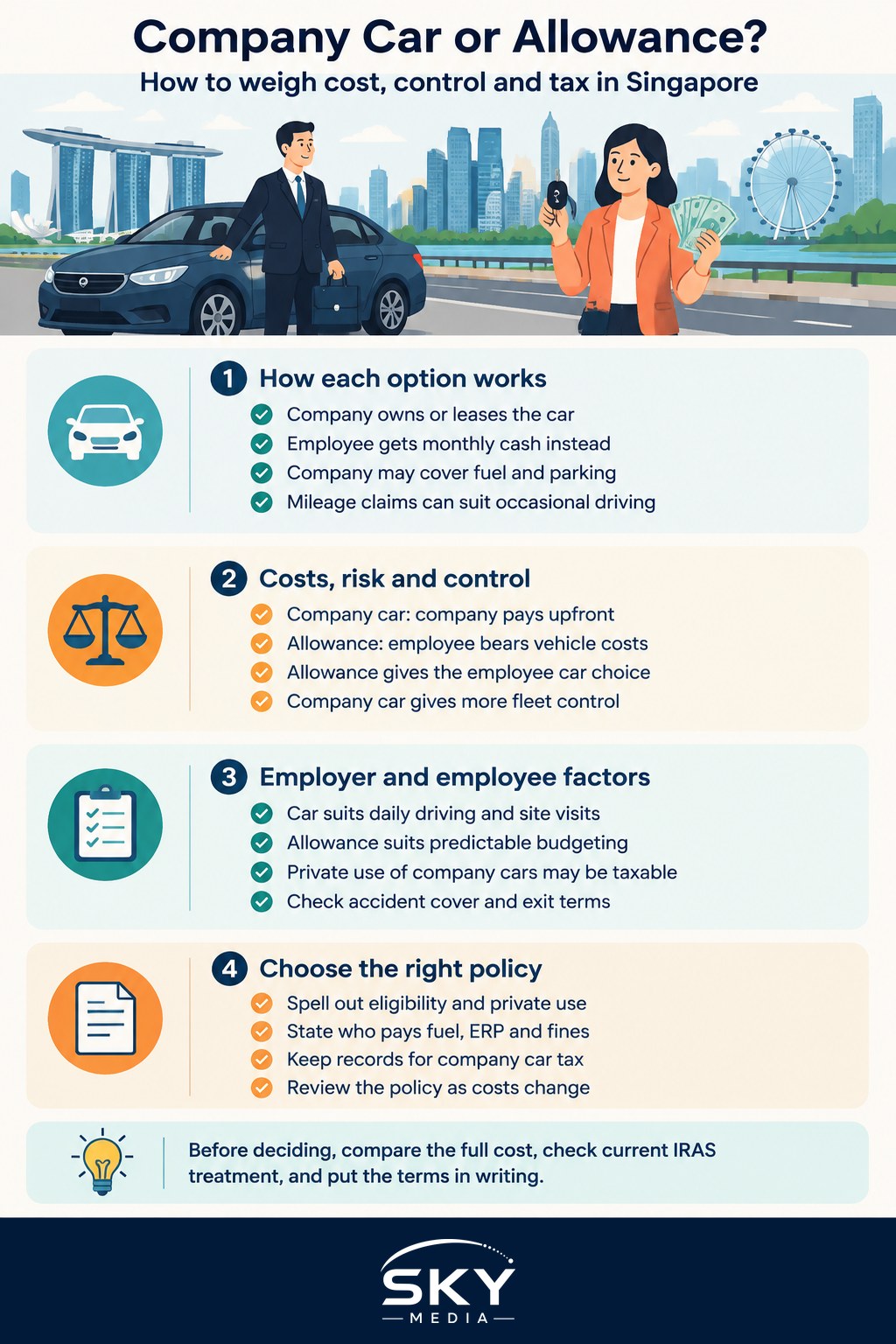
How Each Option Actually Works
A company car is a vehicle owned or leased by the business and assigned to an employee. The company usually pays for the purchase or lease, insurance, road tax, servicing and sometimes fuel, parking and ERP (Electronic Road Pricing) charges. The employee drives it for work and, depending on the policy, for personal use as well.
A car allowance is a fixed cash sum added to the employee’s monthly pay, meant to cover the cost of using their own car. The employee chooses, buys or leases, insures and maintains the vehicle. The company’s involvement ends at payroll.
There is also a third route that many firms forget: mileage or expense reimbursement, where the employee uses any car (or a private-hire ride) for business trips and claims the actual business cost. This suits staff who drive for work only occasionally.
If the business decides to own the vehicle, the practical steps of putting a car in the company’s name are covered in our guide on how to register a car under a company in Singapore.
Side by Side: Cost, Risk and Control
| Factor | Company car | Car allowance |
|---|---|---|
| Who pays upfront | Company (purchase, COE, or lease deposit) | Employee |
| Who carries COE and depreciation risk | Company | Employee |
| Running costs (insurance, servicing, road tax) | Usually company | Employee, out of the allowance |
| Choice of car | Company decides or offers a shortlist | Employee chooses freely |
| Personal use | Allowed only if policy says so, and may be a taxable benefit | Employee’s own car, use it however they like |
| Admin for HR and finance | Higher: fleet records, renewals, accidents, logbooks | Low: a fixed payroll line |
| What happens if the employee leaves | Car returns to the company and is reassigned or sold | Allowance stops, employee keeps their car |
| Image and brand control | Uniform, can carry company livery | None |
The Employer’s View
Why a company car can make sense
- The car is a working tool. Sales reps covering client sites, technicians carrying equipment and managers visiting worksites need a reliable vehicle every day. Owning or leasing gives the business control over availability, safety standards and condition.
- Brand and consistency. Commercial vehicles or cars with company livery act as moving advertising and give clients a consistent impression.
- Retention. A good car is a visible perk, and some employees value not having to finance a vehicle themselves.
Why an allowance can make sense
- Singapore’s ownership costs are high and volatile. A COE (Certificate of Entitlement) is the right to own a vehicle for ten years, and its price moves with each bidding exercise. With an allowance, the company is not exposed to those swings or to depreciation.
- Lower admin. No fleet records, no chasing renewals, no arranging repairs or handling accident claims.
- Fairness and simplicity. One allowance amount per grade is easy to explain and budget for.
The tax angle for the business
Under Singapore tax rules, running expenses on private passenger cars (the S-plated cars most people drive) are generally not deductible for the company, and no capital allowances are given on them. Commercial vehicles such as vans and lorries, and some other categories, are treated differently. A car allowance, by contrast, is part of salary, which is a normal business expense. This difference alone can tilt the decision, so ask your accountant to model both options using current IRAS guidance before committing.
The Employee’s View
What to check before accepting a company car
- Is personal use allowed? If you can use the car for weekends and family trips, IRAS generally treats that private use as a taxable benefit-in-kind. Its value is worked out using an IRAS method and added to your employment income, so a “free” car can still increase your tax bill. Ask HR how it will be reported on your IR8A (the annual employment income form your employer submits).
- Who pays fuel, parking and ERP for private trips? Policies vary widely.
- What happens after an accident? Find out about the insurance excess, whether you are liable for any part of it, and what the claims process is.
- Can you buy the car when you leave or when the lease ends? Some companies offer this, many do not.
What to check before accepting an allowance
- Does the amount really cover a car? Add up instalments or lease payments, insurance, road tax, servicing, fuel, parking and ERP. In Singapore, the allowance often covers only part of the true cost, and the gap comes out of your pocket.
- It is taxable. A car allowance is normally taxed as employment income, just like salary.
- Is it guaranteed? Check whether the allowance is fixed in your contract, whether it is included in bonus or CPF calculations, and whether it can be reduced.
- Do you even need a car? If most of your business travel is short and occasional, an allowance you can spend on public transport and private-hire rides may leave you better off than owning a vehicle.
Which Option Suits Which Situation
A company car usually fits when:
- The job involves heavy daily driving, carrying tools or stock, or visiting many sites.
- The business needs a commercial vehicle (a van or lorry) rather than a passenger car.
- The company wants control over safety standards, appearance and availability.
- Several employees share the vehicle, such as pool cars on shift rosters.
A car allowance usually fits when:
- Driving is part of the role but not the core of it, such as a manager with occasional client meetings.
- The employer wants predictable costs and no exposure to COE or resale value.
- Staff turnover is high, so tying up capital in vehicles is risky.
- Employees would rather choose their own car, or not own one at all.
Mileage reimbursement fits when business trips are irregular, because the company pays only for actual work travel and nobody carries the cost of a vehicle that sits idle.
Getting the Policy Right
Whichever route a business chooses, write it down clearly. A good transport benefit policy covers:
- Eligibility. Which roles or grades qualify, and why.
- Private use rules. What is allowed and how it is recorded for tax.
- Cost split. Exactly which costs the company pays and which the employee pays, including fuel, parking, ERP, fines and insurance excess.
- Records. For company cars, a simple log of business and private trips helps both sides when working out the taxable benefit.
- Exit terms. When and how the car is returned, or when the allowance ends.
- Review dates. Allowance amounts and fleet choices should be reviewed regularly, since vehicle costs in Singapore can shift a lot over a few years.
If you are setting up a new business and deciding on employee benefits for the first time, our guide on how to register a company in Singapore covers the earlier groundwork.
The Bottom Line
A company car gives the business control and gives the employee a car without the upfront cost, but it brings fleet admin, ownership risk and, where personal use is allowed, a taxable benefit. A car allowance is simple and predictable for the employer, while the employee takes on the cost, risk and freedom of choosing their own vehicle. Work out the real numbers on both sides, check the current IRAS treatment, and put the agreed terms in writing before anyone collects the keys.
Frequently Asked Questions
Does a car allowance count towards my CPF and bonus calculations? It depends on how your contract defines it. A car allowance is normally taxed as employment income like salary, but whether it counts for bonus or CPF calculations, and whether it can be reduced, should be checked in your contract and with HR.
Is mileage reimbursement better than a car allowance if I drive only occasionally? Often yes. The company pays only for actual work travel, so nobody carries the cost of a vehicle that sits idle. If most of your business trips are short and irregular, public transport and private-hire rides claimed as expenses may leave you better off.
What happens to a company car when the employee resigns? The car returns to the company and is reassigned or sold. Some companies allow the employee to buy it when they leave or when the lease ends, though many do not. Check the policy and exit terms in writing before accepting.
Who pays if I have an accident in a company car? Policies vary, so ask about the insurance excess, whether you are liable for any part of it, and how the claims process works. Fines, ERP and parking for private trips may also be split differently. Have these terms stated in the written car policy.
Should a small business start with a car allowance or a company car? An allowance is simpler and gives predictable costs, with no exposure to COE or resale value. A company car makes sense when driving is core to the job or a commercial vehicle is needed. Ask your accountant to model both options using current IRAS guidance.
Official sources: IRAS
Further reading: Corporate Transport Options for Small Businesses in Singapore