

Every Singapore company has a rulebook, even if the founders never read it. That rulebook is the company constitution. In Singapore, it sets out how shares are issued and transferred, how directors are appointed, how meetings run and what powers the company has. Most small companies start with a standard version and never look at it again, until a new investor, a co-founder exit or a family succession plan forces the question. This guide explains what a company constitution in Singapore actually contains, how the model constitution works, which custom clauses are common, and how to amend the document properly.
This is general information, not legal advice. The rules sit in the Companies Act and the regulations under it, and the Accounting and Corporate Regulatory Authority (ACRA, the registrar of companies) handles lodgements. For anything specific to your company, speak to a corporate lawyer or your corporate secretary, and confirm current requirements on ACRA’s website.
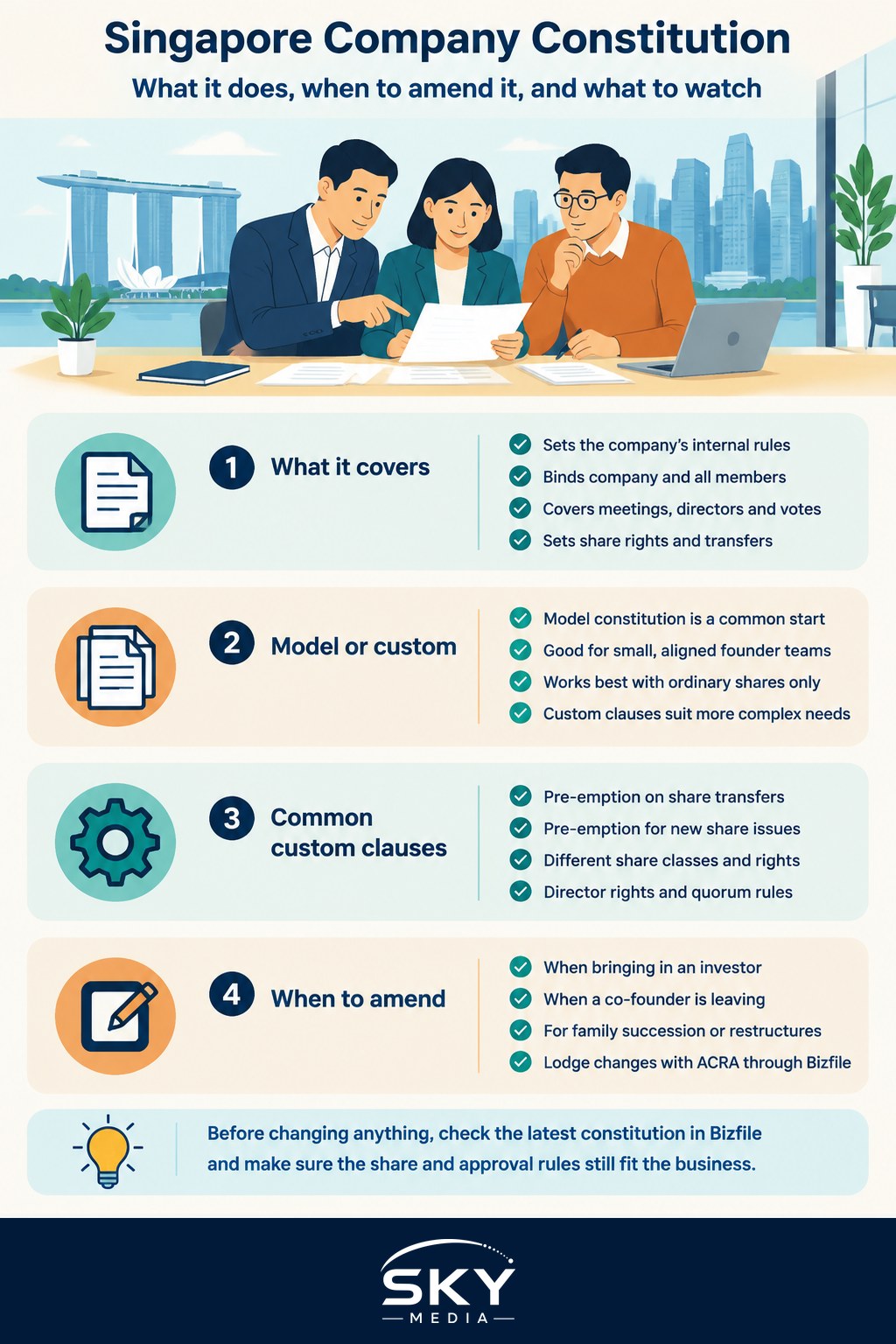
What a Company Constitution Does
Older companies may remember a “Memorandum and Articles of Association”. Changes to the Companies Act merged these two documents into a single “constitution”, and older companies’ memorandum and articles are generally treated as their constitution. Whatever the name, the document does three main jobs:
- It binds the company and its members. The constitution works like a contract between the company and each shareholder, and between shareholders themselves, on the matters it covers.
- It sets internal governance. Quorum for meetings, how votes are counted, the chairman’s casting vote, how directors are appointed and removed, and what directors may do without shareholder approval.
- It governs shares. Classes of shares, rights attached to each class, how shares can be transferred, and whether existing shareholders get first refusal.
Unlike a private agreement, the constitution is lodged with ACRA and forms part of the company’s public record. Anyone who buys the company’s documents through Bizfile (ACRA’s online portal) can see it. That matters when you decide what to put in it.
The Model Constitution and When It Is Enough
When you incorporate through Bizfile, you can adopt the model constitution prescribed under the Companies Act, either in full or with modifications, or lodge your own custom constitution. For a typical one or two founder private company limited by shares, the model constitution is often a sensible starting point because it covers the essentials in a balanced, well understood way.
The model constitution generally addresses:
- Issue of shares and the directors’ powers around it
- Transfer and transmission of shares (for example, when a shareholder dies)
- General meetings, notices, quorum and voting
- Appointment, retirement and removal of directors
- Directors’ powers and proceedings, including board resolutions in writing
- Dividends, accounts and the company seal (where used)
The model works well when the shareholders are closely aligned, there is a single class of ordinary shares and no outside investor is asking for special protections. It starts to feel thin when ownership becomes more complex. If you are still at the set-up stage, our guide on how to register a company in Singapore covers where the constitution choice fits into incorporation.
Common Custom Clauses Business Owners Add
Most custom constitutions are the model version plus a handful of tailored clauses. The ones that come up most often in owner-managed businesses include:
- Pre-emption rights on transfer. A shareholder who wants to sell must first offer shares to existing shareholders, usually at a price set by a defined method. This keeps ownership within the founding group.
- Pre-emption on new issues. New shares must be offered to existing shareholders in proportion to their holdings before outsiders, protecting against dilution.
- Different classes of shares. Preference shares, non-voting shares or shares with different dividend rights, often used for investors or family members.
- Director appointment rights. A specified shareholder may appoint or remove a set number of directors.
- Quorum and reserved matters. Raising the quorum or requiring a particular shareholder’s presence or consent for key decisions.
- Restrictions on business or powers. By default a company has broad capacity. Some founders add restrictions, for example in family holding companies, though this is less common.
- Entrenchment provisions. The Companies Act allows certain clauses to be “entrenched”, meaning they can only be changed under stricter conditions than a normal amendment, such as unanimous consent. These need careful drafting.
Keep in mind that whatever goes into the constitution becomes public. Commercially sensitive terms, such as valuation formulas, vesting schedules or non-compete promises, usually belong in a private shareholders’ agreement instead.
Constitution vs Shareholders’ Agreement
Founders often confuse the two documents. They overlap, but they do different jobs, and many companies use both.
| Point of comparison | Company constitution | Shareholders’ agreement |
|---|---|---|
| Is it required? | Yes, every company has one (model or custom) | No, it is optional |
| Who can see it? | Public, lodged with ACRA | Private between the parties |
| Who is bound? | The company and all members, including future ones | Only those who sign it |
| How is it changed? | Special resolution of shareholders, then lodged with ACRA | As the agreement itself says, often unanimous consent |
| Typical contents | Share classes, transfers, meetings, director powers | Funding duties, vesting, exits, deadlock, non-compete |
Where the two conflict, problems arise. A shareholders’ agreement often includes a promise that the parties will vote to amend the constitution to match it. When you sign one, ask your lawyer to check both documents line up.
How to Amend a Company Constitution
Changing the constitution follows a set route under the Companies Act. The broad steps are:
- Check what the current constitution says. Look for entrenched clauses, special consent rights or class rights. Changing rights attached to a class of shares may need that class’s separate approval.
- Draft the amendment. You can amend specific clauses or adopt a whole new constitution. A lawyer or corporate secretary usually prepares the wording.
- Board approval to propose it. Directors typically resolve to recommend the change and call a general meeting, or circulate a written resolution if the company is a private company and the constitution allows it.
- Pass a special resolution. A special resolution requires at least 75% of the votes cast by members entitled to vote. Longer notice applies than for an ordinary resolution. Private companies can often pass it by written resolution instead of holding a meeting.
- Lodge with ACRA. The special resolution and the amended constitution must be lodged with ACRA through Bizfile within the time allowed. Check the current deadline and any fee on ACRA’s website, as late lodgement can attract penalties.
- Update your records. File the signed resolution in the company’s minute book, update the register of members if share rights changed, and share the new version with directors and shareholders.
The amendment generally takes effect when the special resolution is passed, unless it states otherwise, but the ACRA lodgement keeps the public record accurate.
When It Is Worth Amending
You do not need to touch a working constitution just for the sake of it. These are the common triggers that make an amendment worthwhile:
- Bringing in an investor. Investors usually want preference shares, board seats or consent rights. Expect the constitution to be rewritten as part of the deal.
- A co-founder leaving. If there is no transfer mechanism, an exit can stall. Adding pre-emption and valuation clauses beforehand avoids a standoff.
- Family succession. Passing shares to the next generation is smoother with clear transmission and transfer rules.
- Group restructures. Holding company changes or share swaps often need updated share class provisions. If you are going through one, our piece on surviving a company restructuring in Singapore covers the people side.
- Winding down. Before closing a company in Singapore, check the constitution for any distribution or meeting rules that apply.
Before acting on any trigger, pull your latest constitution from Bizfile and check it reflects who owns and runs the company today. A constitution is cheap to fix while everyone gets along and expensive to argue over once they do not.
Explore more: How to Check a Singapore Company Before You Pay
Frequently Asked Questions
How much does it cost to amend a company constitution? The cost depends on who drafts the changes and how complex they are, plus ACRA’s lodgement fee. Simple edits by a corporate secretary usually cost less than a full rewrite by a lawyer. Ask for a quote up front, and check the current ACRA fee on its website.
Can a sole shareholder amend the constitution alone? Generally yes, if that shareholder controls enough votes to pass the required special resolution, which a sole owner does. The steps are still the same on paper: pass the resolution, keep a signed record and lodge it with ACRA. A corporate secretary can handle the paperwork.
What if some shareholders refuse to agree to the amendment? The change cannot go through unless the required voting threshold is met, and entrenched clauses or class rights may demand even more. Talk to the dissenting shareholders first, and see a lawyer before pushing a vote, since shareholders may have remedies if they feel unfairly treated.
Where can I get a copy of my company’s constitution? Start with the company’s own records, such as the minute book or what your corporate secretary holds. You can also purchase the company’s lodged documents through ACRA’s Bizfile portal. Check that the version you have is the latest one, including any amendments lodged since.
Can I write my own constitution without a lawyer? You can, but it is risky. Badly worded clauses can create disputes, conflict with the Companies Act or fail when you need them. A safer path is to adopt the model constitution and add only the clauses you need, then have a lawyer or corporate secretary review them.
Official sources: ACRA
Further reading: Does Your Singapore Company Need a Common Seal or Company Stamp?