
A share buyback lets a company purchase its own shares from one or more shareholders. In a private company, it is often used when a co-founder leaves, an early investor wants to exit, or the owners want to return surplus cash without bringing in an outside buyer. This guide walks through how a share buyback private company Singapore process usually runs under the Companies Act: the constitution check, the solvency test, the choice of offer, the resolutions, payment and lodgement with ACRA (the Accounting and Corporate Regulatory Authority).
This is general information, not legal or tax advice. The Companies Act has detailed conditions, and getting a step wrong can make the buyback void or expose directors to liability. Work with your company secretary or a corporate lawyer, and confirm current requirements on the ACRA website.
Buyback, Share Transfer or Capital Reduction?
Owners often confuse three different routes for moving or returning shares. They have different rules and paperwork.
| Route | Who buys the shares | Main approval and safeguards | Typical use |
|---|---|---|---|
| Share buyback | The company itself | Constitution must allow it, solvency test, shareholder resolution, ACRA lodgement | Exit of one shareholder funded by company cash |
| Share transfer | Another person or existing shareholder | Constitution transfer rules, board approval, stamp duty | Founder sells to a partner or new investor |
| Capital reduction | No purchase, capital is cancelled or returned | Solvency statement or court route, special resolution, ACRA lodgement and notices | Returning capital to all shareholders or tidying the balance sheet |
If another shareholder is buying, see How to Transfer Shares in a Singapore Private Limited Company. If you want to reduce capital across the board, How to Reduce Share Capital in a Singapore Company covers that separate process.
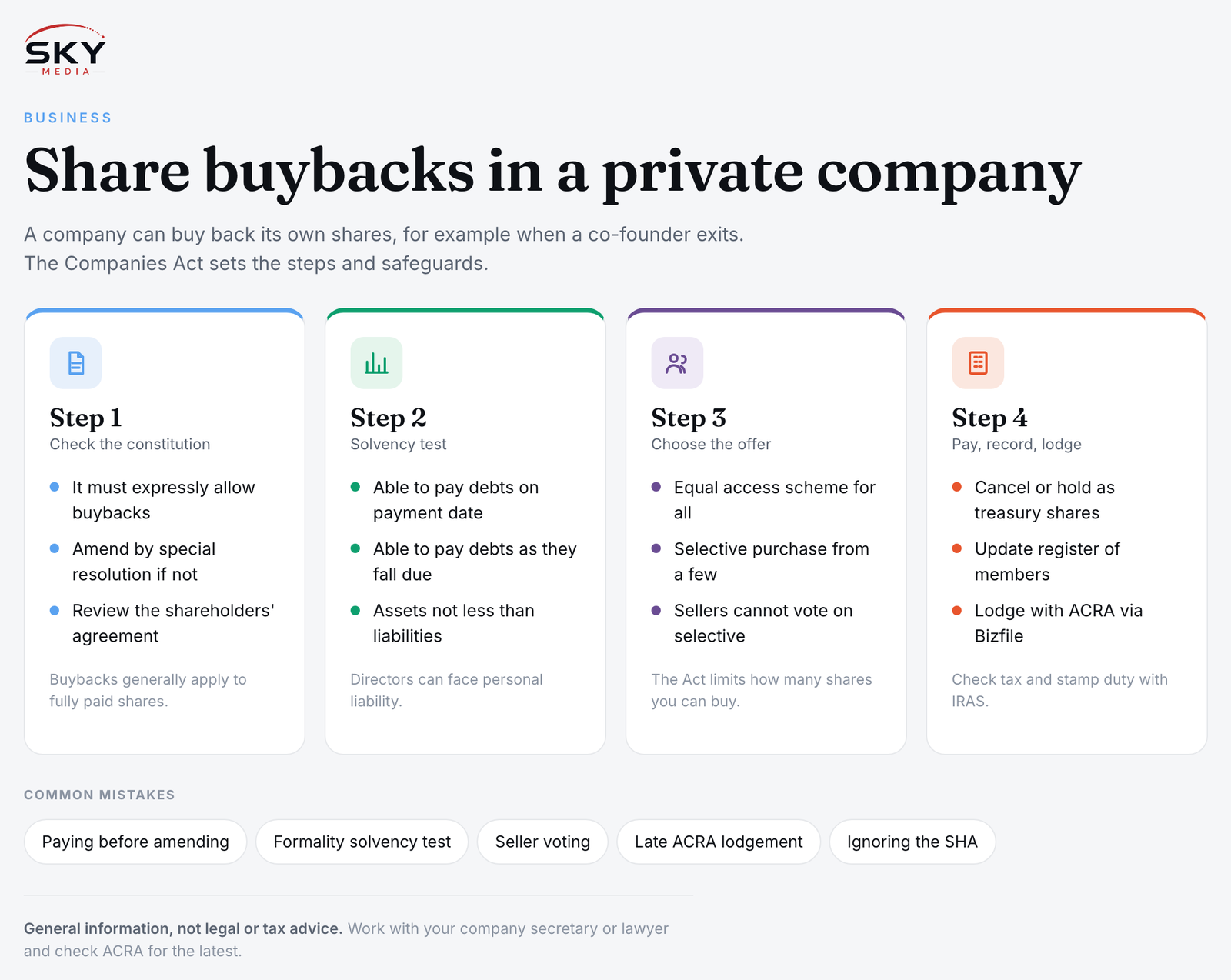
Step 1: Check the Constitution
A company can only buy back its own shares if its constitution expressly permits it. Many older constitutions, or ones adapted from standard templates, are silent or restrictive.
- Read the constitution for a clause authorising share purchases or acquisitions.
- If there is no such clause, the shareholders will usually need to pass a special resolution to amend the constitution first, and the amendment is lodged with ACRA.
- Check any shareholders’ agreement as well. It may give other shareholders pre-emption rights, consent rights or a set valuation method that affects how the buyback is priced.
- Confirm the shares are fully paid. Share buybacks under the Act generally apply to fully paid shares.
Step 2: The Solvency Test
The Companies Act protects creditors by requiring the company to be solvent before paying for a buyback. Broadly, the directors must be satisfied that:
- There is no ground on which the company could be found unable to pay its debts at the date of payment.
- The company will be able to pay its debts as they fall due over the following period set by the Act.
- The value of the company’s assets is not less than its liabilities, including contingent liabilities, and will not become less than its liabilities after the purchase.
Directors should base this on up-to-date management accounts, cash flow forecasts and known obligations such as loans, leases, tax and staff costs. Payment can come from capital or profits, but either way the solvency test applies. Directors who approve a payment while the company is not solvent can face personal liability and penalties, so document the assessment carefully in board minutes.
Step 3: Choose the Type of Offer
Private companies are not listed, so they use off-market purchases. The Act sets out two main forms:
- Equal access scheme: the offer is made to every shareholder of the relevant class, in proportion to their holdings, on the same terms. Shareholders choose whether to accept. Approval requirements are lighter than for a selective offer.
- Selective off-market purchase: the company buys from one or a few specific shareholders, which is common when a single founder exits. This generally needs a special resolution, and the shareholders whose shares are being bought are excluded from voting on it. Check the exact voting and notice rules in the Act with your adviser.
The Act also limits how many shares a company can buy back within a set period, measured against its total issued shares. Your company secretary can confirm the current limit and whether your proposal fits within it.
Step 4: Resolutions and Approvals
The paperwork usually runs in this order:
- Board meeting or written resolution approving the proposed buyback, the price and terms, and recording the directors’ view on solvency.
- Shareholder approval by ordinary or special resolution as the Act and the type of offer require. Private companies often use written resolutions in place of a general meeting, provided the constitution and Act allow it.
- Agreement with the selling shareholder, often a share buyback agreement setting out price, completion date and any warranties or releases.
- Valuation support where the price is not obvious. An independent valuation helps show the price is fair, which reduces disputes and helps with tax treatment.
Keep signed copies of every resolution and the agreement in the company’s statutory records. Related corporate actions follow similar resolution patterns; see How to Declare Dividends in a Singapore Private Company for comparison.
Step 5: Payment, Cancellation or Treasury Shares
Once approvals are in place and the solvency test is satisfied on the payment date, the company pays the shareholder. What happens to the shares then:
- Cancellation: by default, purchased shares are cancelled, and the company’s issued share count falls.
- Treasury shares: the Act allows companies to hold bought-back shares as treasury shares, within limits, and later sell, transfer or cancel them. Treasury shares carry no voting rights or dividends while held. Check the current rules and limits before choosing this route.
Update the electronic register of members maintained by ACRA, the company’s own records and the cap table. If the buyback changes who controls the company, the register of registrable controllers may also need updating.
Step 6: Lodge With ACRA and Consider Tax
The company must notify ACRA of the share buyback through Bizfile, ACRA’s online filing portal, within the deadline set by the Companies Act. The lodgement records the number and class of shares bought, the amount paid and whether payment came from capital or profits. Late or missing lodgements can attract penalties, so diarise it as soon as the purchase completes.
On tax, how the payment is treated depends on whether it is funded from capital or profits and on the shareholder’s circumstances. Stamp duty treatment may also differ from an ordinary share transfer. Check with IRAS (the Inland Revenue Authority of Singapore) or a tax adviser before signing; see also Stamp Duty on Shares in Singapore.
Common Mistakes to Avoid
- Paying before the constitution has been amended to allow buybacks.
- Treating the solvency test as a formality without real accounts behind it.
- Letting the selling shareholder vote on their own selective buyback.
- Forgetting to update the register of members or to lodge with ACRA on time.
- Ignoring the shareholders’ agreement’s valuation or consent clauses.
A well-run share buyback private company Singapore process gives a departing shareholder a clean exit and keeps the company’s records in order. Plan the steps early and check every requirement with ACRA and your advisers.
Official sources: ACRA