

When someone close to you dies, work is the last thing on your mind. Yet within hours you may need to tell your manager you will be away, often without knowing what you are entitled to. Compassionate leave in Singapore, also called bereavement leave, is something many employees assume is guaranteed. In fact, it works differently from annual or sick leave.
This guide explains what the law does and does not require, what company policies typically offer, your other options if there is no policy, and how to ask for time off. It is general information, not legal advice. Check your employment contract, your employee handbook and the Ministry of Manpower (MOM) for your situation.
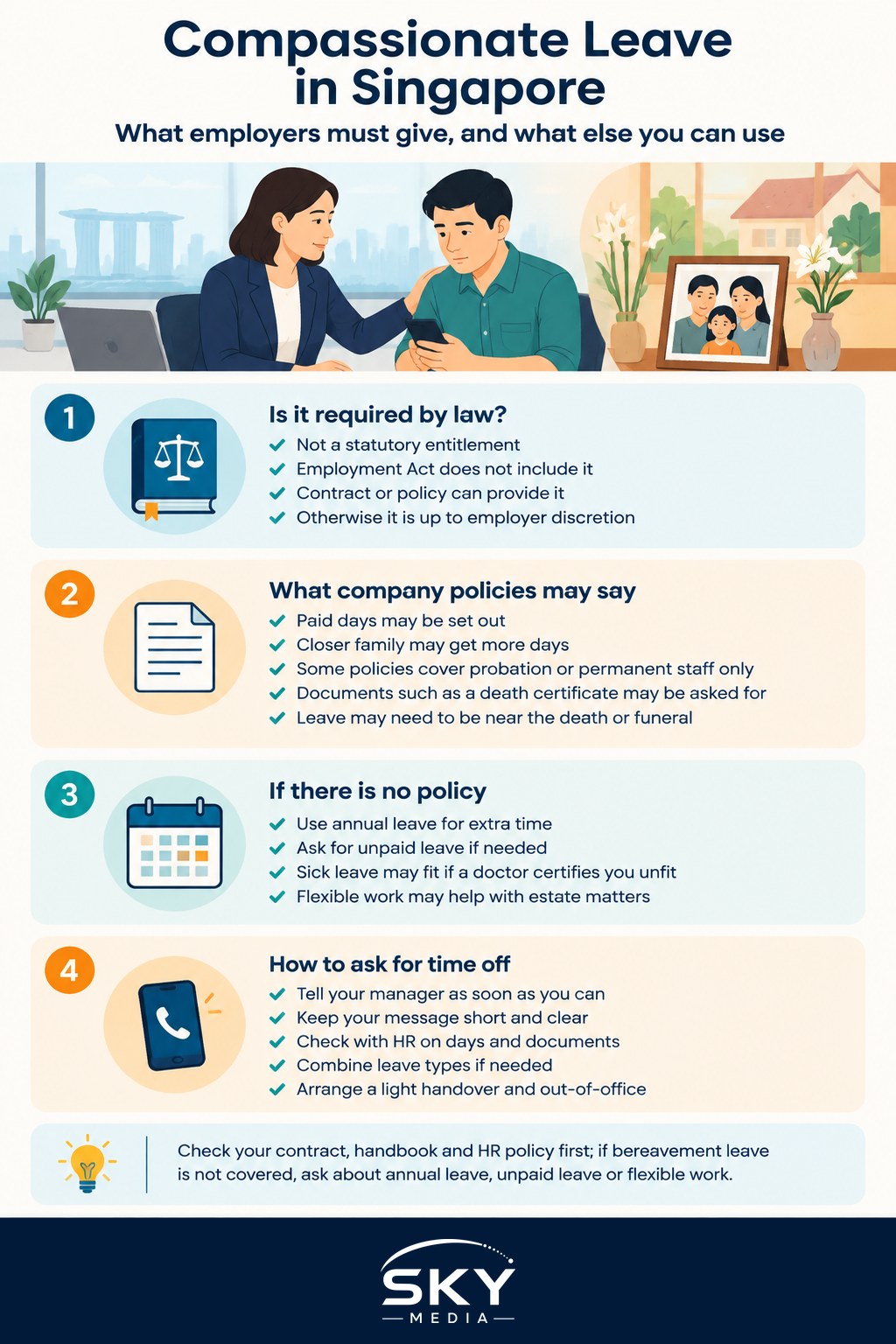
Is Compassionate Leave a Legal Requirement?
No. The Employment Act, Singapore’s main employment law, sets out statutory leave such as annual leave, paid sick leave and hospitalisation leave, and other laws cover leave such as maternity, paternity, shared parental and childcare leave. Compassionate or bereavement leave is not among the statutory entitlements.
That means:
- Your employer is not legally required to give compassionate leave.
- If your employment contract, handbook or collective agreement promises compassionate leave, your employer should honour those terms. Once it is in your terms, it is a contractual benefit.
- If there is no policy, any time off is at your employer’s discretion, or comes from your other leave entitlements.
Many employers still offer compassionate leave as good practice, and the public sector and many larger organisations have long had such policies. Unionised workplaces often include it in their collective agreements.
What Typical Company Policies Look Like
Policies vary widely, so read yours carefully. Common features include:
- A set number of days of paid leave, often a few days for the death of an immediate family member.
- Different entitlements by relationship. Immediate family, such as a spouse, child, parent or sibling, usually gets more days than extended family, such as grandparents or in-laws. Some policies cover in-laws and grandparents equally with immediate family; others give a single day or nothing.
- Eligibility conditions. Some policies apply only after probation or only to permanent staff.
- Documentation. Employers may ask for a copy of the death certificate or a funeral notice. In Singapore, deaths are registered with the authorities and a digital death certificate is generally issued, so this is usually easy to provide later.
- Timing rules. Leave may need to be taken around the date of death or the funeral, rather than saved for later.
If you are unsure, ask HR for the written policy instead of relying on what colleagues remember.
Your Options If There Is No Policy or It Is Not Enough
Funeral customs in Singapore differ by faith and family. A Chinese wake may run over several days, Muslim burials usually take place very quickly, and Hindu, Christian and other rites have their own timelines, followed by prayers or remembrance days. A short policy may not match what your family needs. Here is how the alternatives compare.
| Option | Paid? | When it fits | What to check |
|---|---|---|---|
| Compassionate leave | Usually paid, if your employer offers it | Death of a covered family member | Contract, handbook, days per relationship |
| Annual leave | Paid | Extra days for the wake, funeral or travel | Your balance and any approval process |
| Unpaid leave | No | Extended time away, such as overseas funerals | Employer approval, effect on benefits and CPF contributions |
| Sick leave | Paid, if you are certified unwell | If grief or stress affects your health and a doctor certifies you unfit for work | Valid medical certificate, sick leave entitlement |
| Flexible work arrangement | Normal pay | Working remotely or adjusted hours while handling estate matters | Company FWA policy and the tripartite guidelines on FWA requests |
A few points on these options:
- Annual leave is your entitlement, but your employer can usually still approve the timing. Most employers will be accommodating in a bereavement.
- Unpaid leave is entirely at your employer’s discretion. Ask how it affects your salary, CPF contributions and benefits.
- Sick leave is for genuine medical need, not a workaround. Grief can affect sleep, concentration and health, and a doctor can assess whether you are fit for work.
- Flexible work requests can help in the weeks after a death, when you may be dealing with estate paperwork, banks and government agencies. Singapore’s tripartite guidelines require employers to properly consider formal FWA requests. Check MOM and the Tripartite Alliance for current details.
How to Ask for Compassionate Leave
You do not need to explain more than you are comfortable sharing. A short, clear message is enough.
- Tell your manager as soon as you can. A phone call or brief message is fine. For example: “My grandmother passed away this morning. I need to be away for the wake and funeral, likely until Thursday. I will update you on the exact dates.”
- Ask HR about the policy. Find out how many days of compassionate leave apply, and whether you need to submit documents.
- Combine leave types if needed. If compassionate leave does not cover everything, ask to use annual or unpaid leave for the remaining days.
- Arrange a light handover. If you can, share urgent deadlines and who can cover. Our guide to giving a proper work handover has a simple structure, but in an emergency, a few lines are enough.
- Set an out-of-office message. Keep it simple, without personal details.
If you are a manager receiving such a request, respond with condolences first and logistics second. Flexibility at a time like this builds lasting trust.
For Employers: Setting a Clear Policy
Because compassionate leave is not statutory, it is up to each business to decide. A written policy avoids awkward case-by-case decisions. Consider:
- How many days for each relationship, and whether to include in-laws, grandparents and step-family.
- Whether foreign employees get additional days for overseas travel to attend funerals.
- Whether part-time staff are covered on a pro-rated basis.
- What documents, if any, you require, and when.
- How the policy interacts with annual, unpaid and flexible leave.
Note that compassionate leave is an employer-funded benefit. It is different from government-paid leave schemes such as government-paid maternity or paternity leave, where employers can claim reimbursement. Our guide on claiming government-paid leave reimbursements as an employer explains those schemes.
If You Feel You Were Treated Unfairly
If your contract promises compassionate leave and it was refused, or your salary was wrongly deducted, raise it with HR in writing first. If that does not resolve it, the Tripartite Alliance for Dispute Management (TADM) assists employees and employers with salary-related and employment disputes, and MOM’s website explains your options. Keep copies of your contract, policy and messages.
Losing someone is hard enough. Knowing what your employer must provide, what is goodwill and what alternatives exist can help you focus on your family rather than on paperwork.
Explore more: How to Give a Proper Work Handover · Claiming Government-Paid Leave Reimbursements as an Employer
Official sources: Ministry of Manpower (MOM)
Further reading: Do Employers Have to Accept Telemedicine MCs in Singapore? · Using Up Annual Leave Before Year-End: Carry-Forward and Encashment · Wedding Leave in Singapore and How to Ask for It