

When an employee goes on maternity, paternity or childcare leave in Singapore, the employer usually keeps paying their salary as normal. For many of these leave types, part or all of that pay can then be reclaimed from the Government. Getting a government paid leave claim employer process right matters for cash flow, especially for small firms where one long leave period is a noticeable cost.
Most guides on parental leave are written for employees. This one is for the business owner, HR executive or finance person who has to make the claim. It is general information, not legal or financial advice. Leave entitlements, caps and claim windows are set by the Government and do change, so always check the current rules on the official Government-Paid Leave website and with the Ministry of Manpower (MOM) before relying on any detail.
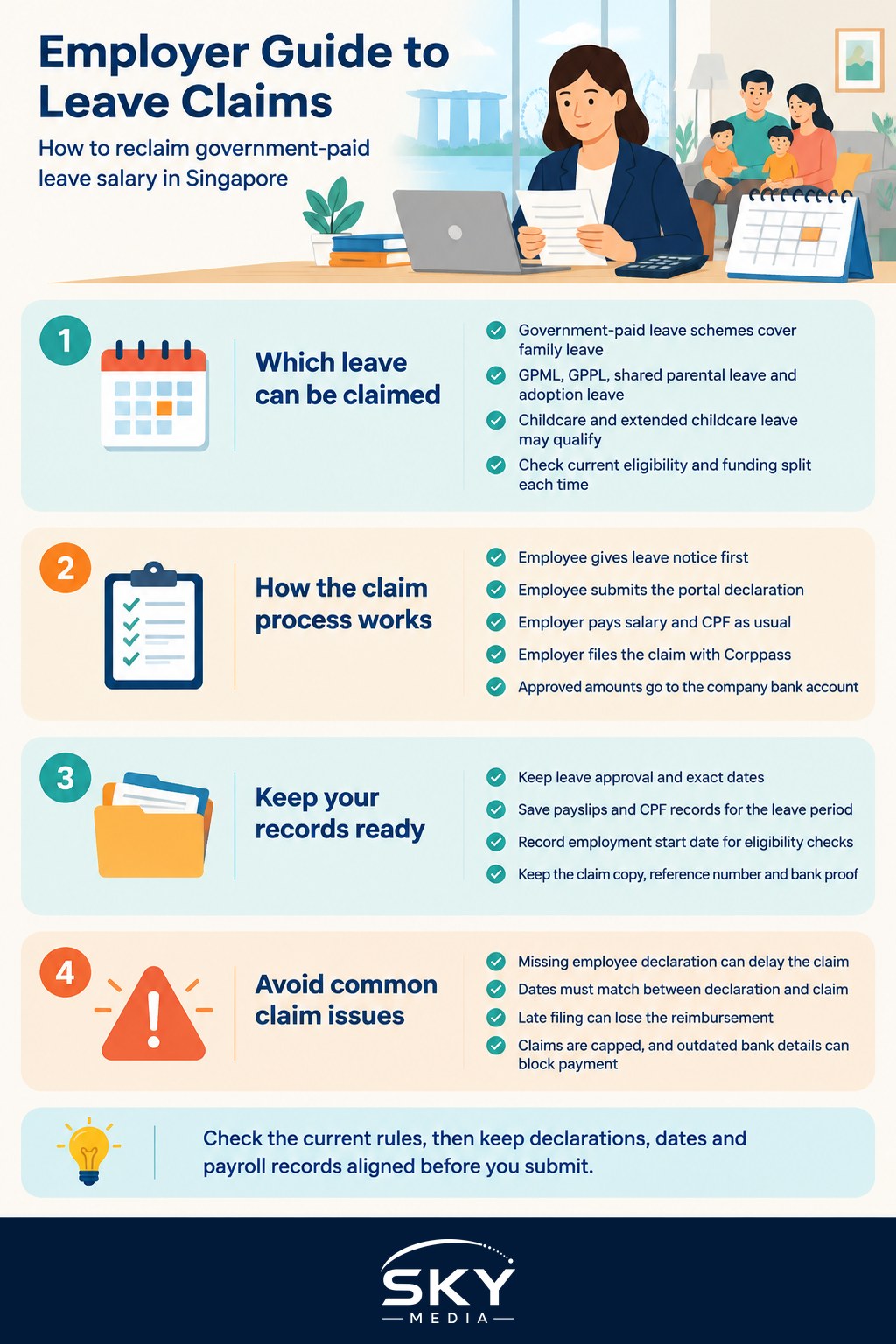
Which Leave Types Can Be Reimbursed
The Government-Paid Leave (GPL) schemes cover several types of family-related leave. The common ones employers encounter are:
- Government-Paid Maternity Leave (GPML): for eligible working mothers. Depending on factors such as the child’s birth order, some weeks may be funded by the employer and others reimbursable, so check the current split for each case.
- Government-Paid Paternity Leave (GPPL): for eligible working fathers.
- Shared Parental Leave: leave that eligible parents can share between them, which the employer may need to grant to the father or mother depending on how the couple splits it.
- Government-Paid Adoption Leave: for eligible adoptive mothers.
- Childcare Leave and Extended Childcare Leave: for parents of young children who meet the eligibility rules. Typically only part of the childcare leave is government-funded, with the rest borne by the employer.
Eligibility usually depends on things such as the child’s citizenship, the parent’s length of service with the employer and, in some cases, the parents’ marital status. The employee’s eligibility is not something the employer decides alone; it is assessed against the scheme rules, which is why the employee’s declaration step matters.
Unpaid infant care leave, by contrast, is unpaid, so there is nothing for the employer to reclaim.
How the Claim Process Works, Step by Step
The process follows a broadly similar pattern for each leave type. The table below shows who does what at each stage.
| Stage | Who acts | What happens |
|---|---|---|
| Leave request | Employee | Employee notifies the employer of planned leave, giving the notice required in their contract or under the law |
| Eligibility declaration | Employee | Employee submits a declaration for the relevant leave on the official GPL portal, so the employer can file a claim |
| Paying salary | Employer | Employer pays the employee’s salary as usual during the leave, including CPF contributions where applicable |
| Submitting the claim | Employer | Employer logs in with Corppass and files the claim for the leave days or weeks taken |
| Reimbursement | Government | Approved amounts are paid to the employer’s registered bank account, up to the applicable caps |
A few practical notes on each stage:
Get the employee’s declaration in early. In many cases the employer cannot complete a claim until the employee has made their declaration. Ask new parents to do this as soon as the leave is confirmed, and add it to your leave approval checklist.
Set up Corppass properly. Corppass is the Government’s corporate login for online business transactions. The company’s Corppass admin needs to assign the right digital service access to the staff member who will handle GPL claims. If that person leaves, reassign the access promptly so claims do not stall.
Pay first, claim after. The scheme reimburses salary the employer has already paid. Keep paying the employee on your normal payroll cycle, then submit the claim.
Watch the claim deadline. Claims must be submitted within a set period after the leave ends. Missing it can mean losing the reimbursement entirely, so check the current window on the GPL website and set calendar reminders.
What Records to Keep
A clean paper trail makes claims faster and protects the company if there is a later query or audit. Keep, for each claim:
- The employee’s leave application and approval, with exact dates
- Payslips covering the leave period, showing gross pay and CPF contributions
- The employee’s employment start date, since length of service often affects eligibility
- Any documents the portal asks for, such as birth or adoption details provided by the employee
- A copy or screenshot of the submitted claim and the reference number
- Bank statements showing the reimbursement received
Store these with your payroll records. Employers in Singapore are already required to keep employee records under MOM rules, so build GPL documents into the same system rather than a separate folder that gets forgotten. If you are tightening up your bookkeeping generally, our guide on claiming business expenses and deductions covers the wider record-keeping habits that make tax season easier.
Common Reasons Claims Get Delayed or Rejected
Most problems are avoidable. The usual culprits include:
- The employee has not made their declaration, so there is nothing for the employer’s claim to match against.
- Leave dates do not line up between the employer’s claim and the employee’s declaration, often because plans changed after a birth.
- The employee was not eligible for the government-paid portion, for example because of service length or citizenship rules, and the employer assumed they were.
- The claim exceeds the cap. Reimbursement for higher earners is capped, so the employer bears any salary above the cap. This is normal, not an error, but finance teams should budget for it.
- Bank details are outdated on the company’s account, so payment cannot be credited.
- The claim was filed late, outside the permitted window.
If a claim is rejected, the portal usually gives a reason. Fix the underlying issue, such as asking the employee to correct their declaration, then resubmit if the rules allow.
Planning for Leave in a Small Business
For a small company, the reimbursement is only part of the picture. Even with the salary covered, the work still needs doing while the employee is away. A little planning makes the period smoother for everyone:
- Map out the leave pattern early. Paternity and shared parental leave can sometimes be taken flexibly in blocks, by mutual agreement. Agree the schedule in writing so payroll and claims match.
- Budget for the gap. Reimbursement arrives after you have paid salary, so you are fronting the cash for a period. Factor this into monthly cash flow, along with any portion of leave the employer must fund.
- Arrange cover. Temporary staff, redistributed duties or a short freelance contract can bridge the gap. If you hire a freelancer, our guide on freelance contracts and getting paid explains what both sides should agree in writing.
- Keep the employee’s role safe. Employment law protects employees on maternity leave from dismissal in many situations. Check MOM’s guidance before making any changes to an employee’s role or employment during or around their leave.
- Handle the return well. A short handover meeting on their return and clarity on any flexible work arrangements help retain a good employee.
It is also worth remembering that family leave policies are part of how employees judge an employer. Processing claims smoothly and paying staff on time during leave builds trust at a meaningful moment in their lives.
Where to Check the Current Rules
Because entitlements and caps are revised from time to time, treat this guide as a map rather than a rulebook. The places to confirm current details are:
- The official Government-Paid Leave website, which hosts the employer and employee portals, eligibility checkers and claim instructions
- The Ministry of Manpower (MOM), for employment law questions such as notice, protection from dismissal and leave entitlements under the Employment Act
- The CPF Board, for questions on CPF contributions payable on salary during leave
- Your payroll provider or accountant, who can set up recurring reminders and help reconcile reimbursements
For employees reading this, the flip side of the process is covered in our guide to claiming work expenses and reimbursements, which explains what staff can expect back from their employer more generally.
Official sources: Ministry of Manpower (MOM)
Further reading: Absentee Payroll Funding: Getting Paid When Staff Attend Training · The Progressive Wage Credit Scheme: How Employers Receive It · Managing Team Leave Requests Around the School Holidays