

Every year around October, HR sends the reminder: “Please clear your leave.” If you still have a stack of unused days, you may be wondering whether you will lose them, whether you can carry forward annual leave in Singapore, or whether your company will pay you for what you do not use. This guide explains how unused leave generally works under the Employment Act, what usually decides carry-forward and encashment, and how to plan your year-end leave sensibly.
This is general information, not legal advice. Your employment contract, company leave policy and the Ministry of Manpower (MOM) are the authorities that apply to your situation.
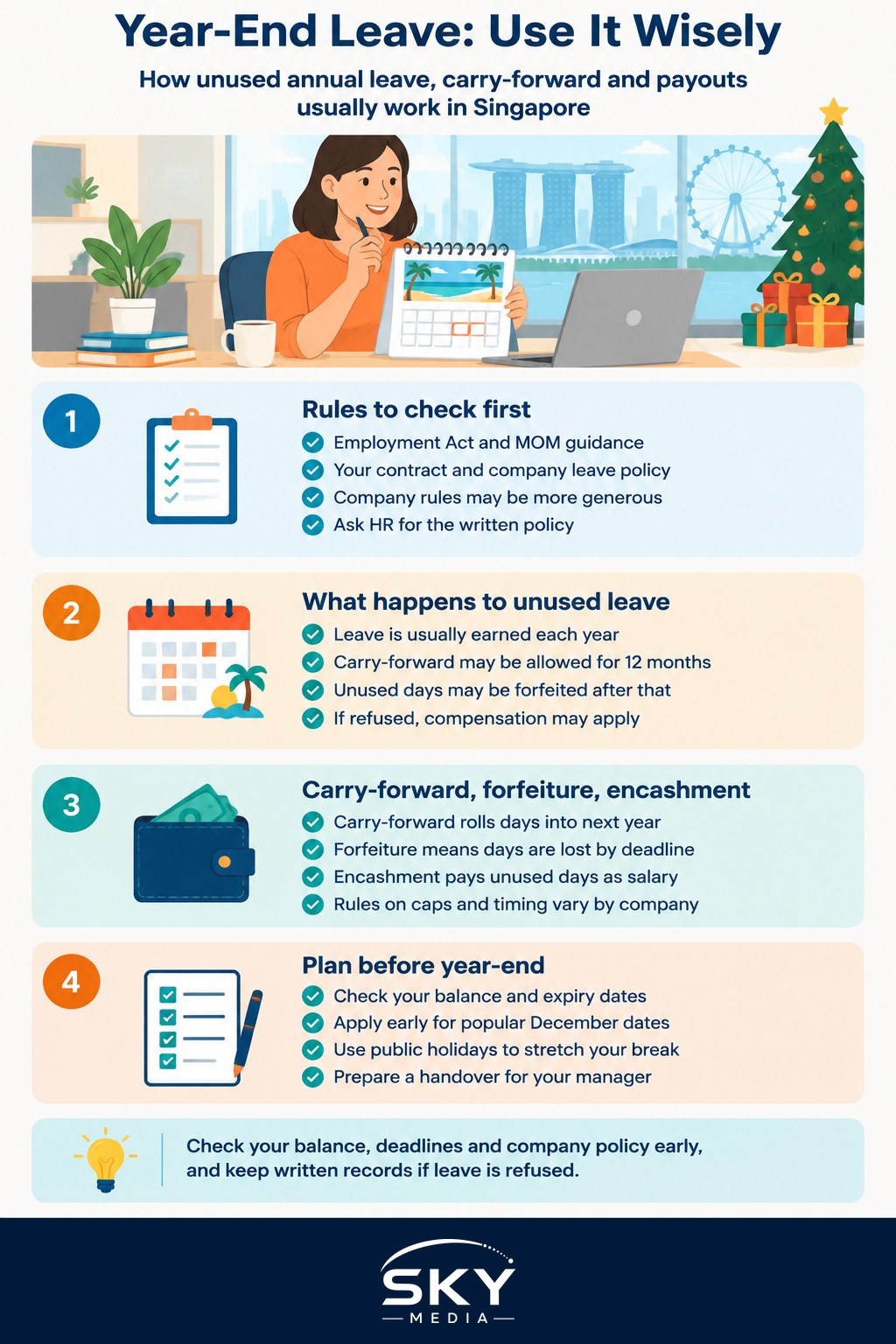
First, Check Which Rules Apply to You
Two layers of rules shape what happens to your unused leave:
- The Employment Act. This is Singapore’s main employment law. MOM publishes plain-language guides on annual leave on its website. The annual leave provisions in the Act cover many, but not all, employees, and some protections apply only to certain groups. Check MOM’s site to see whether and how the leave provisions apply to you.
- Your contract and company policy. Many employers offer more leave than the legal minimum and set their own rules for carry-forward, caps and encashment. These terms often matter most for day-to-day questions.
Where your contract is more generous than the Act, the contract applies. Where a contract term is less favourable than what the Act requires for a covered employee, the Act’s minimum generally prevails. If you are unsure, ask HR for the written leave policy.
What Generally Happens to Unused Annual Leave
Annual leave in Singapore is usually earned per year of service, and the leave year might follow the calendar year, your work anniversary or the company’s financial year. Find out which one your company uses, because “year-end” may not be 31 December for you.
In broad terms, MOM’s guidance for employees covered by the Act’s leave provisions says:
- Unused leave can generally be carried forward to be taken within the following 12 months, and if it is not taken within that period, it may be forfeited.
- If your employer asks you not to take your leave, you should be compensated for the leave you were not allowed to take.
- When employment ends, you are generally entitled to be paid for unused leave, though there are exceptions, for example in some dismissal situations.
Because the details and exceptions matter, read MOM’s annual leave pages for the exact wording, and check the current rules before relying on them.
Carry-Forward, Forfeiture and Encashment Compared
Company policies differ a lot. Here is how the common approaches usually work and what to ask:
| Approach | What it usually means | What to check |
|---|---|---|
| Carry-forward | Unused days roll into the next leave year, sometimes up to a cap | The cap, and the deadline to use carried-forward days |
| Forfeiture | Days not used by a deadline are lost | Whether you were given a fair chance to take leave |
| Encashment | Unused days are paid out as salary | Whether it is automatic, capped or only on resignation |
| Leave refused by employer | You applied but were asked not to go | Keep the written record; compensation may apply |
Encashment is not automatic for everyone. Many companies only pay out unused leave when you leave the company, while others allow a limited payout at year-end. Payouts are generally treated as income, so factor that into your tax planning. IRAS has guidance on what counts as taxable employment income.
Plan Year-End Leave Before Everyone Else Does
December is popular. School holidays, Christmas and New Year mean many colleagues want the same weeks off. A little planning helps:
- Check your balance now. Look at your HR portal for days earned, taken, carried forward and any expiry dates.
- Read the policy deadline. Note when carried-forward days expire, not just this year’s leave.
- Apply early. Many teams approve leave on a first-come basis or try to keep minimum coverage. Early applications have more options.
- Use the public holidays. Pairing leave with public holidays or the school holidays can stretch a few days into a longer break. Check the official public holiday list on MOM’s website.
- Spread it out if you cannot take a block. A few long weekends between October and December can be more restful than one rushed trip.
- Agree a handover. Leave goes more smoothly when your manager knows who covers what. A short handover note makes approval easier.
If you are planning year-end travel, budget for it together with other festive spending. Our guides to budgeting for the year-end festive season and the end-of-year money review can help.
When Your Leave Request Is Refused
Busy periods sometimes clash with leave plans. If a request is refused:
- Ask for alternative dates in writing. A polite email asking which dates would work creates a record.
- Keep your applications. If you repeatedly apply and are refused, written records help if you later discuss compensation or carry-forward.
- Talk to HR. Explain that your leave is close to expiring and ask how the company handles that.
- Know where to get help. If you believe your employment rights have not been respected, MOM and the Tripartite Alliance for Dispute Management (TADM) handle employment claims and advice. Union members can also approach their union.
Most leave issues are resolved through a calm conversation with your manager and HR.
If You Are Resigning Around Year-End
Year-end is a common time to change jobs, often after bonuses are paid. Unused leave interacts with your notice period in a few ways:
- Offsetting notice. Some employees use leave to shorten the days they physically work during notice, but this usually needs employer agreement.
- Payout of leave. As noted above, unused leave is generally paid out when employment ends, subject to exceptions and your contract.
- Prorated leave. If you leave partway through the leave year, your entitlement is usually prorated. Check how your company calculates it.
Before you resign, check the year-end bonus checklist and confirm with HR exactly how many leave days will be paid out or offset.
Quick Year-End Leave Checklist
- Confirm whether your leave year ends in December or at another time.
- Check your balance and any carried-forward expiry dates.
- Read your company’s carry-forward, cap and encashment rules.
- Apply for December leave early and agree a handover.
- Keep written records of leave applications and refusals.
- Check MOM’s annual leave guidance for the current rules.
Unused leave is part of your compensation, and rest matters. A little planning in October means you are less likely to lose days or scramble for approval in December.
Explore more: Annual leave and sick leave explained · End-of-year money review · Year-end bonus checklist · Budgeting for the year-end festive season
Official sources: Ministry of Manpower (MOM)
Further reading: No-Pay Leave in Singapore: How It Works and How It Affects Your Pay · Understanding Annual Leave and MC Norms in Singapore