

Ask a group of homeowners whether a corner unit in Singapore is worth chasing and you will get strong opinions both ways. Some swear by the extra windows and the quiet end of the corridor. Others regret the afternoon heat, the odd angled walls or the higher asking price. The truth is that a corner unit is neither automatically better nor worse. It is a set of trade-offs, and whether those trade-offs suit you depends on how you live, which way the block faces and how the specific floor plan is drawn.
This guide walks through the main factors buyers weigh, from privacy and corridor traffic to airflow, sun exposure and furniture layout, so you can judge a corner unit on its own merits rather than on reputation.
What Counts as a Corner Unit
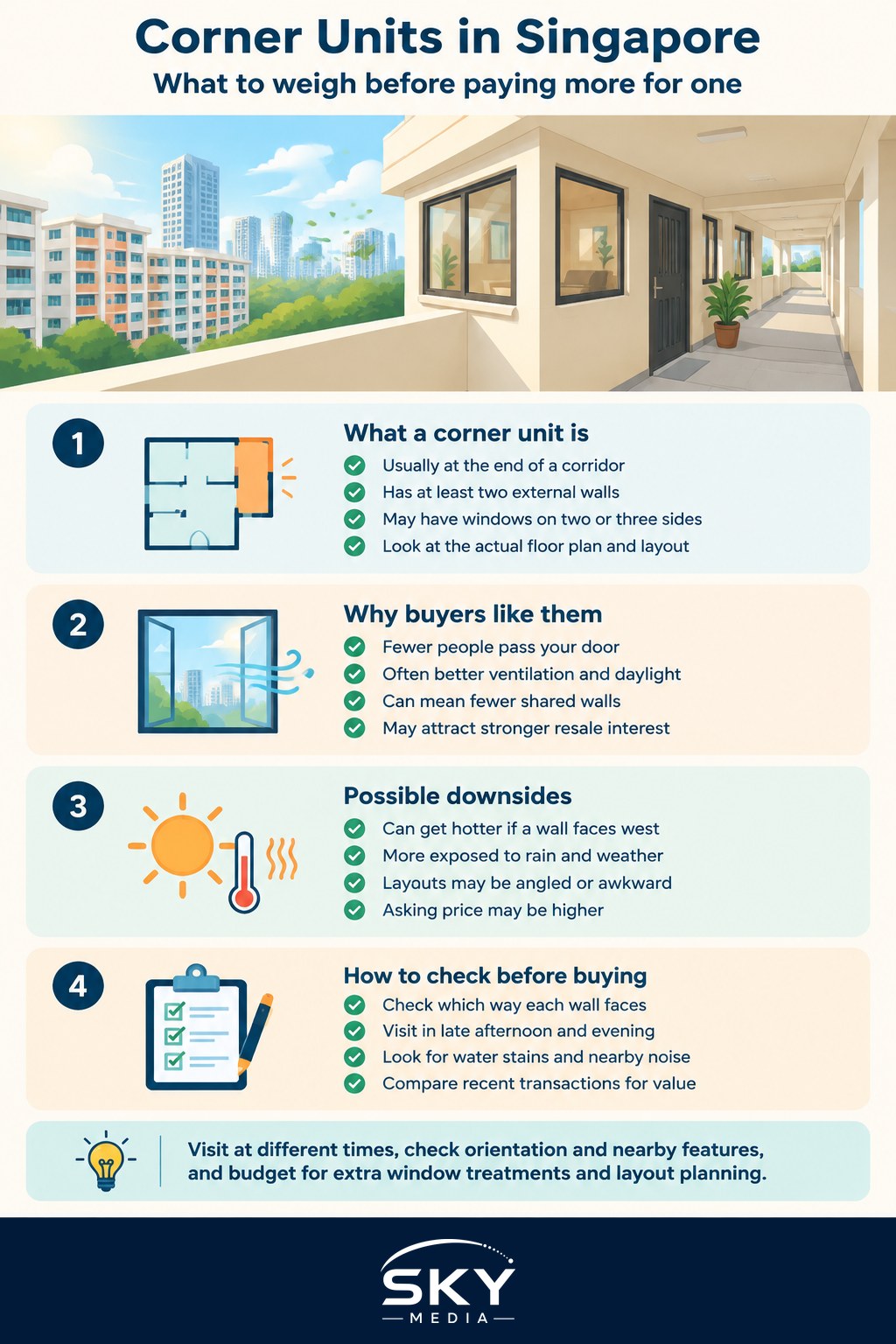
In everyday property talk, a “corner unit” usually means a flat or apartment at the end of a block or corridor, with at least two external walls instead of one. In HDB blocks this is often the last unit along a common corridor. In condominiums it may be the unit at the edge of a stack, sometimes with windows on two or even three sides.
Not every unit marketed as a corner unit behaves the same way. Some sit at the end of a corridor but share a wall with a staircase or refuse chute. Others are at the corner of an L-shaped block and face a neighbouring unit across a short gap. Before you get attached to the label, look at the actual floor plan, the block layout and what sits on each side of the unit.
The Main Advantages
More privacy. The biggest draw for many buyers is that fewer people walk past your door. In a typical HDB corridor, middle units see neighbours, delivery riders and visitors passing by throughout the day. At the end of the corridor, the only people who come your way are usually heading to your home.
Better ventilation and light. Two external walls often mean windows on two sides. That can allow cross ventilation, where air enters on one side and leaves on the other, which makes a real difference in Singapore’s humid climate. More windows also bring in more daylight.
Fewer shared walls. With one less neighbour beside you, there is often less noise from next door, whether that is a television, renovation drilling or a crying baby. This is not guaranteed, since you may still share walls above, below and on one side, but it usually helps.
Perceived resale appeal. Because many buyers like these features, corner units can attract interest when you sell. Treat this as a general market tendency rather than a promise. Prices depend on the whole picture: location, floor, condition, remaining lease and market conditions at the time.
The Main Drawbacks
More heat. An extra external wall means more surface exposed to the sun. If that wall faces west, the afternoon sun can heat up bedrooms and living areas noticeably, and you may rely more on air-conditioning. Ask which direction each external wall faces before you fall for the extra windows.
Rain and weather exposure. Corner units can be more exposed to driving rain during storms. Check window seals, look for water stains near frames and ask the seller or agent whether there has been any seepage.
Awkward layouts. Some corner units have angled or irregular walls, bay windows or a long, narrow shape that makes furniture placement harder. A unit that looks generous on paper can lose usable space to odd corners.
Higher asking prices. Sellers know buyers like corner units, so the asking price may be higher than a similar unit along the corridor. Decide in advance how much extra, if anything, the corner position is worth to you.
Isolation can cut both ways. A quiet end unit is lovely, but it also means fewer neighbours passing by. Some families like the casual watchfulness of a busier corridor, especially when elderly relatives or young children are home alone.
Corner Unit vs Middle Unit at a Glance
| Factor | Corner unit | Middle unit along the corridor |
|---|---|---|
| Corridor foot traffic | Low, mostly your own visitors | Higher, neighbours and riders pass your door |
| Ventilation | Often better, with windows on two sides | Usually windows on fewer sides |
| Heat exposure | Higher if an external wall faces west | Lower, with more shared walls |
| Shared walls | Fewer neighbours beside you | Neighbours on both sides |
| Layout | Can include angled walls or odd shapes | Usually more regular and predictable |
| Asking price | Often higher | Usually lower for a comparable unit |
How to Assess a Specific Corner Unit
Since every corner unit is different, a site visit matters more than the label. Here is a checklist to work through.
- Check the orientation. Use a compass app during the viewing and note which way each external wall faces. North and south facing walls generally receive less direct afternoon sun than west facing ones.
- Visit at different times. If you can, view the unit in the late afternoon to feel the heat and see the light. An evening visit tells you about corridor noise, lighting and how the area feels after dark.
- Look at what is next door. Is the unit beside a staircase, lift lobby, refuse chute or service riser? These can bring noise, smells or foot traffic that undo the privacy advantage.
- Study the floor plan. Count the usable wall lengths in each bedroom and check whether a bed, wardrobe and desk can fit without blocking windows. Angled walls and bay windows can look charming but limit options.
- Inspect for water issues. Look closely at window frames, ceilings and external walls for stains, peeling paint or mould, which can signal seepage.
- Consider the view and what may change. A corner unit with an open view may face a vacant plot. Check URA’s Master Plan, published by the Urban Redevelopment Authority, to understand what the surrounding land is zoned for, since future developments can change light, view and breeze.
- Compare recent transactions. For HDB flats, HDB’s resale price data lets you compare similar flats in the same area. For private property, URA’s published transaction data can help. Use these to judge whether any premium on the corner unit is reasonable.
Who a Corner Unit Suits
A corner unit often suits buyers who value privacy, work from home and want natural light, or simply dislike neighbours walking past their windows. The extra wall and windows can also make it easier to carve out a bright workspace; our guide to home office and study corner ideas has layout tips that work well with a dual-aspect room.
It may suit you less if you are sensitive to heat, want to keep air-conditioning bills low and the unit faces west, or prefer a straightforward rectangular layout for easy furnishing. Households with elderly members who like the reassurance of passing neighbours may also prefer a unit along the corridor.
If you are comparing unit positions more broadly, the trade-offs for a corner unit are quite different from those on the lowest floor. Our guide on what to know about buying a ground floor unit covers access, security and noise considerations that apply at street level.
Practical Tips Before You Commit
- Talk to residents in the same stack if you can. They know the heat, rain and noise better than any listing.
- Budget for window treatments. Extra windows mean extra curtains, blinds or solar film, which adds to your renovation costs.
- Plan furniture before renovation. Ask your interior designer or contractor to draw a layout that respects the angled walls rather than fighting them.
- Remember that HDB rules, financing limits and grants apply in the same way regardless of unit position. Check the current eligibility conditions with HDB and your bank, as these can change.
The Bottom Line on Corner Units
A corner unit in Singapore can be a wonderful home: quieter, brighter, breezier and more private. It can also be hotter, harder to furnish and pricier than the unit next door. Judge each one on its orientation, layout and surroundings, decide what the corner position is genuinely worth to you, and you will make a choice you are comfortable living with for years.
Frequently Asked Questions
Is a corner unit really hotter than a middle unit? It can be. An extra external wall means more surface exposed to the sun, and a west-facing wall can heat rooms in the afternoon. Check the direction of each external wall with a compass app and view the unit late in the afternoon.
Do corner units cost more to buy than similar units along the corridor? Often, because sellers know buyers like them. Compare recent transactions using HDB’s resale price data for flats or URA’s published data for private property, and decide in advance how much extra the corner position is worth to you.
How can I tell if a corner unit has water seepage problems? Look closely at window frames, ceilings and external walls for stains, peeling paint or mould. Ask the seller or agent about past seepage, and talk to residents in the same stack, who know the rain exposure best.
Are corner units good for working from home? They can be, since the extra windows bring in more natural light and make it easier to set up a bright workspace. Make sure the room’s usable wall lengths work for a desk and that the afternoon sun will not make it too hot.
Do I need to budget extra for curtains and blinds in a corner unit? Yes, more windows mean more curtains, blinds or solar film, which adds to renovation costs. Plan this early, and ask your designer to draw a furniture layout that works with any angled walls.
Further reading: Loft and Duplex Condo Units in Singapore: Pros and Cons · Unlucky Unit Numbers and Floors: Do They Affect Property Prices in Singapore? · Pool-Facing vs Road-Facing Condo Units: Which to Choose