

If you have ever looked at your CPF statement and wondered why your MediSave Account stopped growing while your other accounts kept rising, the answer is usually the Basic Healthcare Sum. The basic healthcare sum, or BHS, is the cap on how much you can hold in your MediSave Account. Once you reach it, your money does not disappear. It flows to your other CPF accounts.
This guide explains what the BHS is, how it is set, how it limits MediSave and where excess contributions go. It is general information, not financial advice. The BHS amount is reviewed regularly and the rules can change, so check the current figures and your own account details with the CPF Board.
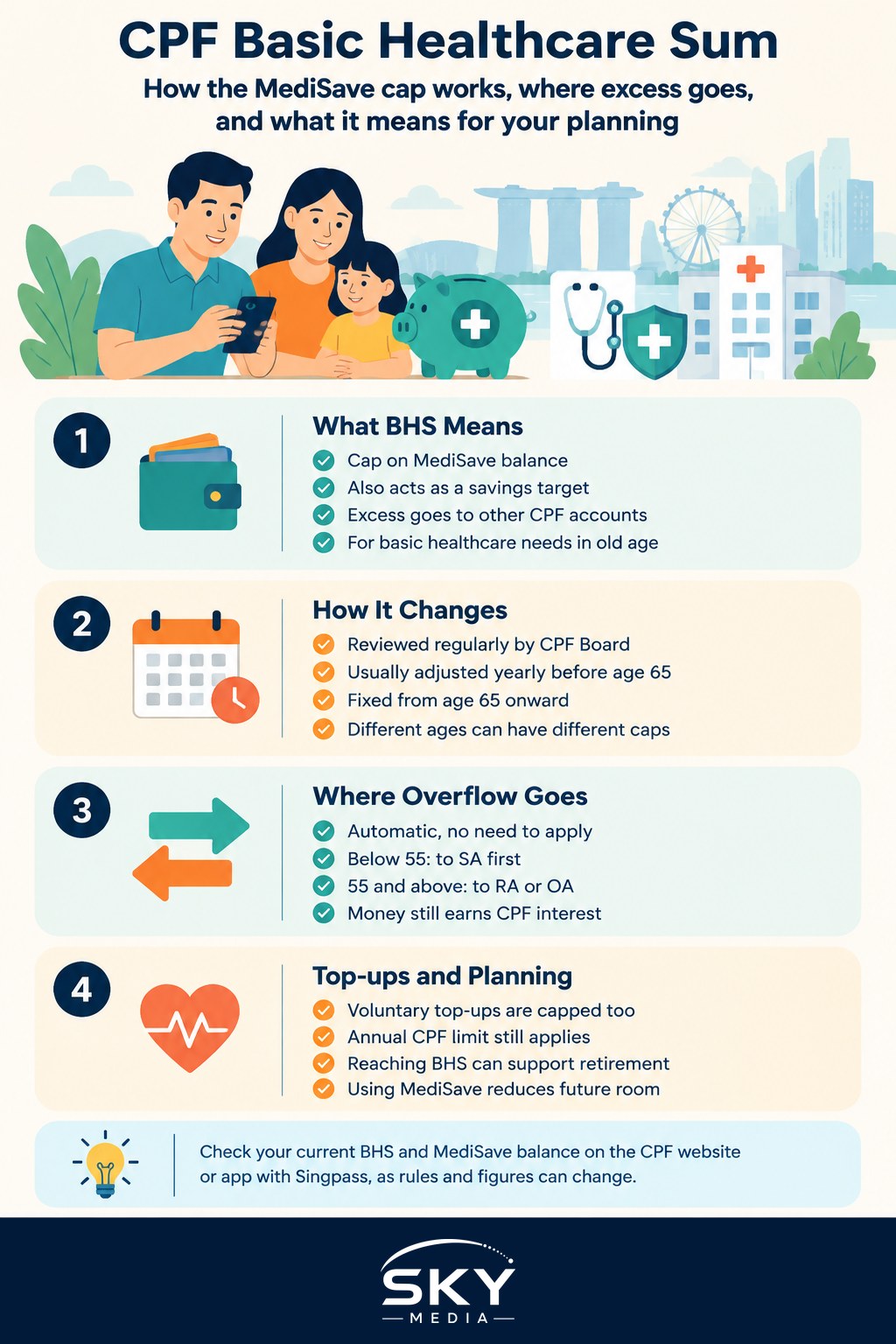
What the Basic Healthcare Sum Is
CPF, the Central Provident Fund, is Singapore’s mandatory savings scheme for citizens and Permanent Residents. Your contributions are split across several accounts, one of which is the MediSave Account (MA). MediSave is meant for healthcare costs, such as hospital bills, certain outpatient treatments and MediShield Life and Integrated Shield Plan premiums.
The Basic Healthcare Sum is the CPF Board’s estimate of the savings a person needs in MediSave to cover basic healthcare needs in old age. It does two jobs:
- It is a target. It gives you a sense of what a reasonable MediSave balance looks like by retirement.
- It is a cap. Your MediSave Account cannot hold more than the prevailing BHS. Contributions beyond that amount are redirected.
The BHS replaced an older system of MediSave caps several years ago. If you read older articles about the “MediSave Contribution Ceiling”, be aware that the current framework is the BHS.
How the BHS Is Set and When It Stops Changing
The BHS is not a fixed number for life until a certain point. How it applies to you depends on your age.
- Below age 65: The BHS is reviewed and typically adjusted each year, usually taking effect in January, to keep pace with expected growth in healthcare spending. Your cap can therefore rise over time.
- From age 65: Your BHS is fixed at the level that applied to your cohort when you turned 65. It does not change for the rest of your life.
This means two people of different ages can face different MediSave caps in the same year. Your current BHS, along with your MediSave balance, is shown when you log in to the CPF website or app with Singpass. The CPF Board also publishes the BHS for each year and cohort.
Where Excess Contributions Go
When your MediSave balance reaches the BHS, any further MediSave contributions, along with interest earned above the cap, flow to your other CPF accounts. Where they go depends mainly on your age. The broad picture is as follows, but check the CPF Board’s current explanation, since account structures have changed in recent years.
| Your situation | Where excess MediSave money goes | What it means for you |
|---|---|---|
| Below 55 | Special Account, until it reaches the current Full Retirement Sum, then Ordinary Account | Boosts retirement savings first, then money for housing and other uses |
| 55 and above, Retirement Account below the Full Retirement Sum | Retirement Account | Helps you build up your retirement payouts |
| 55 and above, Retirement Account at the Full Retirement Sum | Ordinary Account | Money becomes more flexible to use, subject to CPF rules |
| 65 and above | Same flows as 55 and above, against your fixed BHS | Your cap no longer rises, so overflow is more predictable |
A few points worth knowing:
- Overflow is automatic. You do not need to apply. The CPF Board moves it for you.
- The money still earns CPF interest in whichever account it lands, at that account’s rate.
- The Full Retirement Sum matters here. If you want to understand how these sums interact, read our guide to CPF retirement sums: FRS, BRS and ERS.
- Withdrawals from MediSave for approved medical expenses can bring your balance below the BHS again. Future contributions will then go to MediSave first until the cap is reached again.
Topping Up MediSave: Voluntary Contributions and the Cap
Some people make voluntary contributions to MediSave, for example for tax relief or simply to strengthen their healthcare savings. The BHS limits this too.
- You can only top up to the cap. Voluntary MediSave contributions are limited to the gap between your current balance and your BHS.
- Annual limits also apply. Voluntary contributions count towards the overall CPF Annual Limit, alongside your mandatory contributions. If you exceed it, the excess may be refunded.
- Tax relief has its own rules. Some voluntary MediSave contributions qualify for income tax relief, subject to caps and conditions set by IRAS and the CPF Board. Check both before you contribute.
- Timing matters. Because the BHS for under 65s is often adjusted in January, the room you have to top up can change at the start of the year.
If you are self-employed, MediSave contributions are generally compulsory once your net trade income passes a certain level. The same BHS cap applies to your account. Check the current self-employed rules on the CPF Board website.
Why the BHS Matters for Your Planning
The BHS is not just an accounting rule. It shapes how your CPF savings grow and how much healthcare cover you have later.
- Healthcare in retirement: Reaching the BHS by 65 means you have a reasonable buffer for basic healthcare needs, including premiums for MediShield Life, Singapore’s national basic health insurance scheme.
- Retirement income: Once MediSave is full, overflow into your Special or Retirement Account can help you reach your retirement sums faster. Our explainer on the CPF retirement sums covers how those targets work.
- Family decisions: Some families use MediSave to pay for parents’ or children’s medical bills, within the rules. Using MediSave for others reduces your balance and changes how much overflow you see.
- Insurance premiums: If you pay Integrated Shield Plan premiums from MediSave, there are withdrawal limits for the private insurer component. Understanding your MediSave balance relative to the BHS helps you plan whether you can sustain those premiums.
Tips for New PRs and Newcomers
If you have recently become a Singapore Permanent Resident, CPF may be new to you. Contributions usually start at graduated rates for new PRs before reaching full rates. Your MediSave Account will build up over time, and the BHS will not affect you until your balance gets close to the cap.
Our guide to CPF basics for new PRs from China explains the account structure in plain language, and the Singapore healthcare guide covers how MediSave fits into paying for care.
Checking Your Own BHS Position
To see where you stand, log in to the CPF website or app with Singpass and look at your MediSave balance against your current BHS. If the numbers look unexpected, or you are unsure where overflow has gone, the CPF Board’s online resources and enquiry channels can help. For decisions about voluntary top ups or how to balance healthcare and retirement savings, consider speaking to a licensed financial adviser, and always confirm the latest BHS figure with the CPF Board before acting.
Official sources: CPF Board
Further reading: How to Save Money on Healthcare Costs in Singapore · How Means Testing Works for Healthcare Subsidies in Singapore