
Singapore is known for one of the best healthcare systems in the world, but knowing where to go when you are unwell is a different skill from knowing that the system is good. This singapore healthcare guide walks you through the public and private options, when to use each one, and how costs and insurance work in plain terms. Whether you have lived here for years or arrived last week, the aim is to help you feel confident the next time you or your family needs care.
A quick and important note first: this is general information, not medical advice. Costs, subsidies and coverage change, and they depend on your residency status and your insurance. Always confirm the details with the provider or the official source before you rely on them.
How the system is set up: public and private
Singapore runs on a mix of public and private healthcare, and both are widely used.
The public system is run largely through clusters of government-linked hospitals, specialist centres and polyclinics. It is heavily subsidised for citizens and permanent residents, which keeps essential care affordable. The private system covers private hospitals, private specialist clinics and the many neighbourhood GP clinics you see in every housing estate. Private care generally costs more but often offers shorter waits and more choice of doctor.
Most people move between the two without thinking about it. You might see a private GP for a cough, use a polyclinic for a subsidised health screening, and be referred to a public hospital specialist for something more serious.
GPs, polyclinics, specialists and A&E: when to use each
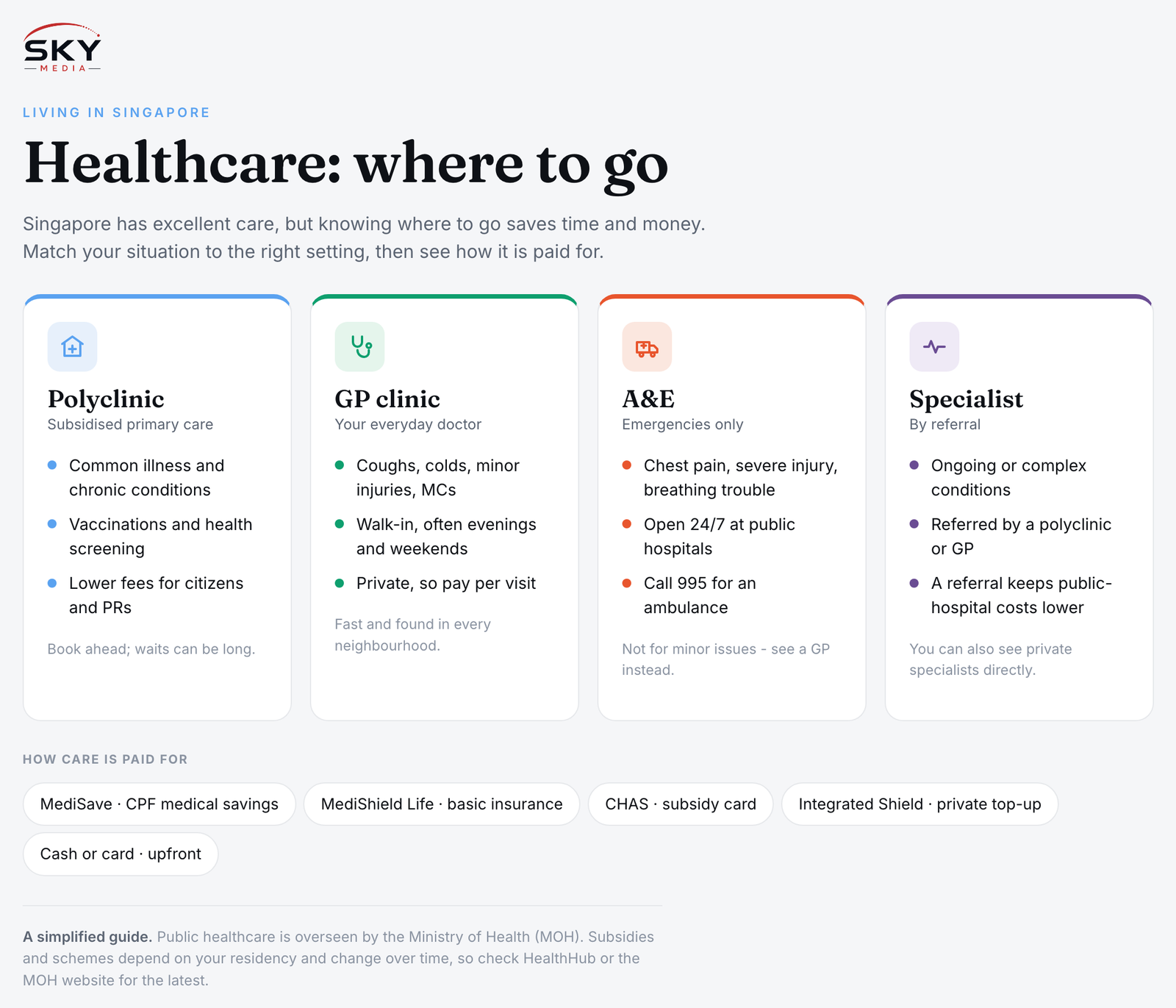
Choosing the right door saves you time, money and stress. Here is the simple version.
GP clinics
A GP clinic in Singapore (general practitioner) is your everyday first stop. These are the private neighbourhood clinics found in HDB estates, malls and office buildings. Go here for common illnesses, minor injuries, vaccinations, medical certificates and repeat prescriptions. Many open in the evenings and at weekends, and some run 24 hours. Waits are usually short, and you rarely need an appointment.
Polyclinics
A polyclinic is a large public clinic offering subsidised primary care under one roof: general consultations, chronic disease management (for conditions like diabetes and high blood pressure), health screening, vaccinations and some allied health services. Fees are lower than private clinics for citizens and PRs, so polyclinics are popular for ongoing care and screening. The trade-off is that they can be busy, so booking ahead helps and waits can be longer.
Specialists
You see a specialist for a specific condition that needs deeper expertise, such as a cardiologist, dermatologist or orthopaedic surgeon. You can go through the public route (often via a GP or polyclinic referral, which helps you qualify for subsidised rates) or privately. A referral is not always compulsory in the private system, but it helps your specialist understand your history.
A&E (emergency)
The A&E (Accident and Emergency) department at a public hospital is for genuine emergencies: chest pain, difficulty breathing, severe bleeding, stroke symptoms, serious injuries or loss of consciousness. A&E is not the place for a mild fever or a sore throat, where a GP is faster and cheaper.
In a life-threatening emergency, call 995 for an ambulance. Save this number in your phone now. For non-emergencies, a GP or polyclinic is almost always the better first call.
Quick guide to picking the right option:
- Minor illness, MC, vaccination: GP clinic
- Subsidised primary care, chronic conditions, screening: polyclinic
- A specific condition needing expert care: specialist (a GP or polyclinic referral can unlock subsidies)
- Serious or life-threatening emergency: A&E, or call 995
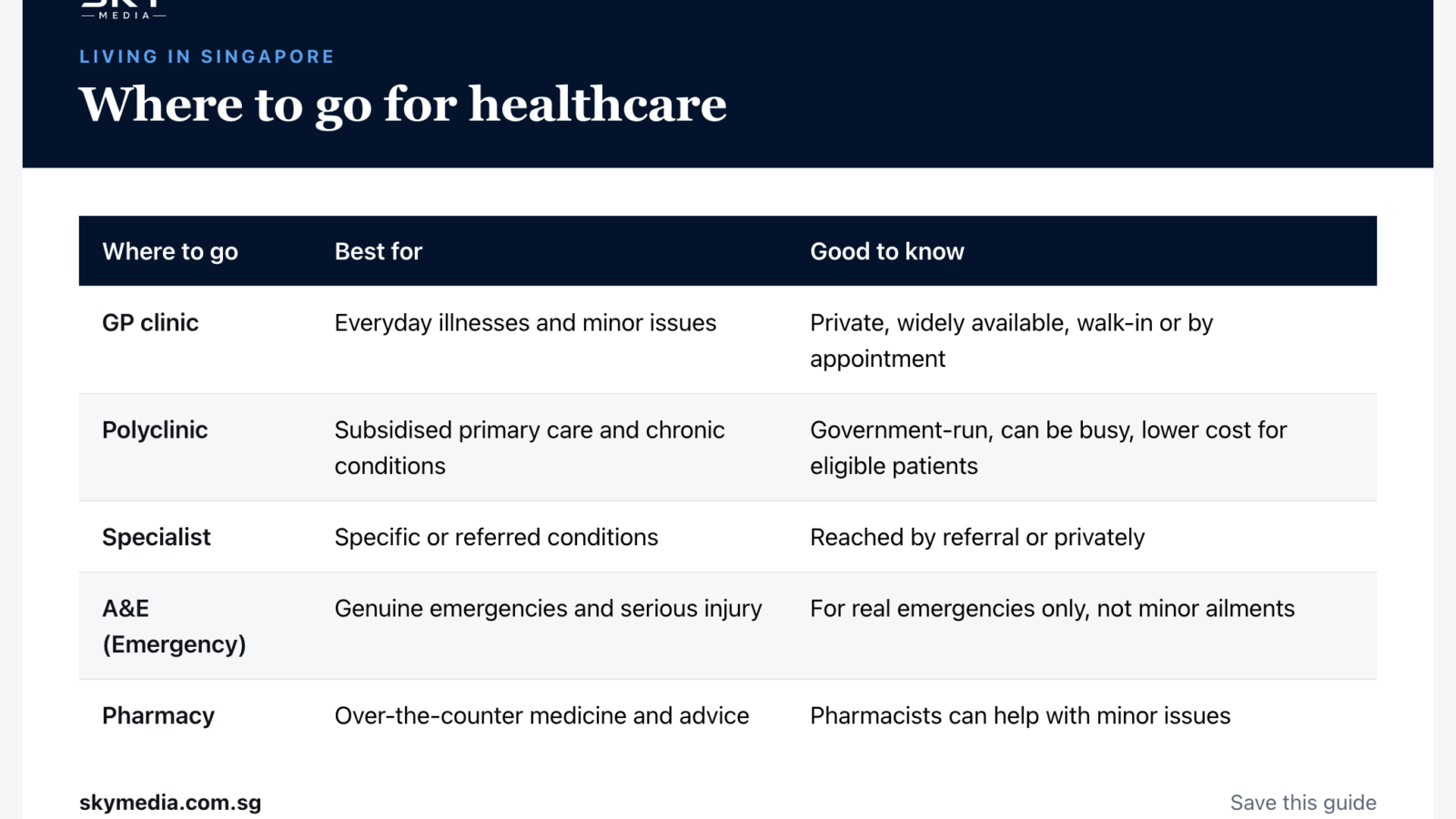
Here is where to go for different needs:
| Where to go | Best for | Good to know |
|---|---|---|
| GP clinic | Everyday illnesses and minor issues | Private, widely available, walk-in or by appointment |
| Polyclinic | Subsidised primary care and chronic conditions | Government-run, can be busy, lower cost for eligible patients |
| Specialist | Specific or referred conditions | Reached by referral or privately |
| A&E (Emergency) | Genuine emergencies and serious injury | For real emergencies only, not minor ailments |
| Pharmacy | Over-the-counter medicine and advice | Pharmacists can help with minor issues |
What healthcare costs
Costs vary widely, so treat any figure as a rough guide and check with the provider before your visit.
A private GP visit typically lands in a modest range that covers the consultation, with medication charged on top. A polyclinic visit is usually cheaper for citizens and PRs thanks to subsidies. Specialist consultations and hospital stays cost much more, and private hospitals sit at the higher end.
Two points matter most for planning:
- Subsidised versus private. Public healthcare is subsidised for citizens and permanent residents, which is why the same treatment can cost very different amounts depending on where you go and your status.
- Foreigners pay more. If you are a foreigner without PR status, you generally do not receive the same subsidies, so public treatment costs more for you than for a local. Private clinics tend to charge everyone similar rates regardless of status. This is why suitable insurance matters so much for newcomers.
MediSave, MediShield and Integrated Shield Plans
Singapore’s financing framework has a few moving parts. In general terms:
- MediSave is a national medical savings scheme. Working citizens and PRs set aside part of their income into a MediSave account, which can be used for certain hospital bills, approved treatments and some outpatient costs, for yourself and your family.
- MediShield Life is a basic national health insurance scheme that helps with large hospital bills and selected costly treatments, designed to protect against big, unexpected expenses.
- Integrated Shield Plans are optional private plans that sit on top of MediShield Life. People choose them for higher coverage, such as private hospital wards or a wider choice of care.
These schemes mainly benefit citizens and PRs. If you are on an Employment Pass, Student Pass or Dependant’s Pass, you usually will not be part of MediSave or MediShield, which brings us to private insurance. For the exact rules on what MediSave and MediShield cover, confirm with the official source (CPF Board and the Ministry of Health).
Health insurance in Singapore for expats
If you are a foreigner without access to the national schemes, health insurance in Singapore is not a nice-to-have, it is essential, because a serious hospital stay without subsidies can be very expensive.
Employers often provide a group health plan as part of your package, so check what yours includes: outpatient GP visits, specialist care, hospitalisation, maternity and dental all vary. Many expats top this up with a personal international or local health plan for broader coverage or higher limits. If you have family here, make sure they are covered too, as dependants are not always included by default.
Before you rely on any policy, confirm the details with the insurer: what is covered, the limits, exclusions, waiting periods, and whether you pay upfront and claim later or the insurer settles directly with the hospital.
Pharmacies and getting medication
For everyday needs, retail pharmacies are found in malls, supermarkets and neighbourhood shops across the island, and pharmacists can advise on common ailments and over-the-counter remedies. Prescription medication is dispensed at clinics and hospitals, and at registered pharmacies where a prescription is required. If you take regular medication, bring a prescription or a doctor’s letter when you move here, and ask a local GP about continuing it.
A short checklist for peace of mind
- Save 995 for emergencies and know your nearest A&E and 24-hour GP clinic
- Sort out health insurance before you need it, and check that family members are covered
- Keep a GP you trust for everyday issues and referrals
- Understand whether you qualify for subsidies (citizens and PRs) or should budget more (foreigners)
- Keep records of your prescriptions, allergies and vaccinations somewhere easy to reach
Getting to know your options before you are unwell makes the whole system feel far less daunting. Singapore gives you good care from many directions; the trick is simply knowing which door to walk through.
Explore more: Moving to Singapore checklist and Cost of living in Singapore.