

Plenty of us in Singapore spend hours sitting cross-legged: on the sofa, on a mat at family gatherings, or with one foot tucked under us on the office chair. None of this is bad in itself. In fact, many people across Asia keep useful hip range precisely because they sit on the floor. The trouble starts when one position becomes the only position, held for long stretches, often lopsided, and then followed by a day of chair sitting.
This guide offers simple hip mobility exercises built around that everyday pattern. It is not a performance programme for lifters or runners. It is a set of gentle moves to undo the specific stiffness that comes from long cross-legged or folded sitting, done at home in a few minutes.
This is general information, not medical advice. If you have pain that is sharp, worsening, comes with numbness or follows an injury, see a doctor, a polyclinic or a physiotherapist before starting.
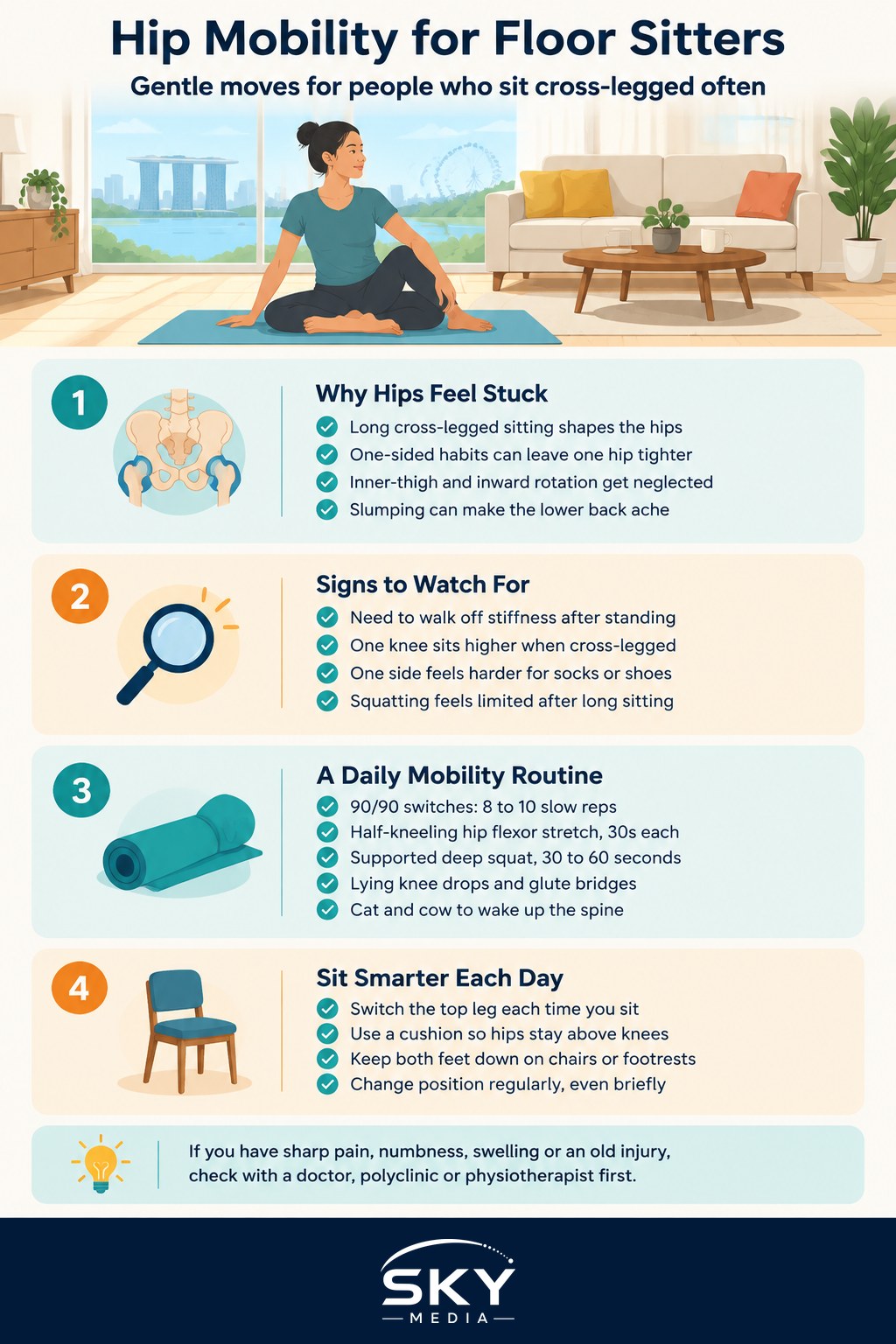
Why Cross-Legged Sitting Leaves Hips Feeling Stuck
Sitting cross-legged places your hips in a deep bend with the thighs turned outwards. Your body is very good at adapting to the positions you hold most, so over months the muscles and tissues around the hip get used to that shape. A few common patterns show up:
- Tight front of the hips. Hours in a folded position mean the hip flexors rarely get lengthened. Standing up after a long session can feel creaky.
- One-sided habits. Most people always cross the same leg on top. Over time one hip may feel looser than the other.
- Inner thigh and inward rotation stiffness. Cross-legged sitting trains outward rotation. The opposite direction, turning the thigh inwards, often gets neglected.
- A rounded lower back. Without support, many people slump, which can leave the lower back achy.
- Knee strain. When the hips are stiff, the knees sometimes take up the slack in a twisted position.
The goal is not to stop sitting on the floor. It is to give your hips the movements they are missing so floor sitting stays comfortable.
Signs Your Sitting Habits Are Affecting Your Hips
Watch for these everyday clues. They are reasons to add mobility work, not a diagnosis:
- You need to “walk off” stiffness after getting up from the sofa or a mat.
- One knee sits noticeably higher than the other when you sit cross-legged.
- Putting on socks or shoes on one side feels harder than the other.
- Your lower back aches after a long floor meal or a movie marathon.
- Squatting down, for example to pick something up at the wet market, feels limited.
If any of these come with pain that wakes you at night, swelling, clicking with locking, or tingling down the leg, skip the self-help and get checked by a professional first.
A Daily Hip Mobility Routine for Floor Sitters
These hip mobility exercises take about ten minutes. Move slowly, breathe normally, and stay in a range that feels like a stretch, not pain. A yoga mat or a carpet is enough.
- 90/90 hip switches. Sit on the floor with both knees bent at roughly right angles, one leg in front and one to the side. Keeping your feet on the floor, rotate both knees to the other side, then back. This trains both inward and outward rotation, the exact balance that cross-legged sitting skews. Aim for 8 to 10 slow switches.
- Half-kneeling hip flexor stretch. Kneel on one knee with the other foot in front. Tuck your tailbone slightly and shift your weight forward until you feel a stretch at the front of the back hip. Hold for 30 seconds each side. Use a folded towel under the knee.
- Supported deep squat. Hold a door frame, a sturdy table or a railing and sink into a squat with your feet flat or on a rolled towel under the heels. Let your hips relax downwards. Hold for 30 to 60 seconds. This gives your hips a deep bend in a neutral, not twisted, position.
- Lying knee drops. Lie on your back, knees bent, feet wider than hips. Let both knees fall gently to one side, then the other. This eases inward rotation without loading the joint.
- Glute bridges. Lying on your back, press through your heels to lift your hips, squeeze your buttocks, and lower slowly. Do 10 to 12. Strong glutes support the hips and lower back after long slumped sitting.
- Cat and cow on all fours. Arch and round your back slowly to wake up the spine that has been held in one curve.
If one side is clearly tighter, spend a little extra time there rather than forcing symmetry on day one. For a broader, performance-focused programme, see our guide to improving your hip mobility.
Better Ways to Sit on the Floor and Sofa
Mobility work works best alongside small changes to how you sit. The comparison below shows common habits and easy swaps.
| Common habit | What it does to hips | Easy swap |
|---|---|---|
| Always crossing the same leg on top | One hip gets used to one shape | Switch the top leg every time you sit down or after each episode |
| Sitting flat on a hard floor for hours | Pelvis tips back, lower back rounds | Sit on a firm cushion or folded blanket so hips are above knees |
| Tucking a foot under you on an office chair | Twists the hip and knee, uneven pelvis | Keep both feet on the floor or a footrest, stand up regularly |
| Kneeling back on heels for long prayers or meals | Heavy load on knees and ankles | Use a small cushion between heels and buttocks, change position when you can |
| Sofa slouching with legs folded | Hips stay bent, back loses support | Add a lumbar cushion and stretch legs out between episodes |
A practical rule: change position regularly, even briefly. Variety is what your hips need most.
Fitting Mobility Into a Singapore Day
You do not need gym time for this. A few ideas that suit local routines:
- During TV time. Do 90/90 switches and knee drops during an episode instead of staying folded.
- After a long family meal. If you have been sitting on a mat at a gathering, a minute of supported squats and standing hip flexor stretches helps before the drive or MRT ride home.
- At the office. Stand up during calls, and do a standing hip flexor stretch by stepping one foot back and tucking the pelvis.
- Before bed. Lying knee drops and bridges are gentle enough to do on a mat beside the bed.
Consistency matters more than intensity. Five minutes daily usually beats a long session once a week. If you want to build strength around the hip once you feel looser, our guide to mastering the hip thrust is a good next step.
When to Get Professional Help
Mobility exercises are a supportive habit, not a treatment for injury or joint disease. Stop and see a doctor or physiotherapist if you notice:
- Pain in the groin that gets worse with movement or weight bearing
- Pain that persists for more than a couple of weeks despite gentle work
- Numbness, tingling or weakness in the leg
- A hip or knee that locks, gives way or swells
Older adults, people who are pregnant, and anyone who has had hip or knee surgery should ask their doctor or physiotherapist which movements are suitable. Polyclinics can refer you to physiotherapy if needed, and HealthHub has general information on joint health.
Keep Sitting Low, Just Move More
Sitting cross-legged is a valuable habit. The aim is simply to balance it. Switch sides, raise your hips on a cushion, change positions often, and spend a few minutes each day on the opposite movements your hips are missing. Over a few weeks, getting up from the floor should feel easier, and that is a very good sign.