

Hearing that a parent or spouse needs dialysis is a heavy moment for any family. Questions come quickly: where will treatment happen, how often, how much will it cost and how will daily life change? This guide explains the main types of dialysis Singapore offers, how centre and home treatment compare, where financial help may come from and how families can share the load.
This is general information, not medical advice. The right treatment depends on the person’s health, and decisions should be made with their kidney doctor (nephrologist) and care team. For subsidy and scheme details, check with the Ministry of Health (MOH), the hospital’s medical social workers and the official websites named below.
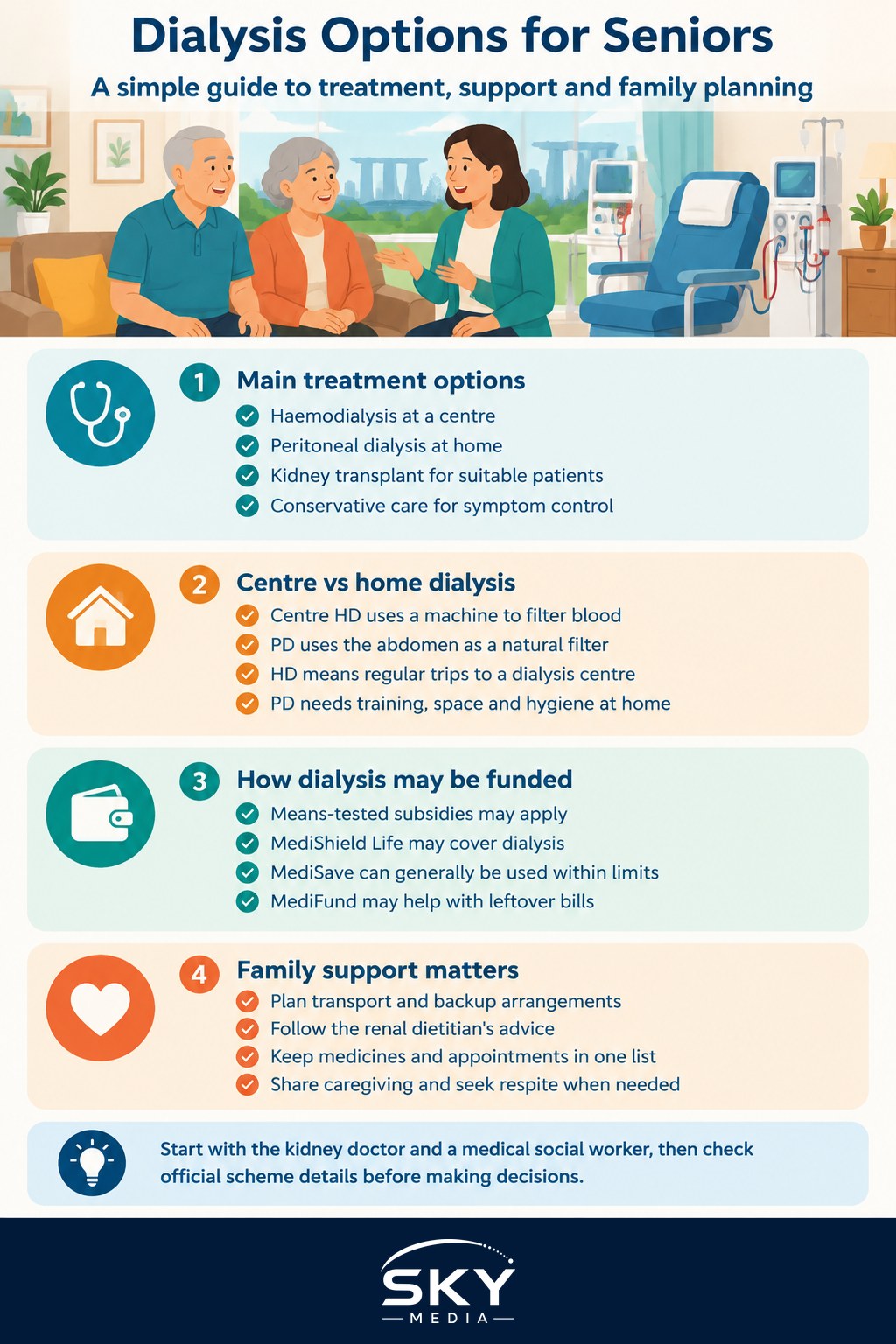
Why Dialysis Is Needed
Healthy kidneys filter waste and excess fluid from the blood. When kidney function falls to a very low level, often called end-stage kidney disease, the body can no longer do this on its own. Dialysis takes over part of that job. Common causes of kidney failure include long-term diabetes and high blood pressure, which is why kidney health is a big focus in Singapore’s ageing population.
Dialysis is not the only path. Depending on the person, the doctor may discuss:
- Haemodialysis, usually done at a dialysis centre
- Peritoneal dialysis, usually done at home
- Kidney transplant, for suitable candidates
- Conservative care, which focuses on managing symptoms and quality of life without dialysis, an option some older patients choose after careful discussion with doctors and family
Centre Haemodialysis Versus Home Peritoneal Dialysis
These are the two most common choices for seniors. They work differently and fit different lifestyles.
Haemodialysis (HD) filters blood through a machine. The patient usually needs a vascular access, often a fistula created in the arm by minor surgery. Sessions are commonly held several times a week at a dialysis centre, with each session lasting a few hours. The exact schedule is set by the care team.
Peritoneal dialysis (PD) uses the lining of the abdomen as a natural filter. A soft tube (catheter) is placed in the abdomen, and dialysis fluid is drained in and out. This is done at home, either through manual exchanges during the day or with a machine overnight while the patient sleeps. Patients and caregivers receive training before starting.
| Aspect | Centre haemodialysis | Home peritoneal dialysis |
|---|---|---|
| Where | Hospital unit or community dialysis centre | At home, after training |
| How often | Several sessions a week at fixed times | Daily, either exchanges or overnight machine |
| Who does it | Trained nurses and staff at the centre | Patient or caregiver, with support from the PD team |
| Travel | Regular trips to the centre | Fewer trips, mainly for reviews and supplies |
| Things to consider | Transport, time away from home, fatigue after sessions | Space for supplies, hygiene, caregiver ability, risk of infection if steps are missed |
Neither option is better for everyone. A senior who lives alone or has poor eyesight may find centre dialysis safer, while someone who values independence and has a capable caregiver may prefer PD. Home haemodialysis also exists for some patients but is less common; ask the care team whether it is suitable.
Where Dialysis Centres Come From
In Singapore, centre haemodialysis is provided by several types of operators:
- Public hospitals, which run dialysis units, often for newer or more complex patients
- Voluntary welfare organisations (VWOs), charities that run community dialysis centres, often with subsidised fees for eligible patients
- Private dialysis providers, which charge market rates
Hospital teams and medical social workers usually help patients find a suitable centre, often considering distance from home. Waiting times and availability vary, so plan ahead once the doctor indicates dialysis is likely.
Paying for Dialysis: Subsidies and Schemes
Dialysis is a long-term cost, and families often worry most about this. Several layers of support may apply, depending on the patient’s circumstances. Rules, limits and eligibility change, so treat this as a starting map, not a final answer.
- Government subsidies. Eligible Singapore citizens and permanent residents may receive means-tested subsidies for dialysis at subsidised centres. The level of support depends on household income and other criteria.
- MediShield Life. Singapore’s basic health insurance covers dialysis as an approved outpatient treatment, subject to claim limits and the scheme’s rules.
- Integrated Shield Plans. If the patient has one, check the policy wording or ask the insurer what applies to dialysis.
- MediSave. MediSave, part of CPF (Central Provident Fund), can generally be used for dialysis within withdrawal limits. Family members’ MediSave may also be usable in some cases.
- MediFund. For patients who still cannot afford the remaining bills after subsidies and other schemes, MediFund is a safety net, assessed by the institution’s medical social workers.
- VWO support. Charities running dialysis centres may offer additional financial assistance for those in need.
The most useful step is to speak with a medical social worker at the hospital. They can assess eligibility, explain the current schemes and help with applications. Check figures and limits on the MOH and CPF Board websites rather than relying on secondhand numbers.
How Families Can Support a Senior on Dialysis
Dialysis changes routines for the whole household. Practical support makes a real difference.
Transport and scheduling
– Agree on who handles transport for centre sessions, and have a backup plan.
– Ask the centre or medical social worker about transport assistance schemes if driving or taxis are difficult.
Diet and fluids
– Dialysis patients often need to limit fluids, salt, potassium and phosphate. Follow the renal dietitian’s advice, as needs differ person to person.
– Adapt family meals so the senior does not feel singled out at the dining table.
Medication and appointments
– Keep a shared list of medicines, appointments and blood test dates.
– Bring questions to each review and write down the answers.
Emotional wellbeing
– Fatigue, low mood and frustration are common, especially in the early months.
– Encourage social contact and activities that still bring joy. Our guide to community support for seniors in Singapore lists ways to stay connected.
Caregiver care
– Caregivers need rest too. Share duties among family members and look into respite options.
– The Agency for Integrated Care (AIC) has information on caregiver support and training. Our overview of elderly care options explains services that can lighten the load.
Questions to Ask the Care Team
- Which type of dialysis do you recommend, and why?
- What would conservative care look like for my parent?
- How soon should we prepare a vascular access or catheter?
- Which centres near our home have space, and what are the costs after subsidies?
- What training will caregivers receive for home dialysis?
- What warning signs mean we should seek urgent help?
Dialysis is a major adjustment, but many seniors continue to enjoy family life, hobbies and outings with the right treatment and support. Work closely with the kidney team and the medical social worker, keep your information current, and check scheme details on official sources. For news on budget measures that may affect seniors’ healthcare costs, see how seniors can read budget support announcements.
Frequently Asked Questions
Can older patients choose not to have dialysis? Yes, conservative care is an option some older patients choose after careful discussion with their doctors and family. It focuses on managing symptoms and quality of life without dialysis. Ask the nephrologist what it would look like for your parent.
Can MediSave be used to pay for dialysis? MediSave can generally be used for dialysis within withdrawal limits, and family members’ MediSave may also be usable in some cases. Check current limits on the MOH and CPF Board websites, and ask the hospital’s medical social worker.
What help exists if we still cannot afford the dialysis bills? MediFund is a safety net for patients who cannot afford remaining bills after subsidies and other schemes, assessed by the institution’s medical social workers. Charities running dialysis centres may also offer financial assistance. Speak to a medical social worker early.
How do I choose between centre dialysis and home peritoneal dialysis? It depends on the person. A senior who lives alone or has poor eyesight may find centre dialysis safer, while someone valuing independence with a capable caregiver may prefer peritoneal dialysis. Ask the care team which suits your parent’s health and home.
What should a dialysis patient eat and drink? Dialysis patients often need to limit fluids, salt, potassium and phosphate, but needs differ from person to person. Follow the renal dietitian’s advice, and adapt family meals so the senior does not feel singled out at the table.
Official sources: HealthHub