
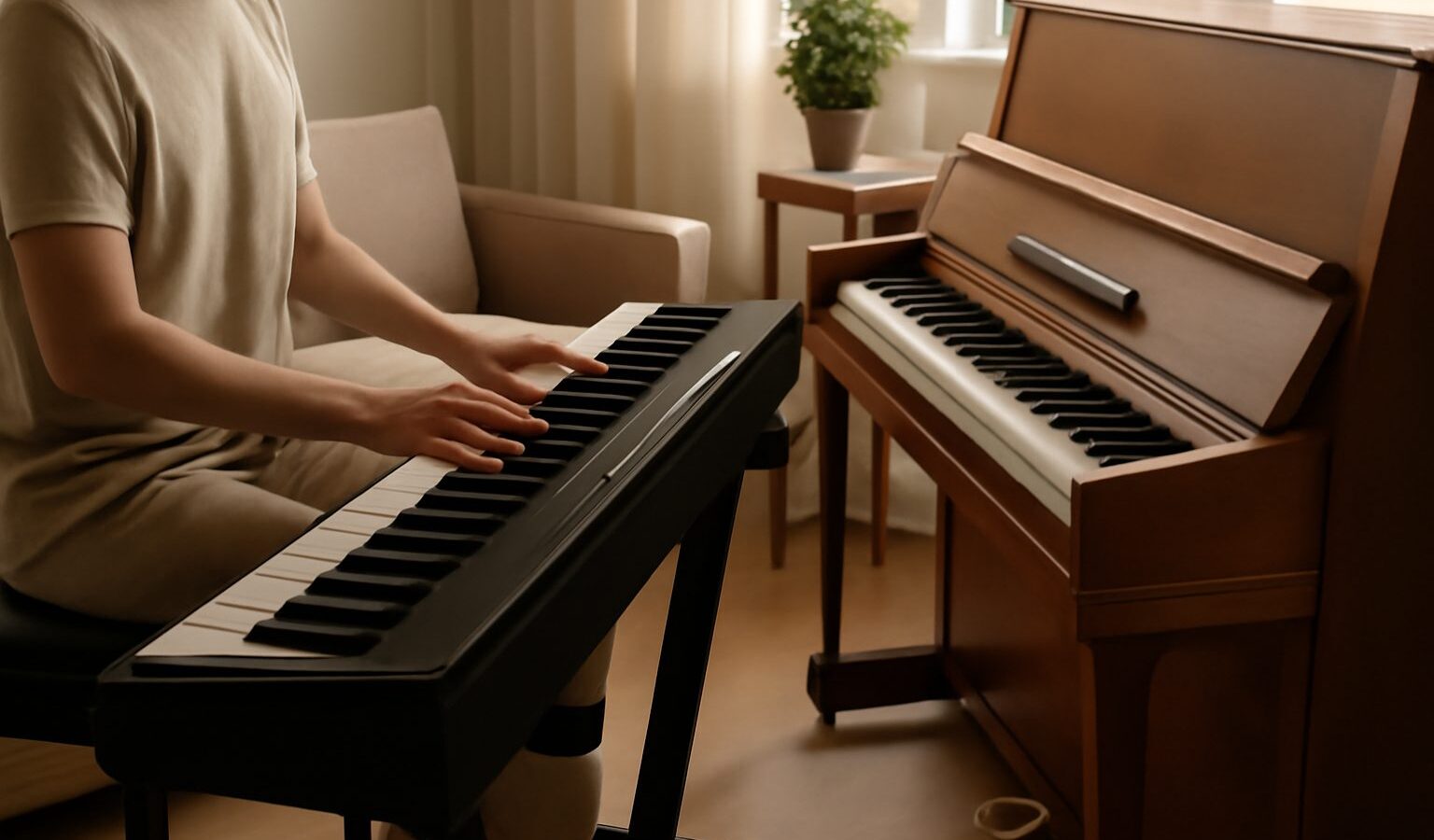
Choosing between a digital vs acoustic piano is one of the biggest decisions a new player or a parent faces, and it shapes years of practice. Both can take you all the way to advanced grades, yet they feel, sound and live in your home very differently. This guide walks through the honest trade-offs, with an eye on Singapore realities: thin HDB walls, close neighbours, high humidity and limited space. By the end you should know which instrument fits your budget, your room and the way you actually want to play.
How The Two Instruments Work
An acoustic piano makes sound mechanically. Press a key and a felt-covered hammer strikes real steel strings, which vibrate against a large wooden soundboard. That physical action gives the instrument its rich, resonant tone and its responsive feel, but it also makes it heavy, sensitive to weather and always audible when you play.
A digital piano makes no acoustic sound of its own. Each key triggers a recorded or modelled piano tone that plays through built-in speakers or headphones. Good models use weighted keys, meaning the keys are engineered to push back with a resistance close to a real hammer action, so your fingers build the same strength and control. The best of them capture how a note changes as you press harder or softer, which is what makes a piano expressive.
Understanding this difference matters because it drives everything else: the price, the upkeep, the volume and how the instrument responds under your hands.
Touch, Tone And Musical Feel
For serious classical study, many teachers still prefer an acoustic piano. The connection between finger and hammer is direct, the tone blooms and decays naturally, and the subtlety of touch is hard to fully replicate. That responsiveness helps with the fine dynamic control that graded exams reward.
A quality digital piano has closed much of the gap. A fully weighted, hammer-action keyboard trains proper technique, and the sampled tones are convincing, especially through good headphones. Cheaper keyboards with light, springy keys are a different matter and are best avoided for real study, because they teach your hands the wrong habits.
If you are still finding your feet with note names and key signatures, pairing practice with a grasp of scales and keys will make either instrument far more rewarding, since the layout of the keyboard is identical on both.
Living With Each In A Singapore Home
This is where the decision often gets settled. In a flat with neighbours a wall away, volume is a daily concern. A digital piano can be played silently through headphones at any hour, which is a genuine gift for shift workers, young children and anyone who practises late. Be considerate all the same, keep listening levels moderate to protect your hearing, and take regular breaks.
An acoustic piano cannot be muted so easily. It fills a room and carries through walls, so you are tied to reasonable hours and mindful of the town council and HDB rules on noise. Some uprights offer a practice pedal that softens the tone, but it is a reduction, not silence.
Humidity is the other local factor. Singapore’s damp, warm air is tough on an acoustic piano’s wood, felt and strings, so it needs a stable environment, occasional care and regular tuning by a professional to stay in pitch. A digital piano shrugs off humidity, never needs tuning and travels lightly, which suits smaller homes and anyone who may move.
Digital vs Acoustic Piano At A Glance
The table below sums up the practical differences most buyers weigh up before deciding.
| Factor | Digital piano | Acoustic piano |
|---|---|---|
| Touch and tone | Very good on weighted models | The richest, most responsive |
| Volume control | Silent with headphones | Always audible, hard to mute |
| Upkeep | None, no tuning needed | Regular tuning and care |
| Humidity | Unaffected | Sensitive to damp air |
| Space and weight | Compact and light | Large and heavy |
| Extra features | Metronome, recorder, voices | Pure piano only |
Read the table as a whole rather than counting ticks. A single factor, such as needing to practise at midnight, can rightly settle the choice on its own.
Cost, Extras And Learning Value
Prices vary widely, so compare current options at a reputable music shop and try before buying. As a rule, a decent weighted digital piano sits at an accessible price, while a good new acoustic upright costs considerably more, plus ongoing tuning. Second-hand acoustics can be tempting but may hide expensive faults, so have any older instrument checked by someone who knows them.
Digital pianos throw in genuinely useful extras. A built-in metronome supports steady timing, and practising this way is a habit worth building early. Many models let you record yourself, split or layer sounds, and connect to learning software, all of which help self-taught players. None of that replaces good teaching, but it lowers the friction of daily practice.
For a student working towards graded exams, either instrument is accepted, though examiners play on acoustic pianos, so occasional time on a real one helps a digital-piano learner adjust to the heavier, more variable feel on the day.
Making Your Decision
Match the instrument to your life, not to an ideal. Choose a digital piano if you need silent practice, live in a compact flat, want low upkeep in the humidity, or are keeping costs down while you find out how far the hobby goes. Choose an acoustic piano if you have the space, the budget and stable conditions, crave the fullest tone and touch, and can work within considerate hours.
Whichever you pick, the fundamentals transfer. Time spent learning to read music, feel a steady pulse and hear how chords move will serve you on any keyboard. If you enjoy playing along to records, our guide on how to learn songs by ear pairs naturally with piano, and a feel for rhythm and time signatures will tighten everything you play. The best instrument is simply the one you will sit down at often, so weigh the digital vs acoustic piano question around the practice you will actually do.