

Telling your employer you are pregnant should be a happy moment, but many women quietly worry about what it means for their job. Understanding pregnant employee rights in Singapore helps you plan your announcement, protect your maternity benefits and know what to do if something goes wrong.
This guide covers the legal protections against dismissal during pregnancy and maternity leave, the conditions for maternity leave and pay, and the steps to take if you believe you were let go unfairly. It is general information, not legal advice. Laws and guidelines are updated, so always confirm the current position with the Ministry of Manpower (MOM).
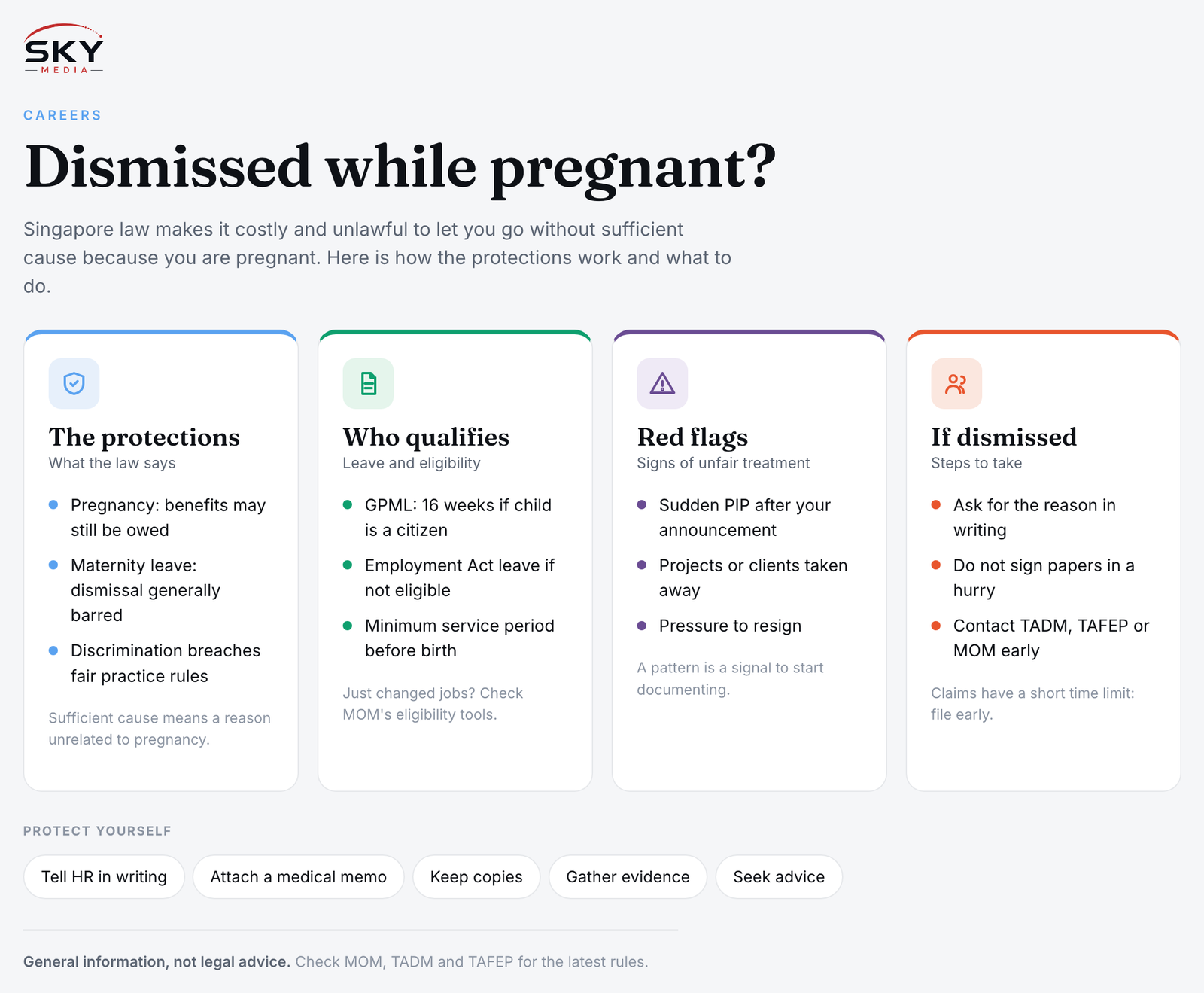
What the Law Says About Dismissal During Pregnancy
Singapore does not ban every dismissal of a pregnant employee. What the law does is make it costly and unlawful for an employer to let you go without sufficient cause because you are pregnant, and it protects you more strongly while you are on maternity leave.
In broad terms:
- During pregnancy: If you are eligible for maternity protection and your employer dismisses you without sufficient cause, or retrenches you, during your pregnancy, the employer may still have to pay the maternity benefits you would otherwise have received. MOM sets out the eligibility conditions for this protection.
- During maternity leave: An employer generally cannot give you notice of dismissal, or dismiss you, while you are on maternity leave, except in limited situations defined in the law.
- Discrimination: Treating someone less favourably because of pregnancy is against the Tripartite Guidelines on Fair Employment Practices, which are promoted by the Tripartite Alliance for Fair and Progressive Employment Practices (TAFEP). The Workplace Fairness Act, passed in 2025, is designed to make pregnancy and caregiving discrimination a legal matter rather than just a guideline issue. Check MOM and TAFEP for when its provisions apply and to which employers.
“Sufficient cause” usually means a genuine reason unrelated to the pregnancy, such as proven misconduct or poor performance that was documented and raised before you announced your news. An employer that suddenly discovers performance problems right after your announcement may face hard questions.
Who Qualifies for Maternity Protection and Leave
Eligibility matters because it decides both your leave and whether the dismissal protection applies to you. The conditions depend on the scheme. The main ones are:
- Government-Paid Maternity Leave (GPML): For mothers whose child is a Singapore citizen and who meet conditions such as having worked for the employer, or been self-employed, for a continuous minimum period before the birth. Eligible mothers receive 16 weeks under this scheme.
- Maternity leave under the Employment Act: For employees who do not qualify for GPML, for example because the child is not a Singapore citizen, the Employment Act may provide a shorter period of maternity leave if conditions are met, with part of it paid.
- Employer policies: Some employers offer more generous terms in their contracts or handbooks. Contract terms cannot give you less than the law requires.
The service period before birth is the condition that trips many people up. If you have just changed jobs, check carefully with MOM’s eligibility tools whether you will have served long enough by your due date.
| Situation | Usual position (check MOM for your case) | What to do |
|---|---|---|
| Eligible employee dismissed without sufficient cause while pregnant | Employer may still owe the maternity benefits you would have received | Keep records and contact MOM or TADM promptly |
| Employee on maternity leave given notice of dismissal | Generally not allowed, apart from limited exceptions | Do not sign anything; seek advice quickly |
| Employee dismissed for documented misconduct unrelated to pregnancy | Dismissal may be lawful if due process was followed | Ask for written reasons and review the evidence |
| Employee who has not met the minimum service period | Some protections and benefits may not apply | Check eligibility with MOM and read your contract |
When and How to Tell Your Employer
There is no single legal deadline for announcing a pregnancy to colleagues, but notifying your employer properly matters for your protections and your leave planning. Practical tips:
- Tell your employer in writing. A short email to your manager and HR, attaching a medical memo confirming the pregnancy, creates a clear record of the date they knew.
- Give notice of your leave. The law expects you to inform your employer before you start maternity leave. Giving notice well ahead also helps your team plan.
- Keep copies. Save emails, letters and performance reviews outside your work account, where your company policy allows.
- Ask about flexible arrangements. If you need adjusted duties or hours for medical reasons, ask in writing and keep your doctor’s advice on file.
For day-to-day comfort, energy and commute tips, see our separate guide on working through your pregnancy in Singapore.
Signs Your Treatment May Be Unfair
Unfair treatment is not always an outright dismissal letter. Watch for patterns such as:
- Being suddenly placed on a performance improvement plan right after your announcement, with no earlier concerns raised.
- Having key projects, clients or responsibilities removed without explanation.
- Being pressured to resign, or told that “it might be easier” to leave.
- Being retrenched while others in identical roles are kept, with no clear selection criteria.
- Comments in meetings or messages linking your pregnancy to your reliability.
A pattern like this does not automatically mean the law has been broken, but it is a signal to start documenting carefully and to seek advice.
What to Do If You Are Dismissed While Pregnant
If you are let go while pregnant or on maternity leave, act calmly and quickly:
- Ask for the reason in writing. You are entitled to understand why your employment is ending.
- Do not sign settlement or resignation papers in a hurry. Take time to read them, and seek advice if they ask you to give up claims.
- Gather evidence. Collect your contract, payslips, appraisal records, your pregnancy notification email and any relevant messages.
- Contact the right body. The Tripartite Alliance for Dispute Management (TADM) handles mediation for employment disputes, including wrongful dismissal claims and salary or benefit claims. TAFEP handles workplace discrimination concerns. MOM can tell you which route fits your case.
- Watch the deadline. Wrongful dismissal claims must be filed within a short time after your last day of employment. Check MOM’s website for the current time limit and file early.
- Consider your union or a lawyer. If you are a union member, your union may help. For complex cases, a lawyer experienced in employment law can advise. Legal aid clinics may be an option if cost is a concern.
If a claim succeeds, outcomes can include compensation or payment of maternity benefits owed. The specific remedy depends on the facts and the process.
Looking After Yourself Through the Process
A job dispute during pregnancy is stressful. Lean on your partner, family or friends, and tell your doctor or polyclinic if stress is affecting your sleep or health. Your employer’s Employee Assistance Programme, if there is one, may offer confidential counselling. Remember that you do not have to resolve everything in one day; the key early steps are keeping records and getting reliable advice.
For a wider look at what Singapore law guarantees all workers, read our guides to employment rights and MOM protections in Singapore and caregiver leave and employment rights, which covers childcare leave after your baby arrives.
The official sources to check are MOM for maternity leave rules and eligibility, TADM for employment claims, and TAFEP for fair employment practices. Rules change, so confirm the current details for your situation before acting.
Official sources: Ministry of Manpower (MOM)