

Not being paid what you are owed is stressful, especially when rent and bills keep coming. In Singapore, most employees with a salary dispute go through the Tripartite Alliance for Dispute Management (TADM) first. This guide walks through a TADM salary claim from the employee’s side: what you can claim, the deadlines, how mediation works and what happens if it fails and your case moves to the Employment Claims Tribunals (ECT).
This is general information, not legal advice. Claim limits, deadlines, fees and eligibility are set by law and by the Ministry of Manpower (MOM), TADM and the State Courts, and they can change. Check the current rules on the TADM and MOM websites before filing.
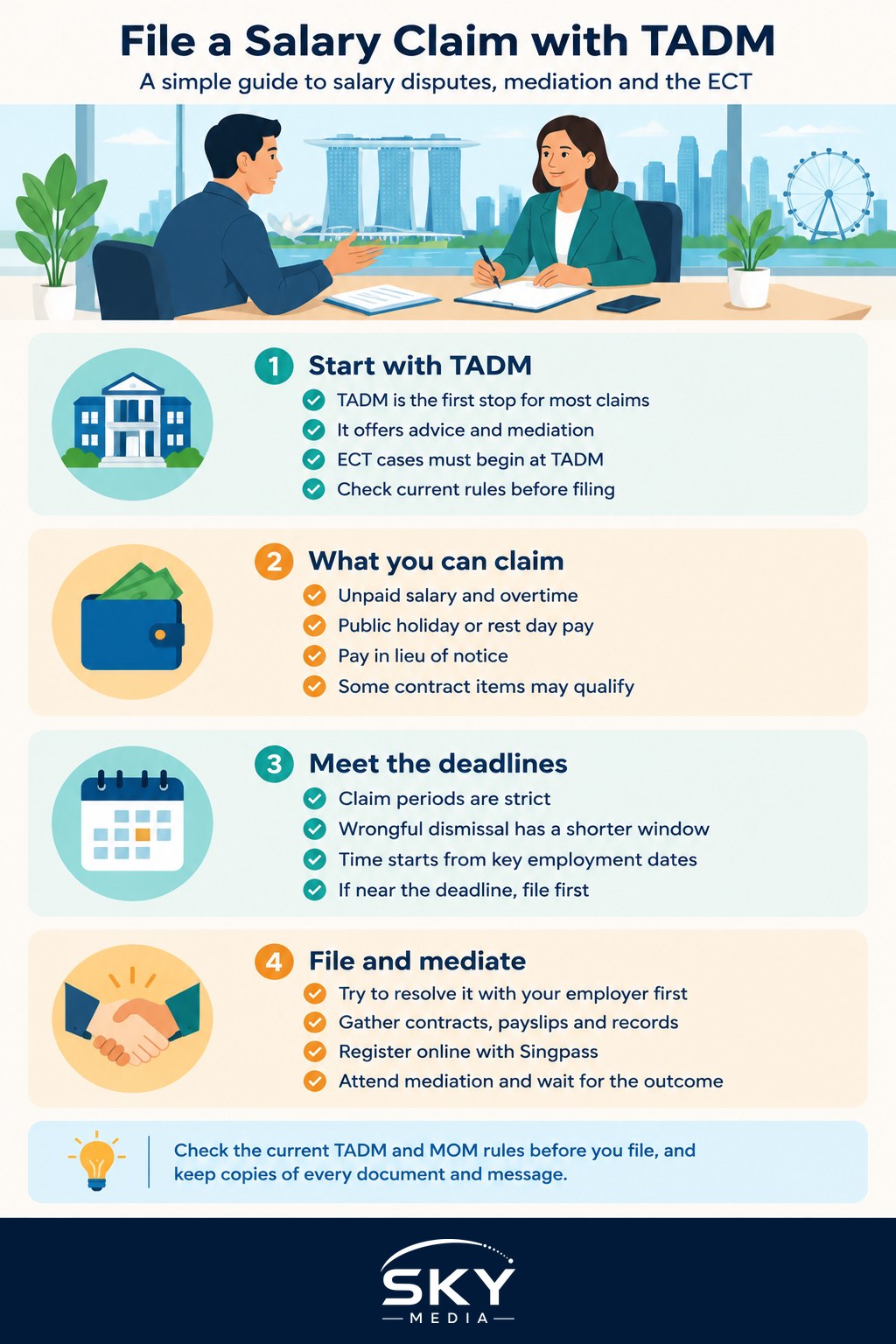
What TADM and the ECT Are
TADM is a tripartite body set up by MOM, the National Trades Union Congress (NTUC) and the Singapore National Employers Federation (SNEF). It provides advisory and mediation services for employment disputes.
The ECT is part of the State Courts. It hears salary-related and wrongful dismissal claims that could not be settled at mediation. It is designed to be faster and less formal than a regular court, and parties usually present their own case without lawyers.
The basic rule is simple: for claims within the ECT’s scope, you must first register your claim with TADM and attempt mediation. Only if mediation does not resolve the dispute can you take the claim to the ECT.
What You Can Claim
TADM handles two broad types of claims:
- Salary-related claims. These include unpaid salary, unpaid overtime, unpaid public holiday or rest day pay, salary in lieu of notice, and other payments due under your employment contract or the Employment Act. Contractual items such as bonuses or allowances may also qualify if they are written into your contract.
- Wrongful dismissal claims. If you believe you were dismissed without just cause or for an unlawful reason, such as because of pregnancy or to deny you a benefit, you may be able to claim.
There are claim amount limits for the ECT, with a higher limit for claims that went through union-assisted or tripartite mediation. Some groups of workers, such as public servants and domestic workers, generally use different channels. Check TADM’s eligibility page to confirm your situation is covered. If your salary is just late rather than unpaid, read late salary in Singapore: what employees can do first, as raising it with your employer may resolve things quickly.
Deadlines You Must Not Miss
Time limits are strict, and a late claim may not be accepted. Under the current rules as published by TADM and MOM:
- Salary-related claims must generally be filed within a set period, which is longer if you are still employed and shorter after your employment ends.
- Wrongful dismissal claims have a much shorter window counted from your last day of employment.
Check the exact current periods on TADM’s website as soon as a dispute arises. If you are close to a deadline, file first and gather extra documents later rather than waiting.
Step-by-Step: Filing Your Claim
- Try to resolve it internally first. Write to your employer or HR, clearly stating what is owed and for which period. Keep copies. This is not always required, but it creates a record and sometimes settles the matter.
- Gather your evidence. Collect your employment contract or letter of appointment, itemised payslips, bank statements showing salary credits, timesheets or rosters for overtime, your resignation or termination letter, and messages or emails about the dispute.
- Calculate your claim. List each item, the period it covers and the amount. Be realistic and show your workings; a clear calculation makes mediation more productive.
- File online with TADM. Log in with Singpass to TADM’s e-services and register your claim. Foreign employees without Singpass can check TADM’s site for alternative channels. A registration fee may apply; check the current amount on the website.
- Attend mediation. TADM will notify you and your employer of the mediation session. Attend on time with your documents.
- Settle or get a referral. If you reach agreement, the terms are recorded in a settlement agreement. If mediation fails, TADM issues a Claim Referral Certificate, which allows you to file your claim with the ECT.
If you are a union member, contact your union early. Unions can advise you and may help represent you at mediation.
What Happens at Mediation
Mediation is a structured conversation led by a neutral TADM mediator. The mediator does not decide who is right. Instead, they help both sides understand each other’s positions and explore a settlement.
| Stage | What happens | Tips for employees |
|---|---|---|
| Opening | Mediator explains the process and confidentiality | Listen and ask about anything unclear |
| Your account | You explain what is owed and why | Stick to facts, dates and documents |
| Employer’s account | Employer responds, may dispute amounts | Do not interrupt; note points to answer |
| Discussion and options | Mediator explores a settlement, sometimes in separate sessions | Know your minimum acceptable outcome before you go |
| Outcome | Settlement agreement signed, or Claim Referral Certificate issued | Read the agreement carefully, including payment dates, before signing |
A settlement agreement reached at TADM is binding. If the employer does not pay as agreed, there are steps to register and enforce it; ask TADM about this if it happens.
Employers have their own process for preparing for these sessions, explained in how employers should respond to a TADM salary claim. Reading it can help you anticipate the arguments you may hear.
If Your Claim Goes to the ECT
With a Claim Referral Certificate, you can file your claim with the ECT through the State Courts’ online system within the time allowed. Typically:
- Filing. You submit your claim and pay the tribunal’s filing fee as stated on the State Courts website.
- Case management. The tribunal may hold a consultation or case management session to narrow the issues and, sometimes, encourage settlement.
- Hearing. If not settled, a Tribunal Magistrate hears both sides and makes an order. Bring your documents and any witnesses.
- Enforcement. If the employer does not comply with the order, you can apply for enforcement through the State Courts.
Lawyers are generally not allowed to represent parties at the ECT, which keeps costs down and puts the focus on the facts.
Practical Tips While Your Claim Is Ongoing
- Keep working records. Save payslips and bank statements regularly, not only when trouble starts.
- Stay professional. If you still work there, continue doing your job. Retaliation is a serious matter; report concerns to MOM.
- Check your work pass. Foreign employees whose employment ends during a dispute should check with MOM about their pass status and whether they can stay while the claim is resolved.
- Look after yourself. Disputes can be draining. Lean on family, friends, your union or a counsellor if the stress builds.
For official guidance, use the TADM website for filing and mediation, the State Courts website for ECT procedures, and MOM for Employment Act questions.
Official sources: Ministry of Manpower (MOM)
Further reading: Can You Be Dismissed While Pregnant? Employment Protections in Singapore · Whistleblowing at Work in Singapore: How to Report Wrongdoing Safely · Can You Take a Second Job? Moonlighting Rules for Singapore Employees