
If you have recently moved to Singapore from mainland China, the Dragon Boat Festival (端午节, Duanwu Jie) will feel familiar and strange at the same time. Rice dumplings fill the markets and dragon boats race on the water, yet many of the dragon boat festival customs you grew up with are quieter here, done differently, or missing altogether. And the biggest surprise for many newcomers: there is no day off.
This guide looks beyond food at the customs, rules and everyday habits that differ between the two places. For the dumplings themselves, our article on China festivals that Singapore marks differently covers the zongzi comparison, and our general guide to the Dragon Boat Festival explains how the festival is celebrated locally.
No Public Holiday: Duanwu Is a Working Day
In China, the Dragon Boat Festival has been a national public holiday since 2008, and it is usually part of a short multi-day break, sometimes with adjusted working weekends around it.
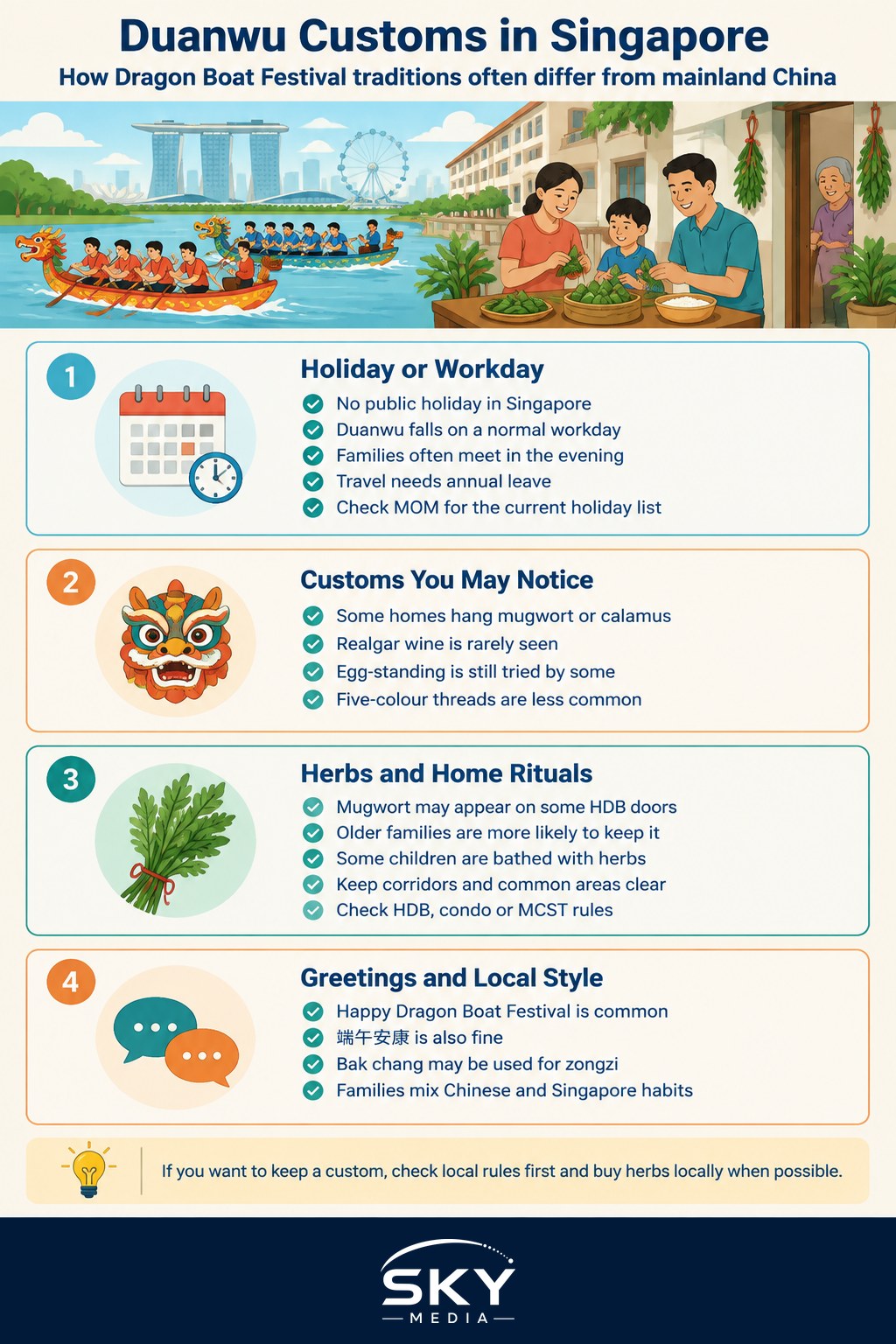
In Singapore, it is not a public holiday. Singapore’s gazetted public holidays are spread across its main communities and faiths, and for Chinese festivals that means Chinese New Year, while Vesak Day is the Buddhist holiday. Duanwu falls on an ordinary working day, and schools are often already on their June holidays at that time of year, which shapes how families celebrate.
What this means in practice:
- Do not plan a “Duanwu trip” expecting to get the day off work. If you want to travel, you will need to apply for annual leave with your employer.
- Family gatherings tend to happen in the evening or on the nearest weekend rather than on the day itself.
- If you hold a work pass, your leave entitlement is set by your contract and Ministry of Manpower (MOM) rules. Check with HR rather than assuming festival leave.
- The official list of public holidays is published each year by MOM, so check there for the current year.
Customs Compared: What Changes in Singapore
Most Chinese Singaporeans trace their roots to southern Chinese communities such as Hokkien, Teochew, Cantonese, Hakka and Hainanese. Their festival customs grew from those regional traditions and then evolved over generations in Southeast Asia. That is why some northern or nationwide Chinese practices are less visible here.
| Custom | Common in China | What you will usually see in Singapore |
|---|---|---|
| Public holiday | National holiday, usually a short break | Normal working day, no holiday |
| Mugwort and calamus on doors | Widely hung on doors in many regions | Seen in some homes, especially older or traditional families, but not widespread |
| Realgar wine (雄黄酒) | Traditional in some regions, now often discouraged | Rarely seen |
| Egg standing at noon (立蛋) | Popular fun activity in some places | A playful tradition some families, schools and media still feature |
| Five-colour threads and sachets | Common for children in many regions | Less common, though some families keep it up |
| Greeting | “端午安康” increasingly preferred in some circles | “Happy Dragon Boat Festival” or simple greetings, with little debate over wording |
Every family is different. Some Singapore households keep many of these customs carefully, while some families in China skip them entirely.
Mugwort, Calamus and Warding Off Illness
In many parts of China, the fifth lunar month was traditionally seen as a time when heat, insects and illness increased. Hanging bundles of mugwort (艾草) and calamus (菖蒲) on doors was believed to keep bad influences away, and the strong scent was thought to repel insects.
In Singapore, you may spot mugwort or similar herbs on the doors of some HDB flats and shophouses, particularly in older neighbourhoods. Some families also bathe children in water with herbs or leaves on the festival day, a custom passed down through particular dialect groups. Wet markets sometimes sell bundles of herbs in the days before the festival.
If you want to keep the custom, it is perfectly fine to hang mugwort on your door. A couple of practical points:
- In HDB flats and condominiums, keep corridors and doorways clear, and follow your town council or condo management (MCST, the Management Corporation Strata Title) rules about items in common areas.
- Bringing fresh plants or herbs into Singapore from overseas is regulated. Our guide to bringing food and drink from China through customs explains why checking with the authorities first matters. Buying locally is usually simpler.
Realgar Wine: Better Left as Tradition
Realgar wine (雄黄酒) is the custom many newcomers ask about. The story of Madame White Snake (白蛇传) made it famous, and some regions traditionally drank a little or dabbed it on children’s foreheads.
Realgar is an arsenic-containing mineral. Health authorities and doctors widely advise against drinking it, and it is rarely seen in Singapore. If you want to mark this part of the festival, tell the story instead. For any concerns about traditional remedies, speak to a doctor or a registered TCM (Traditional Chinese Medicine) practitioner.
Standing an Egg at Noon
The custom of trying to balance an egg upright at exactly noon on Duanwu (立蛋) is a lighthearted tradition in parts of China and Taiwan, and it survives in Singapore too. Some families, kindergartens and community groups still try it, and it occasionally appears in local news and social media around the festival.
It makes a fun activity with children, especially since many will be home for the June holidays. Choose a flat surface, use a fresh egg and be patient.
Greetings and Etiquette
In China, you may have seen discussion over whether to say “端午快乐” (Happy Duanwu) or “端午安康” (wishing you peace and good health), because of the festival’s traditional link with commemoration and warding off illness.
In Singapore, this debate is far less noticeable. Many people simply say “Happy Dragon Boat Festival” in English, or a Mandarin or dialect greeting. If you prefer “端午安康”, that is perfectly fine too. Locals will understand either.
A few more differences you may notice:
- Language. You will hear dialect names for food, such as “bak chang” (Hokkien) for zongzi, alongside Mandarin.
- Gifting dumplings. Giving rice dumplings to neighbours, colleagues and relatives is common, much like in China.
- Ancestral offerings. Some families offer dumplings at the home altar before eating them. Practices vary by family and faith.
Making the Festival Your Own in Singapore
You do not have to choose between “Chinese” and “Singapore” ways of celebrating. Many newcomer families combine both: zongzi from their hometown recipe, a Nyonya dumpling from the local market, an egg-standing challenge at noon, and an evening out to watch the dragon boats. The festival in Singapore is relaxed and flexible, and your own customs are welcome in it.
Frequently Asked Questions
Why does Singapore’s bak chang taste different from the zongzi back home? Singapore’s Chinese communities mostly trace their roots to southern groups such as Hokkien, Teochew and Cantonese, so local dumplings follow those regional recipes, with local twists like Nyonya versions. Zongzi in other parts of China can be sweeter or filled differently. Neither is the correct version, just different traditions.
Can I bring zongzi from China into Singapore? Some food items, especially those containing meat, are subject to import rules, so do not assume they are allowed. Check the Singapore Food Agency’s current requirements and the rules for bringing food through customs before you pack. Buying locally during the festival is usually the simpler option.
Are there Dragon Boat Festival events newcomers can join in Singapore? Community clubs and grassroots groups sometimes hold festival activities, and dragon boat regattas are open to spectators. Events change each year, so check the People’s Association and community club listings closer to the date. Neighbourhood wet markets and bakeries are also good places to see the season.
How do I explain Duanwu to local friends and colleagues? Keep it simple: it commemorates the poet Qu Yuan, who is remembered with dragon boat races and rice dumplings. Sharing a few dumplings, or sharing the egg-standing game, is an easy way to introduce your own customs. Many locals will recognise the festival, even if their family traditions differ.
Further reading: Dongzhi in Singapore vs China: How Winter Solstice Customs Differ · Making Dragon Boat Festival Fragrant Sachets With Kids · Telling Kids the Story Behind the Dragon Boat Festival