

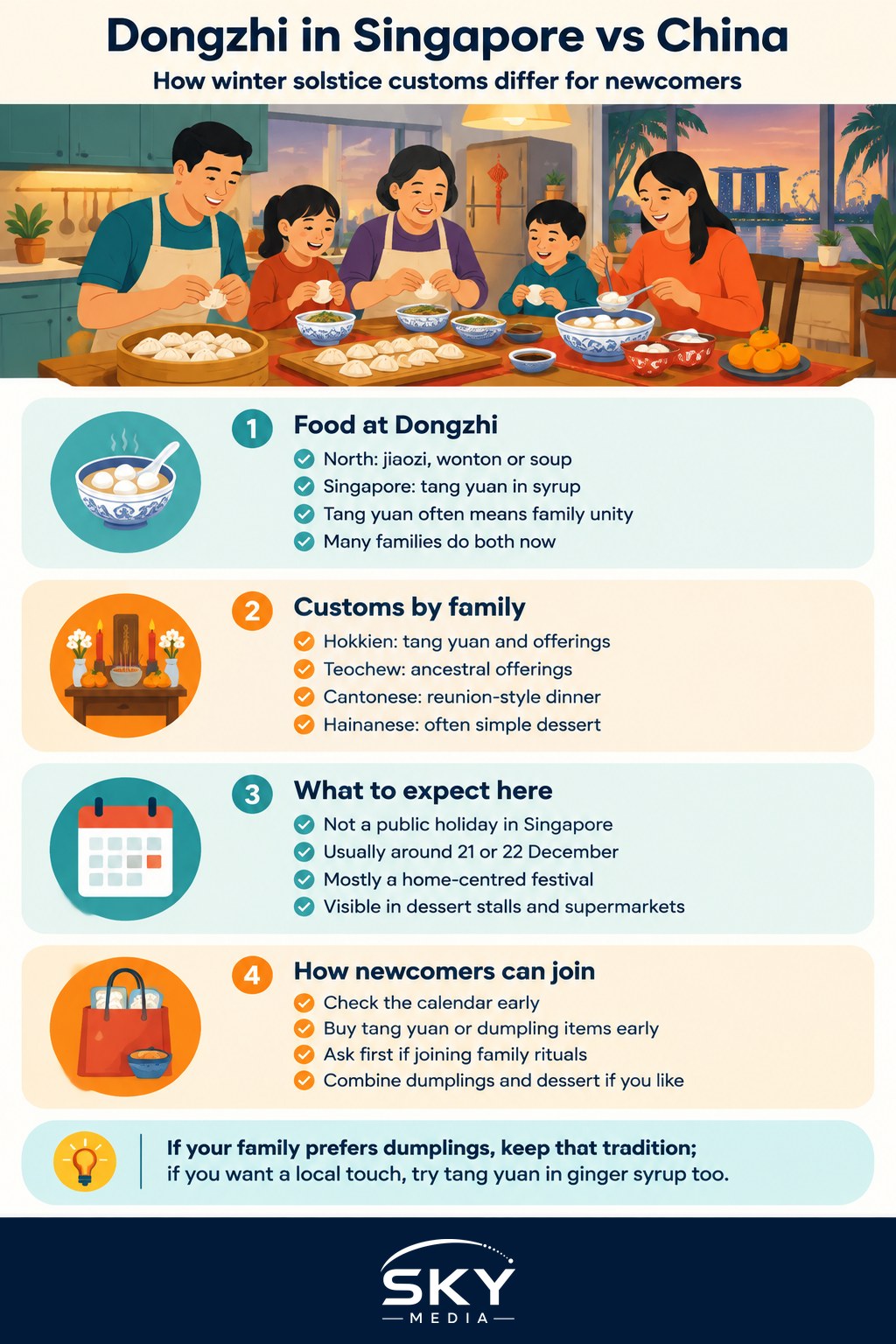
If you have just moved here from China, Dongzhi in Singapore vs China can feel surprisingly different. In much of northern China, the winter solstice means a plate of jiaozi (dumplings), cold weather and sometimes a family gathering. In Singapore, which has no winter at all, the day around 22 December is usually marked with a bowl of tang yuan, sweet glutinous rice balls, and the customs you see often trace back to southern Chinese dialect groups such as Hokkien, Teochew and Cantonese. This guide explains the differences so you know what to expect, and how to join in.
Why Dongzhi Looks Different in Singapore
Most of Singapore’s Chinese community descends from migrants who came from southern provinces, mainly Fujian and Guangdong, along with Hainan and other regions. They brought the food customs of their home villages, and those customs set the template for how festivals are celebrated here today.
In northern China, Dongzhi traditions grew around a genuinely cold season. Hot dumplings were a practical winter food, and a well-known folk saying links eating dumplings at the solstice with keeping your ears from freezing. In southern China, tang yuan were the more common solstice food, and the round shape is widely associated with family togetherness and completeness.
Singapore inherited the southern tradition. Add tropical weather, a multicultural society and a working calendar where Dongzhi is not a public holiday, and you get a festival that is quieter, more home-centred and very focused on one dessert.
Food: Northern Dumplings vs Singapore Tang Yuan
Food is the clearest difference, and the one most newcomers notice first.
In northern China
– Jiaozi are the main dish, often made together at home with fillings such as pork and cabbage or lamb.
– Some regions eat wonton, noodles or mutton soup instead.
– The meal is savoury and filling, suited to cold weather.
In southern China and Singapore
– Tang yuan are the centrepiece, either small plain balls (often pink and white) or larger filled ones with black sesame, peanut or red bean.
– They are usually served in a light ginger syrup, sometimes with pandan.
– Some families also prepare a fuller dinner, but the dessert is what most people think of as “doing Dongzhi”.
You can still find dumplings easily in Singapore, so if your family prefers jiaozi, nothing stops you making them. Many China-newcomer households end up doing both.
Dialect-Group Customs You May See in Singapore
Customs vary by family, and many younger Singaporeans keep only the dessert. But you may come across these commonly seen practices, especially in more traditional households:
- Hokkien families: some roll tang yuan together the night before and offer a bowl at the household altar to ancestors and deities before eating. A practice sometimes mentioned in older households is sticking a tang yuan on doors or household items as a symbol of blessing, though this is now rare.
- Teochew families: Dongzhi can be an important day for ancestral offerings, and some families prepare a fuller spread of dishes alongside tang yuan.
- Cantonese families: there is a saying that Dongzhi is as important as the new year, and some families treat it as a reunion dinner, sometimes with roast meats as well as tang yuan.
- Hainanese and other groups: practices differ, and some families keep a simple dessert-only tradition.
A common folk belief across groups is that eating tang yuan at Dongzhi means you have grown a year older. Treat all of these as traditions that differ from household to household rather than fixed rules.
A Side-by-Side Comparison
| Aspect | Northern China | Singapore |
|---|---|---|
| Main food | Jiaozi (dumplings), sometimes wonton or mutton soup | Tang yuan in ginger or pandan syrup |
| Weather | Cold, often freezing | Hot and humid, sometimes rainy monsoon season |
| Holiday status | Not a public holiday in China, but culturally significant in many regions | Not a public holiday; normal working and school day (though it often falls in the school holidays) |
| Main setting | Family meal at home | Home dessert, sometimes ancestral offerings, dessert shops |
| Customs | Family dumpling-making, regional soups | Dialect-group practices, altar offerings in some homes |
| Public visibility | Varies by region | Low-key; most visible in supermarkets and dessert stalls |
What This Means for You as a Newcomer
The biggest practical difference is visibility. In some Chinese cities you might see Dongzhi promotions everywhere. In Singapore, the festival is mostly private. Here is how to make it feel like home:
- Check your calendar. Dongzhi falls on the solstice, usually 21 or 22 December. Because it is a normal working day, plan a family dinner in the evening.
- Shop a few days early. Frozen tang yuan, glutinous rice flour and dumpling wrappers are sold in supermarkets and provision shops. Popular items can run short just before the festival.
- Keep your own tradition. If dumplings are what Dongzhi means to your family, make them. Nobody will find it odd.
- Try the local version too. A bowl of tang yuan in ginger syrup is a simple way to connect with local friends and colleagues.
- Ask before joining others’ rituals. If you are invited to a colleague’s home, it is polite to follow their lead, especially around the altar. A simple question like “Is there anything I should know?” is always welcome.
- Talk about it at work. Mentioning Dongzhi to Chinese Singaporean colleagues is an easy conversation starter. Many will happily share how their family marks the day, which may differ from their neighbours.
Children, School and Mixed Families
For families with children in local schools, Dongzhi often falls during the year-end school holidays, which makes a family activity easier to plan. Rolling tang yuan together is a fun, hands-on way to teach children about the festival, and you can add a dumpling-making session to share your own regional tradition.
In mixed families, for example one partner from northern China and one Singaporean, many couples simply combine customs: dumplings for dinner, tang yuan for dessert. This kind of blending is very Singaporean in spirit.
Other Festivals That Follow the Same Pattern
Dongzhi is a good example of a wider pattern. Many Chinese festivals look slightly different in Singapore because local customs grew from southern dialect groups and adapted to a tropical, multicultural setting. You will notice similar contrasts during the new year, the Dragon Boat Festival and the seventh lunar month.
To go deeper, read Celebrating Winter Solstice (Dongzhi) in Singapore for local customs in more detail, and compare other festivals with How Chinese New Year Differs: China vs Singapore, Duanwu Customs From China That Singapore Does Differently and Hungry Ghost Month in Singapore vs China: How Customs Differ.
Frequently Asked Questions
Do non-Chinese Singaporeans celebrate Dongzhi? It is mainly a Chinese festival, and customs depend on the household, with many younger families marking it with just the dessert. Friends and colleagues of other backgrounds are often happy to share a bowl of tang yuan if invited. Ask politely about what is welcome.
Am I expected to join ancestral offerings if invited to a Singaporean home? No one should pressure you to. If you are invited to a colleague’s home, follow your host’s lead and ask something like whether there is anything you should know. You can simply watch respectfully, or decline politely if you prefer not to take part.
What should I bring if I’m invited to a Dongzhi meal? A small, thoughtful item works well, such as fruit or a dessert, and you can offer to bring something from your own tradition, like dumplings. Ask your host first, since some households have set plans or dietary needs. Keep it simple, and avoid assuming what the family eats.
Do younger Singaporeans still follow these dialect-group customs? Many keep only the dessert, and the older practices are less common, especially in younger households. Customs differ from family to family, so treat them as traditions, not fixed rules. If you are curious, asking colleagues how their family marks the day is a good conversation starter.
Are there public Dongzhi events in Singapore, or is it mostly private? It is mostly private and low-key, with the festival most visible in supermarkets and dessert stalls. Some community groups or clan associations may hold activities, so check the community club or association listings. Do not expect city-wide promotions.