
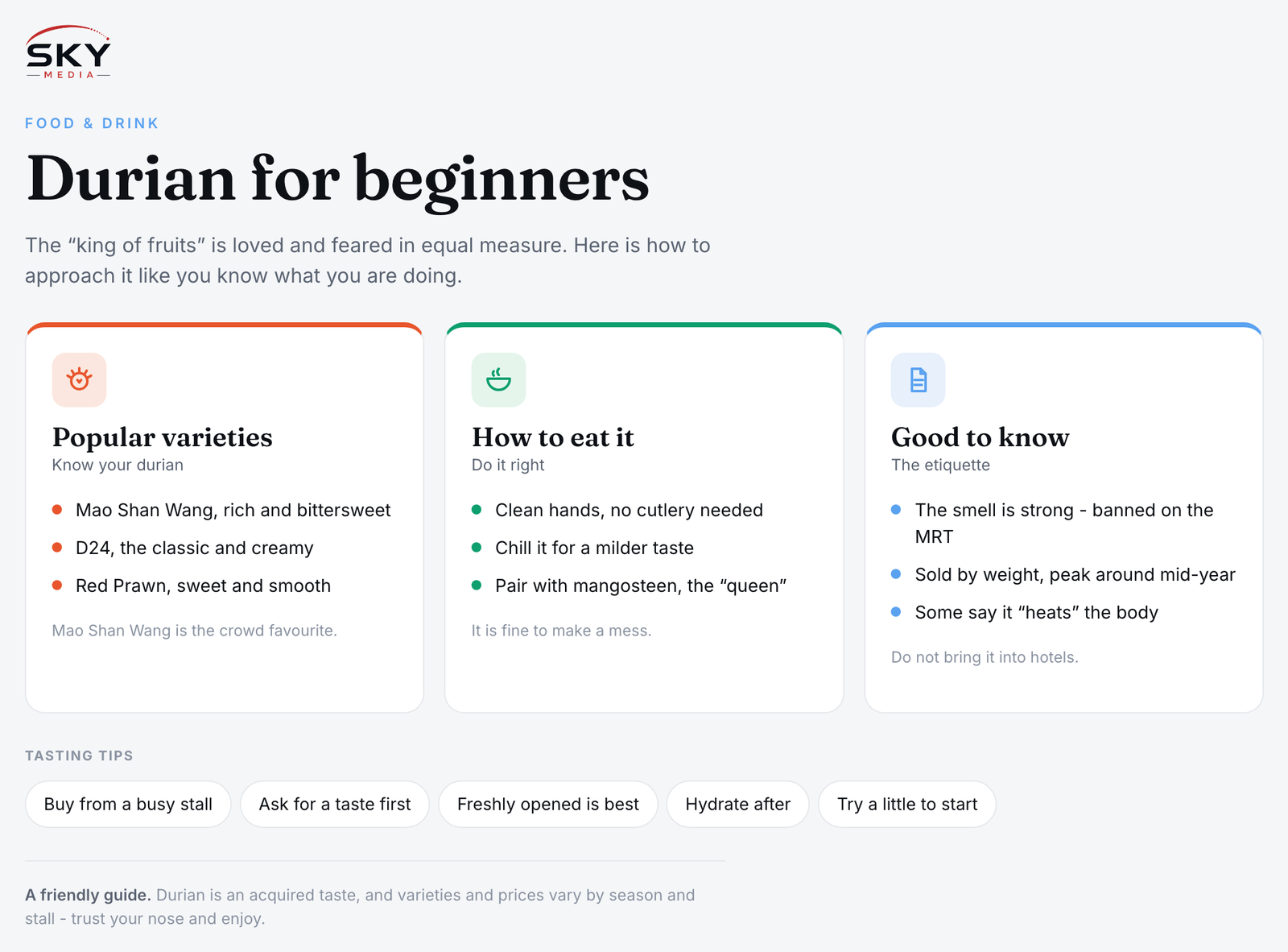
Some people call it the king of fruits. Others cross the street to avoid it. If you have just arrived in Singapore, or you grew up here but never quite got past the smell, this durian guide for Singapore beginners is for you. We will cover what durian actually is, the varieties worth knowing, when durian season lands, how to buy and eat it without embarrassing yourself, and the local etiquette that keeps it off trains and out of hotel rooms.
What Durian Is (and That Smell)
Durian is a large, spiky tropical fruit grown mostly in Malaysia, Indonesia and Thailand. Inside the hard shell sit pods of soft, custard-like flesh wrapped around a seed. The texture is rich and creamy, closer to a mousse than a fruit, and the taste swings from sweet to bitter depending on the type.
Then there is the aroma. Durian smells strong, and reactions vary wildly. Newcomers often describe it as onions, gas, or something faintly savoury; fans describe it as deep, almondy and floral. The smell is why durian is banned in so many indoor spaces. Our honest advice: try it before you judge it. Plenty of people who wrinkled their nose at the first whiff now queue up in season.
Popular Durian Types
Understanding durian types is the fastest way to feel confident when you buy. Sellers use grades and cultivar names, and prices climb with reputation. Here are the ones you will hear most often.
- Mao Shan Wang (MSW): The most famous premium variety, also called Musang King. Rich, bittersweet, sticky and intense, with deep yellow flesh. If you only try one, many locals say try this. It is also the priciest.
- D24 (Sultan): A long-time favourite that balances sweet and bitter. Smooth, reliable and usually gentler on the wallet than Mao Shan Wang, which makes it a great starting point.
- Red Prawn (Ang Heng): Named for its reddish-orange flesh. Sweet, creamy and mild, with less of the sharp bitterness. A crowd-pleaser and a good choice for first-timers.
- XO: Known for a bittersweet, almost boozy, slightly alcoholic aftertaste from longer fermentation on the tree. Softer, wetter flesh. One for people who like a stronger, more grown-up flavour.
- Black Thorn (Ochee): A prized, less common variety with smooth, intensely sweet flesh and small seeds. When it appears, it commands a high price.
A simple rule for beginners: start mild and sweet (Red Prawn or D24), then work up to the bold, bitter kinds (Mao Shan Wang, XO) once you know what you enjoy.
Flavours also shift from tree to tree and season to season, so two Mao Shan Wang from different stalls can taste noticeably different. That is part of the fun.
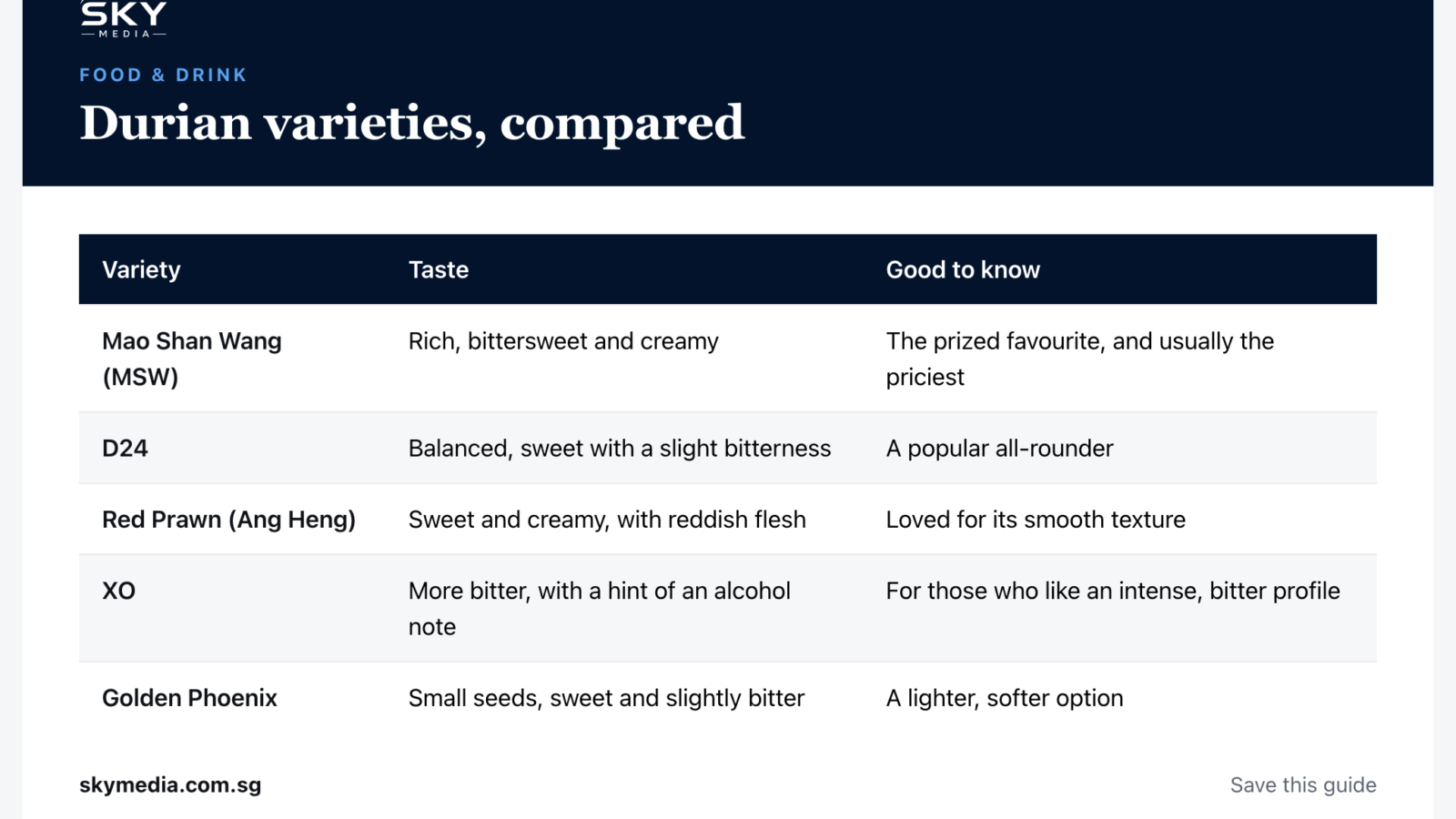
Here is a quick guide to the popular varieties:
| Variety | Taste | Good to know |
|---|---|---|
| Mao Shan Wang (MSW) | Rich, bittersweet and creamy | The prized favourite, and usually the priciest |
| D24 | Balanced, sweet with a slight bitterness | A popular all-rounder |
| Red Prawn (Ang Heng) | Sweet and creamy, with reddish flesh | Loved for its smooth texture |
| XO | More bitter, with a hint of an alcohol note | For those who like an intense, bitter profile |
| Golden Phoenix | Small seeds, sweet and slightly bitter | A lighter, softer option |
Durian Season and Timing
Durian is seasonal, and the season is the best time to buy: more supply, better variety and friendlier prices. In this region the main durian season usually falls around the middle of the year, roughly June to August, with a smaller second window often appearing towards the end of the year. Timing shifts with the weather and the harvest, so it is never fixed to exact dates.
During peak season, stalls overflow and the good stuff sells fast, often in the evenings. Outside season you can still find durian, but expect less choice and higher prices for a smaller haul.
Where to Buy Durian
Once you know what you want, deciding where to buy durian comes down to two main routes.
By the Whole Fruit
Neighbourhood durian stalls and roadside sellers, common in areas like Geylang and around many heartland markets, sell durian whole and open it for you on the spot. You can smell it, watch it being cut, and eat straight away. This is the freshest experience and lets a good seller guide you to a fruit that suits your taste. Prices are often quoted per kilogram, and premium types like Mao Shan Wang sit well above everyday varieties.
Pre-Packed
Supermarkets and many stalls also sell durian already deseeded in plastic boxes. It is convenient, portioned, and easy to carry home, though usually a little pricier per gram and you cannot inspect the whole fruit. Good for a quick fix or a small serving when you do not want to commit to a whole durian.
Quick tips for buying by the fruit:
- Tell the seller your budget and how bitter or sweet you like it; a good stall will match you.
- Ask to smell it, and let them open it in front of you.
- Look for flesh that is intact and dry-sticky, not watery or grey.
- Buy what you will finish soon. Durian is best eaten fresh, ideally the same day.
- Prices are a rough guide only and swing with season and grade, so compare a couple of stalls.
How to Eat and Pair Durian
Eating durian is refreshingly low-tech. Use your fingers, lift a pod of flesh from the shell, and eat around the seed (do not eat the seed). If your hands smell afterwards, rub a little water inside the empty shell and wash with it; it helps cut the odour.
For pairings, locals traditionally balance durian’s richness with something cooling. Mangosteen, the so-called queen of fruits, is the classic companion. Plain water or weak tea also helps. A well-known piece of local lore says to avoid heavy alcohol with a big durian feast, as the combination can leave you feeling unwell, so go easy if you drink. Durian is filling and rich, so pace yourself rather than racing through a whole one.
Etiquette, Storage and the MRT Rule
This is the part newcomers most need to know. Because the smell lingers, durian comes with real rules.
- No durian on the MRT. It is one of the few explicit no-go items on the train, and yes, it is enforced by disapproving looks even where signs are absent.
- Hotels and many rentals ban it too. Look for the crossed-out durian sign at entrances. The odour clings to rooms and can earn you a cleaning charge.
- Be considerate in shared spaces. Offices, buses, and lifts are best avoided. Eat it outdoors, at the stall, or in a well-ventilated home.
For storage, durian keeps best eaten fresh. If you must save some, seal the flesh tightly in an airtight container (a good one, or the whole fridge will smell) and refrigerate for a day or two. For longer, freeze it; frozen durian eaten slightly thawed has an almost ice-cream texture that many people love.
Your First Durian, Made Easy
Go during season, pick a mild variety like Red Prawn or D24 to start, buy from a stall that opens it in front of you, and eat it fresh with a mangosteen or two on the side. Skip the train home, keep it out of the hotel, and give the bold types a go once you have found your feet. Do that, and you will understand exactly why so many Singaporeans count down to durian season every year.
Explore more: Must-try hawker food in Singapore and Free things to do in Singapore.