

Earth Hour falls on a Saturday evening in late March each year, when people around the world switch off non-essential lights for an hour as a show of support for the planet. Most of the attention goes to homes and landmark buildings, but an earth hour office plan can do far more than a dark lobby for sixty minutes. Workplaces use a lot of electricity on lighting, air-conditioning and equipment, and the habits staff build around one symbolic night can carry on for the rest of the year.
This guide is for business owners, office managers and anyone who has been handed the “can we do something for Earth Hour?” question. It covers what to switch off, how to bring staff along, what to do if your business operates on a Saturday night, and how to turn the event into savings you can actually measure. If you are looking for ideas to do with your children at home, see our separate guide to Earth Hour activities for families at home.
Why Earth Hour Matters for a Workplace
The hour itself saves a modest amount of electricity. Its real value for a business is as a prompt. It gives you a fixed, public date to look at how your premises use energy, start a conversation with staff and landlords, and show customers that you take sustainability seriously.
Offices in Singapore tend to run air-conditioning for long hours, leave screens and printers on standby overnight, and light empty meeting rooms. These habits cost money every month, and Earth Hour is a low-pressure way to notice them.
Because the official event usually takes place on a weekend evening, when many offices are already closed, the most useful approach is to treat Earth Hour as the launch of a short campaign: a week or a month of energy-saving actions, with the switch-off itself as the headline moment. Check the official Earth Hour website each year for the exact date and time, as these are announced by the organisers.
What an Office Can Switch Off (and What It Should Not)
Before the night, walk the premises with whoever manages your facilities and sort everything into three groups.
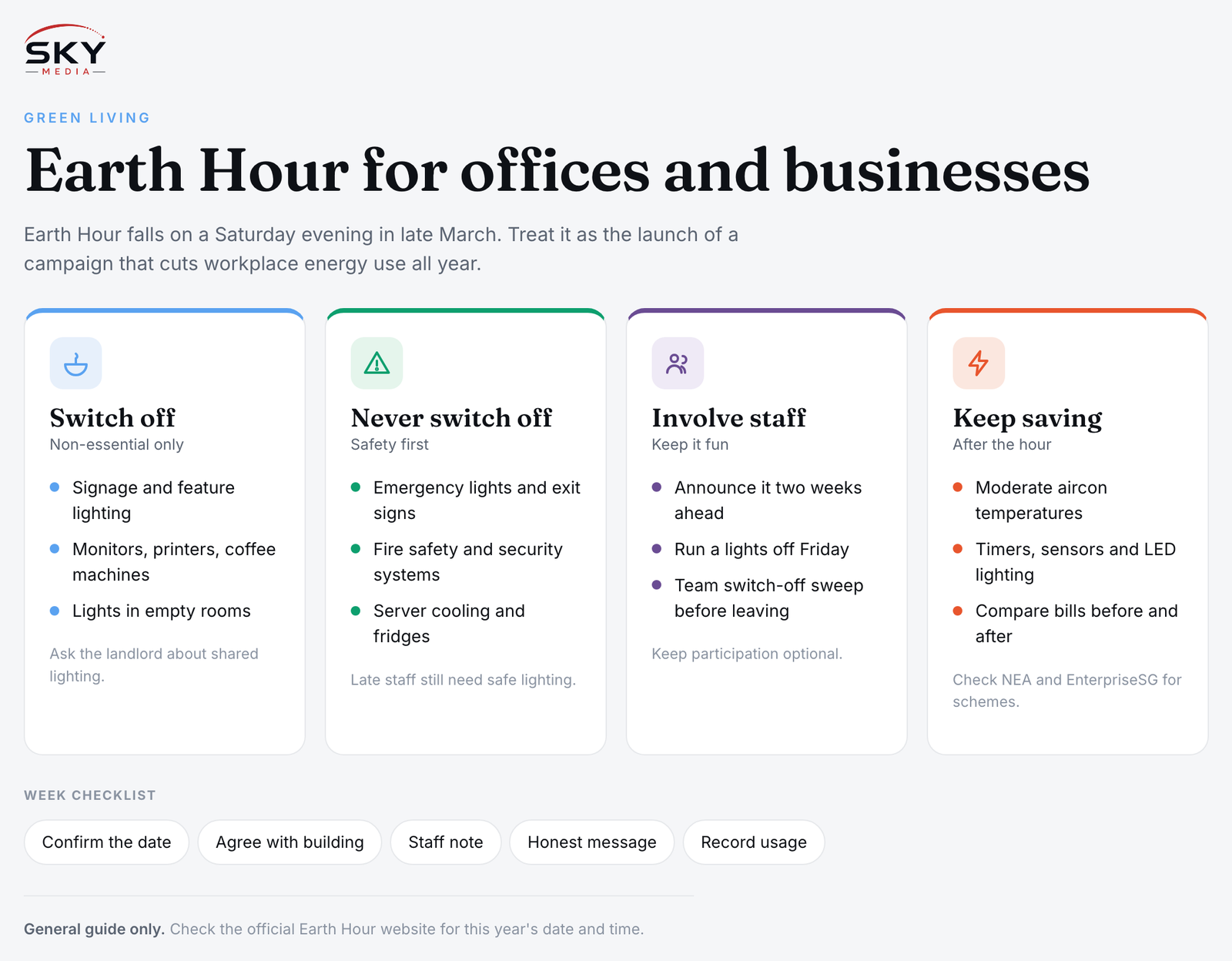
- Safe to switch off: decorative and signage lighting, lobby feature lights, lights in empty rooms, monitors, printers, coffee machines, display screens and spare equipment.
- Switch off only with permission: shared building lighting, external façade lights and anything controlled by the building management. If you rent, speak to your landlord or managing agent first.
- Never switch off: emergency lighting, exit signs, fire safety systems, security systems, server rooms that need cooling, fridges holding food or medicine, and anything required by your lease or by law.
Safety comes first. Earth Hour is about non-essential lighting, so staff working late or cleaners on site must still have safe lighting to move around.
| Workplace type | What you can usually do | What to check first |
|---|---|---|
| Tenant in a shared office tower | Switch off your own unit’s lights, screens and signage; ask staff to power down before leaving | Building management rules on façade and common-area lighting |
| Shophouse or standalone shop | Switch off signboards, display and window lighting for the hour | Your lease terms and any security or insurance conditions |
| Restaurant, café or retail open on Saturday night | Dim lights, use candles or battery lanterns safely, run a themed “lights low” hour | Fire safety and SCDF guidance on naked flames, customer safety |
| Co-working space or serviced office | Ask the operator to join and promote it to members | Who controls the lighting and air-conditioning schedules |
| Factory or warehouse | Switch off office and signage lighting; review idle machines | Safety-critical equipment and shift requirements must stay on |
Getting Staff Involved Without Making It a Chore
An Earth Hour campaign works best when it feels voluntary and a little fun, not like another compliance memo.
- Announce it early. Send a short note two weeks ahead explaining what Earth Hour is and what the business plans to do. Keep it to a few lines.
- Run a “lights off Friday.” Since the event is on Saturday, many offices pick the Friday before for a daytime version: blinds up, lights off where daylight is enough, and a reminder at the end of the day to shut everything down.
- Do a switch-off sweep. Ask each team to check their area before leaving on Friday: monitors off, chargers unplugged, meeting room lights off, air-conditioning off if your system allows.
- Ask for ideas. Staff often spot waste that managers miss, such as a room that is always cooled but rarely used.
If a few colleagues are keen, consider forming a small volunteer group to plan the campaign each year and keep the momentum going between events. Remember that some colleagues may be on leave, working part-time or caring for family, so keep participation optional.
Keeping the Savings Going After Earth Hour
The real return on an earth hour office campaign comes from what you keep doing afterwards. Pick a few changes that are easy to sustain.
- Set sensible air-conditioning temperatures. Many organisations in Singapore follow guidance to set office air-conditioning around a moderate temperature rather than very cold. Pair this with a relaxed dress code so people are comfortable.
- Schedule equipment. Ask IT whether monitors, printers and shared screens can go to sleep automatically after hours.
- Use timers and sensors. Motion sensors in toilets, pantries and meeting rooms stop lights running in empty spaces. If you rent, ask your landlord about upgrades.
- Switch to LED lighting when fittings need replacing. It is one of the simplest long-term savings.
- Review your electricity bill. Compare a few months before and after your changes. If you are a tenant on a shared meter, ask building management whether usage data is available.
- Check for support schemes. Singapore agencies have offered grants and programmes to help businesses improve energy efficiency over the years. Scheme names and conditions change, so check the National Environment Agency (NEA) and Enterprise Singapore websites for what is currently available.
Write down each change and its date, so next year’s Earth Hour becomes a natural review point.
Telling Customers and the Public
Customers increasingly notice how businesses behave, but they also notice exaggeration. Keep your messaging honest.
- Say what you are actually doing: “We are switching off our signboard and display lights for Earth Hour” is better than vague claims about “saving the planet.”
- Share the follow-up: if you have reduced electricity use or changed suppliers, say so in plain terms, without inventing numbers.
- If you are a café or shop open that night, a quiet, candle-lit or low-light hour can be a pleasant experience for customers. Keep it safe and keep exits clearly lit.
Making Earth Hour Part of Your Wider Sustainability Plan
For many small and medium businesses, Earth Hour is the first visible sustainability action. It can be a gentle starting point for bigger questions: how much energy and waste your business produces, what your customers and larger clients expect, and how you would answer a supplier questionnaire on environmental practices.
You do not need a full report on day one. Start with a simple list: what you switched off, what you changed afterwards, and what you plan to look at next. Over time, this becomes the foundation of a more structured sustainability approach that you can share with clients, staff and partners.
A simple checklist for the week of Earth Hour:
- Confirm the date and time on the official Earth Hour website.
- Agree with building management what you may and may not switch off.
- Send a short staff note with the plan and the Friday switch-off sweep.
- Prepare an honest, short message for customers or social media.
- Record your electricity usage before and after to track progress.
- Pick two or three habits to keep for the rest of the year.
Done this way, one dark hour on a Saturday night becomes a lasting change in how your workplace uses energy, and that is the point of Earth Hour in the first place.
Explore more: Earth Hour activities for families at home · Staying healthy while working in an office
Further reading: Reducing Waste in the Office in Singapore