

Ask anyone who has lived here for a while and they will have an opinion on east vs west Singapore. Some people swear by the sea breeze and old shophouse streets of the east. Others love the greenery, universities and growing business hubs of the west. The island is small enough that you can cross it in about an hour, yet the two sides feel noticeably different day to day.
This guide does not walk you through every estate. Instead, it compares the broad lifestyle trade-offs so you can narrow down which half of the island fits your routine before you start viewing homes.
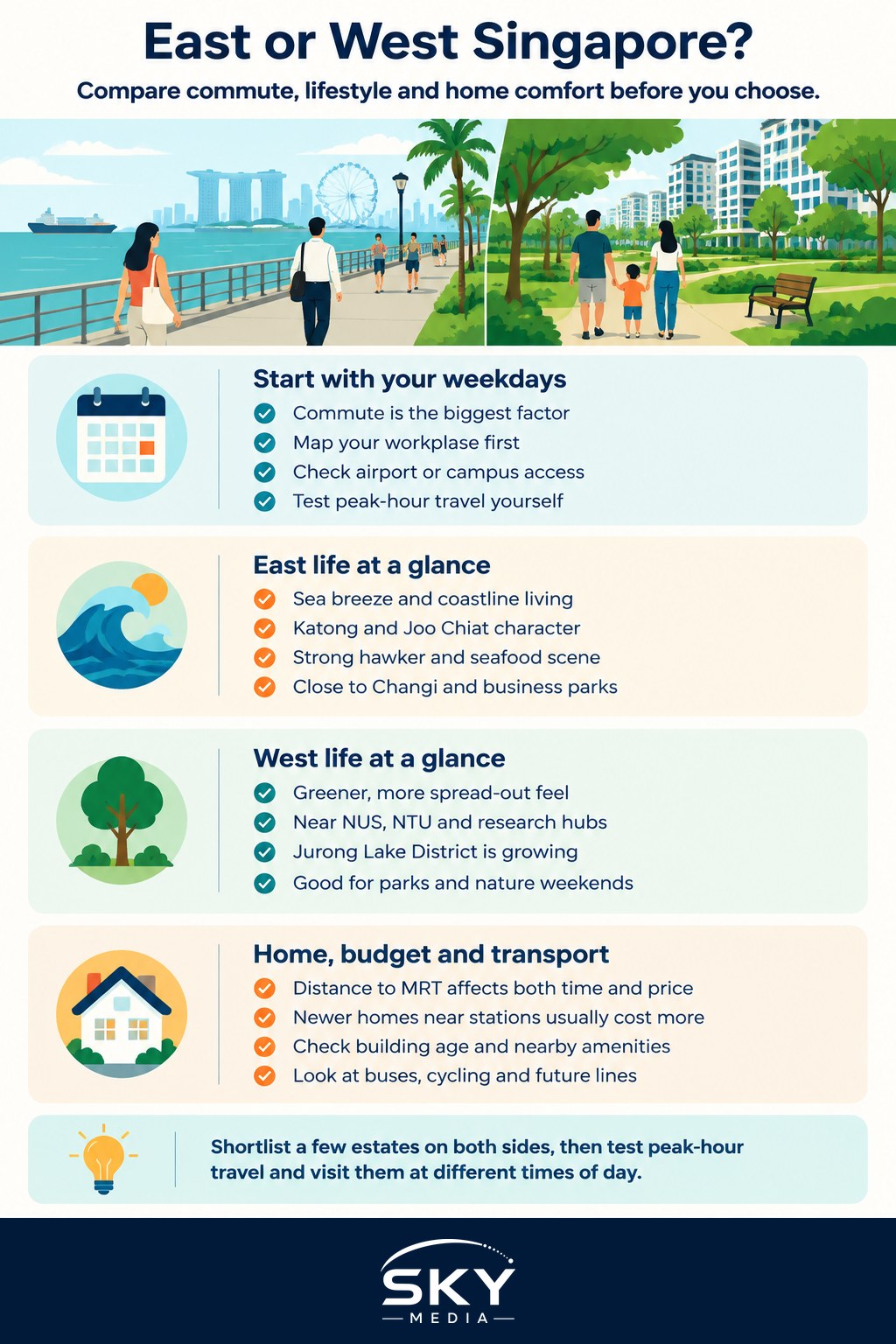
Start With Where You Will Spend Your Weekdays
The single biggest factor is your commute. Singapore’s public transport is reliable, but a cross-island journey twice a day adds up quickly, and it is the thing newcomers most often regret not weighing properly.
Map out the places you will travel to most often:
- Your workplace. The east has Changi Business Park, Paya Lebar and the Tampines regional centre. The west has the Jurong Lake District, one-north and the business parks around Jurong and Clementi.
- The airport. If you fly often for work or to see family, being on the eastern side near Changi saves real time over a year.
- Schools or campuses. NUS sits in the west around Kent Ridge, and NTU is in the far west near Boon Lay. Many international and local schools are spread across both regions, so check the specific school rather than the region.
- The city centre. Both sides connect well to the CBD by MRT, but travel time depends heavily on which line runs near your home.
A useful test is to do the journey yourself during peak hours before you commit to a lease. A route that looks short on a map can involve a long transfer, while a home further out on a direct line can be faster.
What Daily Life Feels Like in the East
The east is often described as relaxed and residential, with a strong food culture and easy access to the coast.
- Seaside living. The long stretch of coastline is a big draw. Weekends often revolve around cycling, jogging or a barbecue at East Coast Park.
- Heritage streets. Areas such as Katong and Joo Chiat have Peranakan shophouses, colourful terrace houses and older neighbourhood eateries, which give the area a distinct character.
- Food. The east is known for hawker centres, seafood and long-running local favourites. Many residents say they rarely need to leave the area to eat well.
- Housing mix. You will find HDB estates in towns like Bedok, Tampines and Pasir Ris, condominiums along the coast and around Siglap, and pockets of landed homes.
- Airport access. Changi Airport and the business parks around it are close, which suits frequent travellers and people working in aviation or logistics.
The trade-off is that some parts of the east are further from the western business hubs and universities, and parts of the area can feel busy around major malls and interchanges.
What Daily Life Feels Like in the West
The west is often seen as greener and more spread out, with a mix of nature, education and industry.
- Nature and parks. The west has large green spaces, nature reserves and parks. Families often spend weekends at places like West Coast Park or around Jurong Lake Gardens.
- Universities and research. With NUS, NTU and research clusters nearby, the west suits academics, students and people in science, tech or engineering roles.
- A growing business hub. The Jurong Lake District is being developed as a major commercial centre outside the city. If you work there, living nearby can mean a very short commute.
- Housing mix. HDB towns such as Jurong West, Bukit Batok and Clementi sit alongside condominiums and some landed estates. For a wider look at the area, see our guide to exploring Jurong and the West.
- Industry nearby. Parts of the far west are close to industrial estates and port areas. This is not a problem for most homes, but it is worth checking traffic and noise if you are looking near the fringes.
The trade-off is that the far west can feel far from the airport and from the eastern side of the city, and some estates are quieter in the evenings than more central areas.
East vs West Singapore at a Glance
This table summarises the broad patterns. Every region has exceptions, so use it as a starting point rather than a rule.
| Factor | East | West |
|---|---|---|
| Typical draw | Coastline, heritage streets, food culture | Green spaces, universities, new business hubs |
| Airport access | Close to Changi | Longer journey to Changi |
| Major work hubs | Changi Business Park, Paya Lebar, Tampines | Jurong Lake District, one-north, Jurong business parks |
| Weekend outdoors | Beach, cycling along the coast | Nature parks, gardens, hiking trails |
| Feel | Lively, established, food-focused | Spacious, leafy, mixed with industry in parts |
| Good fit for | Frequent flyers, food lovers, coastal fans | Academics, tech and research workers, nature lovers |
Transport Links and Future Plans
Both regions are served by the East-West MRT line, which runs across the island and links them through the city. Beyond that, each side has its own network of lines and bus interchanges.
A few practical points:
- Check the nearest station, not the town name. Two homes in the same town can have very different commutes depending on which line they are near.
- Look at planned lines. New MRT lines and extensions are being built in both regions. The Land Transport Authority (LTA) publishes plans for upcoming lines, and the Urban Redevelopment Authority (URA) Master Plan shows how areas are expected to develop. Timelines can shift, so check the latest updates directly with LTA and URA.
- Consider buses and cycling. Many estates have park connectors and direct bus routes that can be quicker than a train for short trips.
If you are moving for the long term, future transport links can change how convenient an area feels within a few years, so it is worth reading up before you sign.
Housing, Budget and Home Comfort
Rents and prices vary far more by specific estate, age of building and distance to MRT than by east or west alone. A newer condo next to a station in either region will usually cost more than an older unit a bus ride away.
When comparing homes across regions, look at:
- Distance to the MRT. Walking time affects both your daily routine and the price.
- Age of the building. Older blocks may have larger layouts but fewer facilities.
- Orientation. Sun direction matters in Singapore’s heat. If a unit catches the afternoon sun, our guide on how to cool a west-facing flat explains what you can do about it.
- Nearby amenities. Check for a supermarket, clinic, hawker centre and school within easy reach.
For current rental and resale data, the HDB and URA websites publish transaction information that you can filter by town.
A Simple Way to Decide
If you are still torn, try this approach:
- List your top three weekly destinations, such as work, school and a family member’s home.
- Check peak-hour travel times from a shortlist of estates on each side.
- Visit your top choices on a weekday evening and a weekend morning to get a feel for the atmosphere.
- Walk to the nearest MRT, supermarket and hawker centre to test daily convenience.
- Ask yourself which weekend activities you will actually do: beach and food trails, or parks and nature walks.
Most people end up choosing based on commute first and lifestyle second. Neither side is better overall. The right answer is the one that cuts your travel time and matches how you like to spend your free hours.
Frequently Asked Questions
Is it cheaper to live in the east or the west of Singapore? There is no simple answer, since rents and prices depend more on the estate, the building’s age and the distance to the MRT than on the side of the island. Compare similar homes on both sides, and check the HDB and URA websites for recent transaction data.
Which side is better for families with school-going children? Neither side is better overall, as good schools are spread across the island. Start with the specific schools you are considering, and check how far they are from the homes on your shortlist, including commute time on a typical school morning.
Is aircraft noise a problem in the east near Changi? It can be in some areas, depending on how close the home is to flight paths. If you are looking near Changi, visit at different times of day, and ask neighbours how they find it. Check for any official information on flight paths before you commit.
Should I live in the middle of Singapore to balance the commute? A central location can shorten trips to both sides and the city, but homes there often cost more. Test the actual door-to-door journey from a few central estates to your workplace and other regular destinations before deciding whether the premium is worthwhile.
Should I rent first before buying in an area I do not know well? Renting for a while is a low-risk way to test the commute, noise and neighbourhood feel before you commit large sums. It also lets you see how the area changes through the week and the seasons. Ask yourself how long you can live with the trade-offs.