

Most Singapore companies know about the annual corporate tax return, Form C-S, Form C-S (Lite) or Form C. Fewer founders understand the earlier step that comes before it: Estimated Chargeable Income, or ECI. Getting ECI filing in Singapore right matters because it sets your company’s first tax bill for the year, decides whether you can spread payments over several months, and, if missed, can lead to an estimated assessment from IRAS (the Inland Revenue Authority of Singapore).
This guide focuses on the ECI process itself: what it is, the deadline, when you do not need to file, and how instalments work. It is general information, not tax advice. IRAS updates its rules and concessions from time to time, so confirm current details on the IRAS website or with a tax agent before filing.
What ECI Actually Is
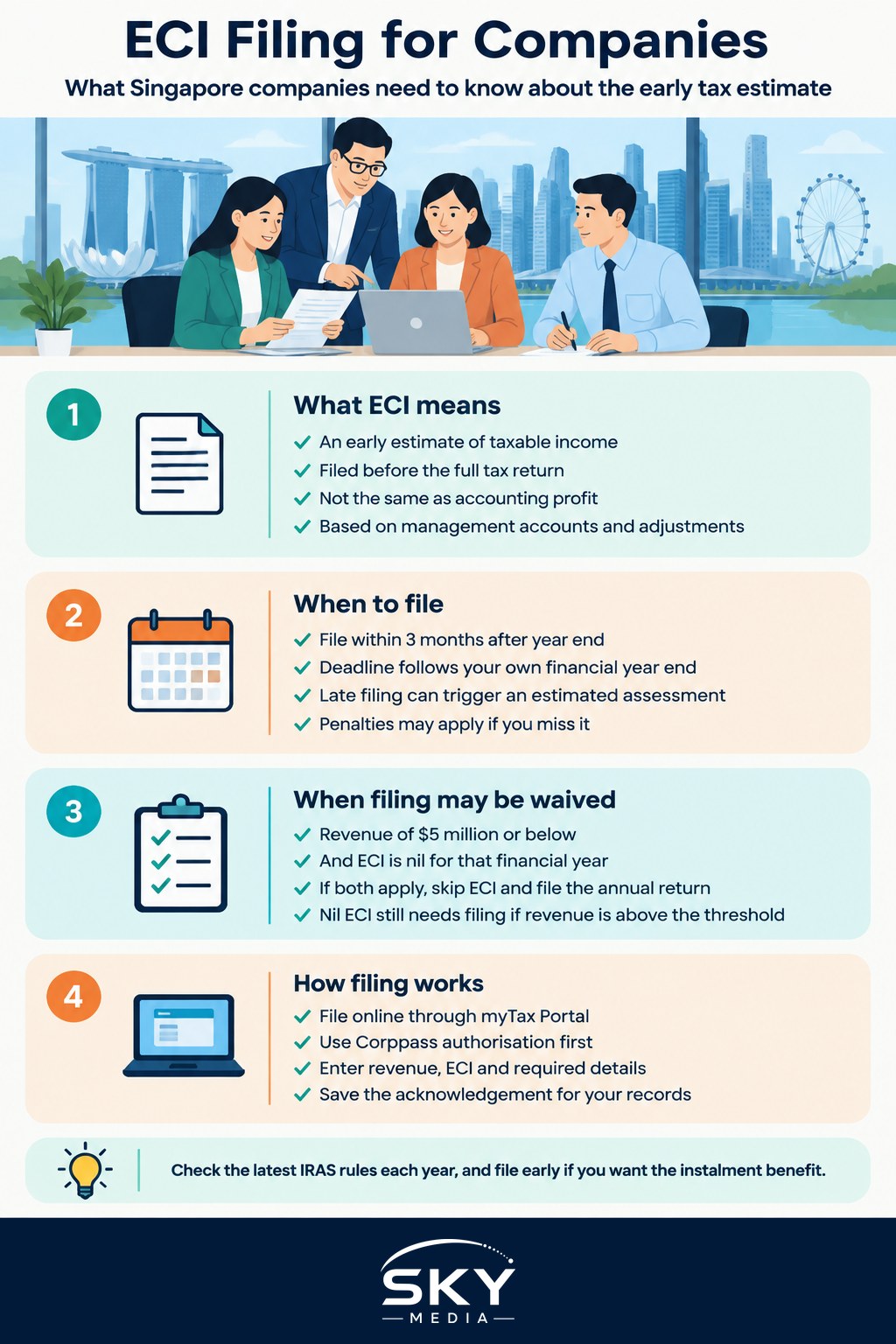
ECI is your company’s estimate of its taxable income for a Year of Assessment (YA), after deducting tax-allowable expenses but before applying exemptions such as the partial tax exemption or the start-up tax exemption. It is filed early, soon after the financial year ends, so IRAS can raise an estimated tax bill before the full return is submitted months later.
A few points that often confuse new directors:
- It is an estimate. You are not expected to have audited figures. Use your management accounts and a reasonable view of adjustments.
- It is not the same as profit. Non-deductible expenses are added back, and capital allowances and other deductions are subtracted.
- It does not replace the annual return. You still file Form C-S, Form C-S (Lite) or Form C by the usual deadline. IRAS then finalises the tax and adjusts for any difference.
The ECI Deadline
A company must file its ECI within three months from the end of its financial year. The deadline depends on your own financial year end, not a single calendar date for everyone. For example, a company with a financial year ending 31 December files ECI by 31 March of the following year, while one ending 30 June files by 30 September.
If you miss the deadline and the waiver below does not apply, IRAS may issue an estimated Notice of Assessment based on its own view of your income. You must pay the tax on that notice even if you disagree, and then object or file your actual figures. Penalties can also apply for late filing. It is far easier to file on time.
When You Do Not Need to File ECI
IRAS grants an administrative concession that waives ECI filing for companies meeting both of these conditions for the financial year:
- Annual revenue is $5 million or below, and
- ECI is nil.
If your company qualifies, you simply skip ECI and file the annual return as normal. If it does not qualify on either count, for example revenue is low but you expect taxable income, you must file.
Other points to note:
- Newly incorporated companies follow the same deadline rules once their first financial year ends. Check the IRAS guidance for new companies, as some groups may receive reminders while others do not.
- Dormant companies may have separate arrangements. Check IRAS guidance on dormant companies and whether a waiver of return filing applies.
- A nil ECI still counts. If your revenue is above the threshold, you must file even when your estimate is zero.
Because thresholds can change, check the current concession on the IRAS website each year rather than assuming last year’s rule still applies.
How to File ECI Step by Step
ECI is filed online through myTax Portal, the IRAS online services portal.
- Set up Corppass authorisation. Corppass is the government’s corporate login. Your company’s Corppass administrator must authorise the person filing for the relevant IRAS e-service, as an approver or preparer.
- Prepare your figures. You will need revenue for the financial year and your estimated chargeable income. Tax agents often prepare a short tax computation to arrive at the figure.
- Log in to myTax Portal with Corppass and select the ECI filing option under the company’s corporate tax services.
- Enter the details. Confirm the financial period, enter revenue and ECI, and for some companies, additional items IRAS asks for.
- Submit and save the acknowledgement. Keep a copy for your records and for your auditor or accountant.
If your circumstances change before IRAS issues the final assessment, you can usually file a revised ECI through the same portal. Check IRAS guidance on when revisions are still accepted.
GIRO Instalments: Why Filing Early Pays
One of the biggest benefits of filing ECI early is cash flow. If your company pays corporate tax by GIRO (an interbank direct debit), IRAS offers interest-free instalments on the tax from ECI, and the number of instalments depends on how soon after the financial year end you file.
| When ECI is filed after financial year end | Instalments available by GIRO | Practical effect |
|---|---|---|
| Within the first month | Up to 10 | Smallest monthly payments, best for cash flow |
| In the second month | Up to 8 | Moderate monthly payments |
| In the third month (by the deadline) | Up to 6 | Larger monthly payments |
| After the deadline, or not via ECI | No ECI instalment benefit | Tax payable under normal terms of the assessment |
These instalment arrangements are set by IRAS and can be revised, so confirm the current number of instalments on the IRAS website before relying on them. A few practical points:
- Set up GIRO before you file, or the instalment benefit may not apply.
- Instalments generally apply only to tax raised on ECI, not to additional tax assessed later when the final return is processed.
- Missing a GIRO deduction can cause the plan to be cancelled and the full balance to become due, so keep enough funds in the bank account.
Getting the Estimate Right
Underestimating to reduce today’s bill tends to backfire: the balance arrives later as additional tax, without the instalment benefit, and IRAS may question large differences. Overestimating ties up cash unnecessarily, although the excess is refunded or set off after the final assessment.
Good habits:
- Close the books promptly after year end so ECI is based on real numbers.
- Add back non-deductible items such as certain entertainment, private car or fine-related expenses, following IRAS rules.
- Apply exemptions correctly. ECI is reported before exemptions, but you should understand how they will reduce the final tax.
- Align with your annual compliance calendar. ECI sits alongside ACRA annual filing and your annual general meeting obligations, and the dates cluster after year end.
For the wider compliance picture, see our guides to ACRA annual filing and compliance and AGM rules and exemptions for private companies. If you are new to Singapore tax generally, filing your taxes online with IRAS explains the myTax Portal basics.
A Simple ECI Checklist
- Note your financial year end and the three-month ECI deadline in your calendar
- Check whether the revenue and nil ECI waiver applies
- Confirm Corppass authorisation for the person filing
- Set up GIRO for corporate tax if you want instalments
- Prepare a reasonable estimate with your accountant or tax agent
- File early, ideally within the first month, and save the acknowledgement
- Diary the Form C-S, Form C-S (Lite) or Form C deadline that follows
Explore more: ACRA Annual Filing and Compliance · AGM Rules and Exemptions for Singapore Private Companies · Filing Your Taxes Online With IRAS
Official sources: IRAS
Further reading: Choosing Between Form C-S, Form C-S (Lite) and Form C