

Many small business owners assume every company in Singapore must hold a formal annual general meeting each year. That is no longer always true. The AGM requirement for a Singapore private company has a number of exemptions and opt-outs, and knowing which apply can save time while keeping you compliant.
This guide looks closely at when an AGM is required and how a private company can avoid holding one. It is general information, not legal advice. The Accounting and Corporate Regulatory Authority (ACRA), which administers the Companies Act and the Bizfile portal, is the authority on current requirements. Check ACRA’s website, or speak to your company secretary or a professional adviser, before relying on any exemption.
What an AGM Is and Why It Exists
An annual general meeting is a yearly meeting of a company’s members, meaning its shareholders. Traditionally, it is where:
- the financial statements are laid before the shareholders;
- directors are re-elected where the constitution requires it;
- auditors are appointed or re-appointed, where the company needs an auditor; and
- shareholders can question the directors about the company’s performance.
For a small private company, where the shareholders and directors are often the same few people, a formal meeting can feel like paperwork for its own sake. That is why the Companies Act gives private companies flexibility.
When a Private Company Must Hold an AGM
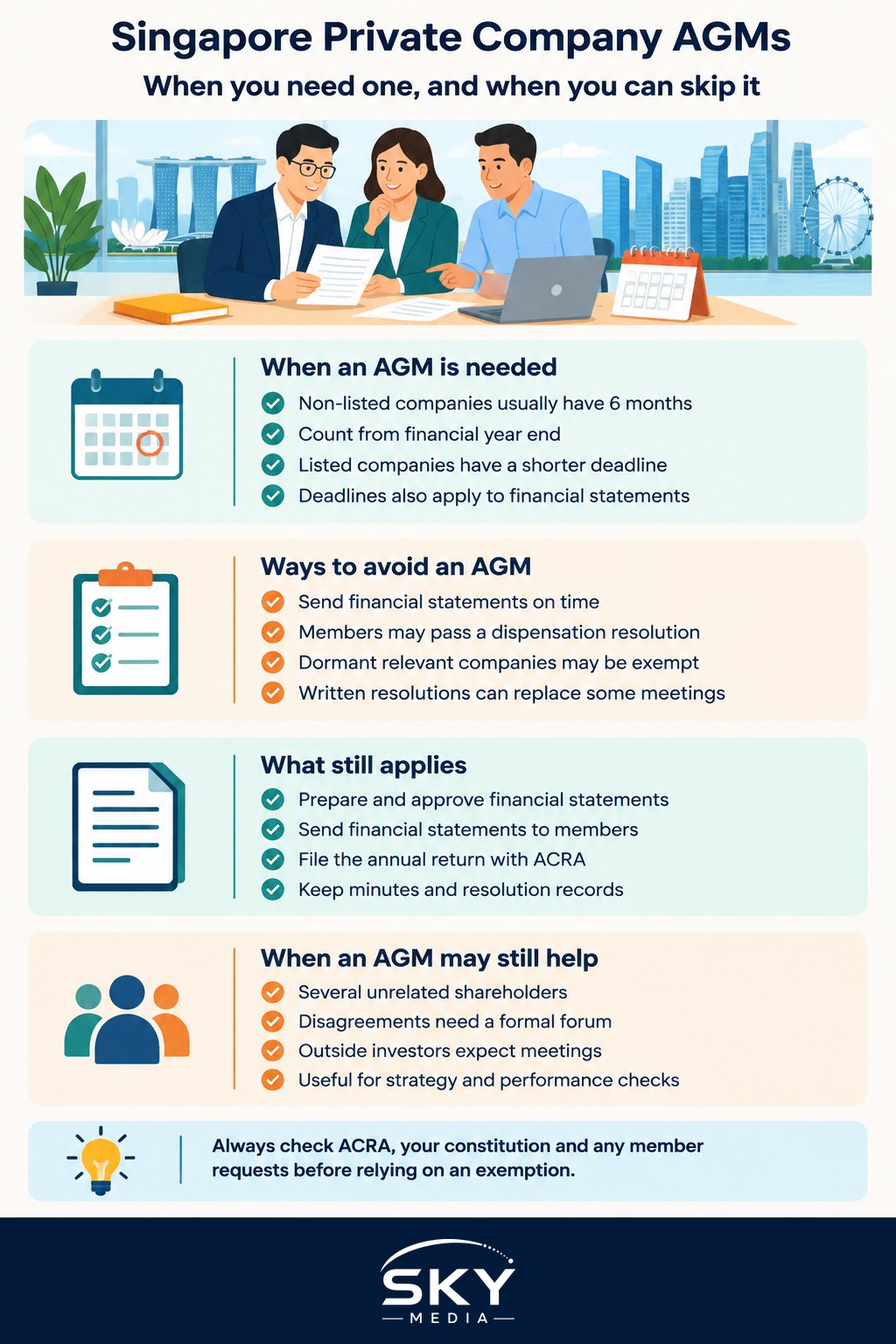
As a starting point, a company that has not used one of the exemptions or dispensations below must hold an AGM within the time limit set by the Companies Act, counted from the end of its financial year. For non-listed companies, this is generally within six months of the financial year end. Listed companies have a shorter deadline.
The financial statements presented at the AGM must also meet timing rules. Missing these deadlines can lead to penalties for the company and its directors, so check ACRA’s current timelines.
The Main Exemptions and Opt-Outs
There are several routes for a private company to avoid holding an AGM. This table compares the main ones.
| Route | How it works | Key conditions | Can a shareholder still ask for an AGM? |
|---|---|---|---|
| Automatic exemption by sending financial statements | No AGM needed if financial statements are sent to members within the time allowed after the financial year end | Applies to private companies that meet the timing for sending financial statements | Yes, within the time limits set by the Act |
| Dispensing with AGMs by resolution | Members pass a resolution to dispense with AGMs, which applies until revoked | Generally needs the agreement of all members entitled to attend and vote | Yes, a member can give notice requiring an AGM in a given year |
| Dormant relevant company exemption | Certain dormant private companies are exempt from holding AGMs | Must meet ACRA’s definition of a dormant relevant company | Yes, in limited circumstances |
| Written resolutions in place of meetings | Specific decisions are passed in writing rather than at a meeting | Must follow the Companies Act and the constitution | Not applicable in the same way |
Automatic exemption by sending financial statements
Following amendments to the Companies Act, a private company is not required to hold an AGM if it sends its financial statements to all members within a set period after the end of its financial year. Members can still ask for an AGM by giving notice within the time limits in the Act, and the company must then hold one. This is the simplest route for many small companies, provided the accounts are ready on time.
Dispensing with AGMs by resolution
A private company can also choose to dispense with AGMs altogether by passing a resolution. Under the Companies Act this generally requires the agreement of all members entitled to attend and vote at a general meeting. Once passed, the dispensation applies to the year of the resolution and later years, until it is revoked.
Even after a dispensation, the company must still send financial statements to its members within the required time, and any member can require an AGM for a particular year by giving notice within the time allowed. The resolution can be revoked, after which AGMs resume.
Dormant companies
Dormant private companies that meet ACRA’s definition may also be exempt from holding AGMs. If your company is not trading, read our guide to dormant company requirements for the broader picture.
What Still Applies Without an AGM
Skipping the AGM does not mean skipping compliance. Several obligations remain:
- Financial statements still need to be prepared, approved by the directors and, where required, audited. Small companies may qualify for an audit exemption, but that is a separate test.
- Financial statements must be sent to members within the required time.
- The annual return must still be filed with ACRA through Bizfile, within the time limit counted from the financial year end. For private companies that are exempt from AGMs, the annual return deadline is linked to the financial year end rather than to a meeting date.
- Tax filings with IRAS continue as normal and are separate from ACRA obligations.
- Minutes and records of resolutions, including the dispensation resolution, should be kept in the company’s records.
How to Dispense With AGMs Step by Step
If all shareholders agree that AGMs are not needed, the process is usually straightforward:
- Check your constitution. Some company constitutions contain specific provisions on meetings. Make sure nothing in yours conflicts with the plan.
- Prepare the resolution. Your company secretary can draft a resolution to dispense with AGMs.
- Get all members’ agreement. This is commonly done by written resolution signed by all members entitled to vote.
- Record it properly. File the signed resolution with the company’s records and, where ACRA requires notification, lodge it through Bizfile.
- Diarise your remaining deadlines. Set reminders for sending financial statements and filing the annual return each year.
When Holding an AGM Is Still a Good Idea
An exemption does not mean an AGM is pointless. Consider holding one if:
- you have several unrelated shareholders who value a regular forum to question directors;
- there are disagreements among shareholders and a formal meeting helps keep decisions transparent;
- you have outside investors whose shareholder agreement expects formal meetings; or
- you want a regular checkpoint to review strategy and performance together.
Business owners who also own property may know the residential version, the MCST AGM. Our guide to attending your MCST AGM covers that different kind of meeting.
Common Mistakes to Avoid
- Assuming exemption without checking. Each route has conditions. Confirm which one you are relying on.
- Forgetting the annual return. No AGM does not mean no filing.
- Not getting every member’s agreement for a dispensation resolution, where it is required.
- Losing track of member requests. If a shareholder validly asks for an AGM, the company must hold one.
- Missing financial statement deadlines, which can take away the automatic exemption.
Getting It Right From the Start
If you are setting up a new company, think about meeting arrangements early. Our guide on how to register a company in Singapore covers the incorporation steps, and your company secretary can advise on whether to dispense with AGMs from the outset. The AGM requirement for a Singapore private company is flexible, but only if you follow the rules. Check ACRA’s website for the current position each year.
Frequently Asked Questions
Does a company with only one shareholder still need an AGM? The same exemption and dispensation routes apply, and with a single member the agreement needed for a dispensation is easy to obtain. Do not assume you can ignore the rules, though. Annual returns and financial statements obligations remain. Check with ACRA or your company secretary.
What happens if a company misses its AGM or filing deadline? The company and its directors can face penalties, and late filings can build up. Prompt action is better than waiting. Check ACRA’s current penalties and timelines, and speak to your company secretary if you have already missed a date so you can fix it.
Does being exempt from audit also exempt me from the AGM? No, they are separate tests. Audit exemption concerns whether your financial statements need to be audited, while AGM exemption concerns whether you must hold a meeting. A company may need to satisfy one, both or neither. Confirm each condition separately with ACRA.
Can a private company hold its AGM online? Often yes, provided the company’s constitution and the Companies Act allow electronic meetings. Read your constitution for provisions on how meetings are held and how notice is given. If it is silent or unclear, ask your company secretary about amending it.
What do I need to prepare if my company does hold an AGM? At minimum, prepare the financial statements, a proper notice of meeting and any resolutions for approval, such as re-electing directors or appointing an auditor. Keep minutes of what is decided. Your company secretary can usually handle these and make sure the notice period is correct.
Official sources: ACRA
Further reading: How to Apply for an ACRA Extension of Time for Your AGM or Annual Return