

If you run a Singapore company, your annual return is not just a form. For many companies it also has to carry the financial statements in a machine-readable format called XBRL. Getting XBRL filing in Singapore right is a separate skill from preparing the accounts themselves, and it is where many small directors get stuck the first time. This guide explains what XBRL is, which companies have to use it, how the simplified template differs from a full XBRL file, and how to prepare a clean submission.
This is general information, not legal or accounting advice. The Accounting and Corporate Regulatory Authority (ACRA) updates its filing rules from time to time, so always confirm the current requirements on the ACRA website before you file.
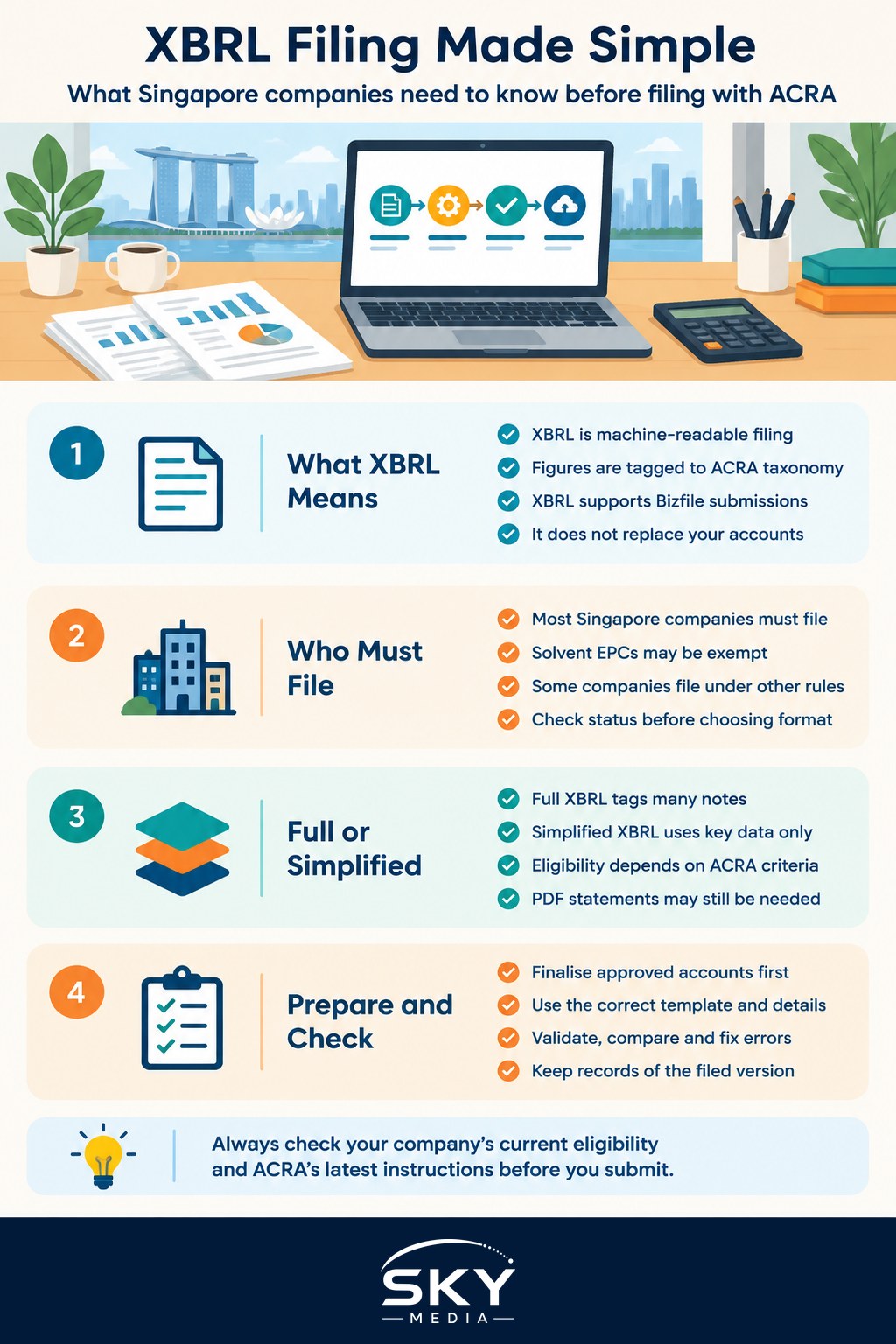
What XBRL Actually Is and Why ACRA Uses It
XBRL stands for eXtensible Business Reporting Language. Instead of uploading a PDF that a person has to read, the company submits its numbers with each figure “tagged” against a standard list of items, called a taxonomy.
ACRA uses XBRL so it can analyse filings at scale, compare companies and make financial information available to the public and to other agencies in a consistent form. For you, the practical effect is that your accounts have to be mapped line by line into ACRA’s taxonomy before they can be filed through Bizfile, ACRA’s online filing portal.
XBRL does not replace your financial statements. You still prepare and approve them as usual, and the XBRL figures must match the approved statements exactly. The XBRL file is then attached to the annual return.
For the bigger picture of what the annual return involves, see our guide to ACRA annual filing and compliance.
Which Companies Must File in XBRL
As a broad rule, Singapore-incorporated companies that are limited or unlimited by shares are expected to file financial statements in XBRL with their annual return. The main categories that are commonly exempt or treated differently include:
- Solvent exempt private companies (EPCs). An exempt private company is a private company with no corporate shareholders and no more than 20 members. If it is solvent, it is generally not required to file financial statements with ACRA at all, though it may choose to do so. An insolvent EPC is in a different position and must file.
- Companies limited by guarantee. These are typically charities, clubs and associations, and they file under separate arrangements.
- Certain regulated entities, such as banks and insurers supervised by the Monetary Authority of Singapore (MAS), which may be allowed to file in a different format.
- Foreign companies registered in Singapore as branches, which follow their own filing rules.
The exact exemptions, and any conditions attached to them, are set out by ACRA. Check your company’s status carefully before assuming you can skip XBRL, because filing the wrong format can lead to a rejected or late annual return, and late filing attracts penalties.
Full XBRL Versus the Simplified Template
ACRA does not expect every small trading company to tag every note in its accounts. Over the years it has introduced lighter options so that smaller companies can comply without specialist help. In general terms there are two levels.
Full XBRL means the main financial statements and a wide range of notes are tagged in detail. This is the standard expectation for companies that do not qualify for a lighter option.
Simplified XBRL is a reduced set of data that eligible companies can file. It focuses on key figures such as the statement of financial position, income statement and selected key information, rather than every disclosure in the notes. Eligibility is decided by ACRA’s criteria, which have historically looked at factors like the company’s size and whether it is a listed or publicly accountable entity. Because those criteria can change, check the current conditions on ACRA’s website rather than relying on an old checklist.
Here is a quick side-by-side to help you decide which path to look into:
| Point of comparison | Full XBRL | Simplified XBRL |
|---|---|---|
| Who it suits | Larger companies and those not eligible for lighter filing | Smaller companies that meet ACRA’s current eligibility criteria |
| What gets tagged | Primary statements plus many detailed notes | Primary statements and a limited set of key data |
| Effort and cost | Higher, often handled by accountants or XBRL specialists | Lower, often manageable by a company secretary or bookkeeper |
| Risk of tagging errors | Higher, because of the volume of elements | Lower, but figures must still match the approved accounts |
Even when you file a simplified XBRL set, ACRA may also require the full financial statements to be attached in PDF so that the notes are still available. Check the current instructions for your situation.
How to Prepare Your XBRL File Step by Step
ACRA provides a free preparation tool, known as BizFinx at the time of writing, that guides you through templates and validates your file before submission. Commercial XBRL software is another option. Either way, the workflow looks broadly like this:
- Finalise and approve the financial statements first. Never start tagging from draft numbers. Changes after tagging are the most common cause of mismatches.
- Pick the correct template. Choose full or simplified based on your eligibility, and the correct financial reporting framework.
- Enter company and filing information. This includes the company’s Unique Entity Number (UEN), the financial year dates, the currency and the level of rounding used in the accounts.
- Map each line item. Match your statement lines to the closest element in the taxonomy. If your accounts group items differently, follow ACRA’s guidance on how to map them rather than inventing a new label.
- Run validation. The tool checks for errors, such as totals that do not add up or mandatory fields left blank, and warnings, which you should read and resolve where they apply.
- Review against the PDF. Print or view the rendered output and tick it against the signed statements, line by line.
- Upload with the annual return on Bizfile. The person filing, usually a director, company secretary or authorised filing agent, attaches the XBRL file during the annual return transaction.
If you want to understand the numbers you are tagging, our guide on how to read your financial statements is a useful primer.
Common Mistakes That Get Filings Rejected
Most problems are avoidable with a little care:
- Wrong rounding or currency. If your accounts are in thousands, the XBRL must say so. A slip here can make your revenue look a thousand times larger or smaller.
- Signs flipped. Expenses and losses are often entered with the wrong positive or negative sign. The validation tool catches some, but not all.
- Mismatched comparatives. Prior-year figures must match the prior-year column in the approved statements, including any restatements.
- Choosing the wrong template. Filing simplified XBRL when the company is not eligible can lead to a request to refile.
- Leaving it to the last week. XBRL takes longer than expected, especially the first year.
Who Should Do the Filing
A small company with simple accounts can often prepare simplified XBRL using ACRA’s free tool. Once your accounts include group structures, leases or complex financial instruments, it is usually worth engaging your accountant or corporate secretarial firm.
Whoever prepares it, the directors remain responsible for what the company files. Keep a copy of the validated XBRL file, the signed statements and the filing acknowledgement in your company records.
If you are setting up a new company and want to plan ahead for these obligations, see our guide to registering a company with ACRA in Singapore.
Quick Checklist Before You Submit
- Financial statements approved and signed by the directors
- Company eligibility for full or simplified XBRL confirmed on ACRA’s site
- Correct template, currency, rounding and financial year dates
- Validation run with all errors cleared and warnings reviewed
- XBRL output checked line by line against the signed accounts
- Annual return details ready on Bizfile, with the filing deadline noted
Official sources: ACRA
Further reading: How to Apply for an ACRA Extension of Time for Your AGM or Annual Return