
Getting your child into school is one of the more stressful parts of relocating, partly because the process depends heavily on your family’s residency status and partly because timing matters more than people expect. This guide focuses on the enrolment process itself, the practical steps to secure a place, rather than a general overview of school types. Knowing which pathway applies to you, and starting early, makes all the difference.
Rules, dates and eligibility are set by the authorities and change from year to year, so use this as a general overview and confirm current details with the Ministry of Education (MOE), the Early Childhood Development Agency (ECDA) and the Immigration and Checkpoints Authority (ICA).
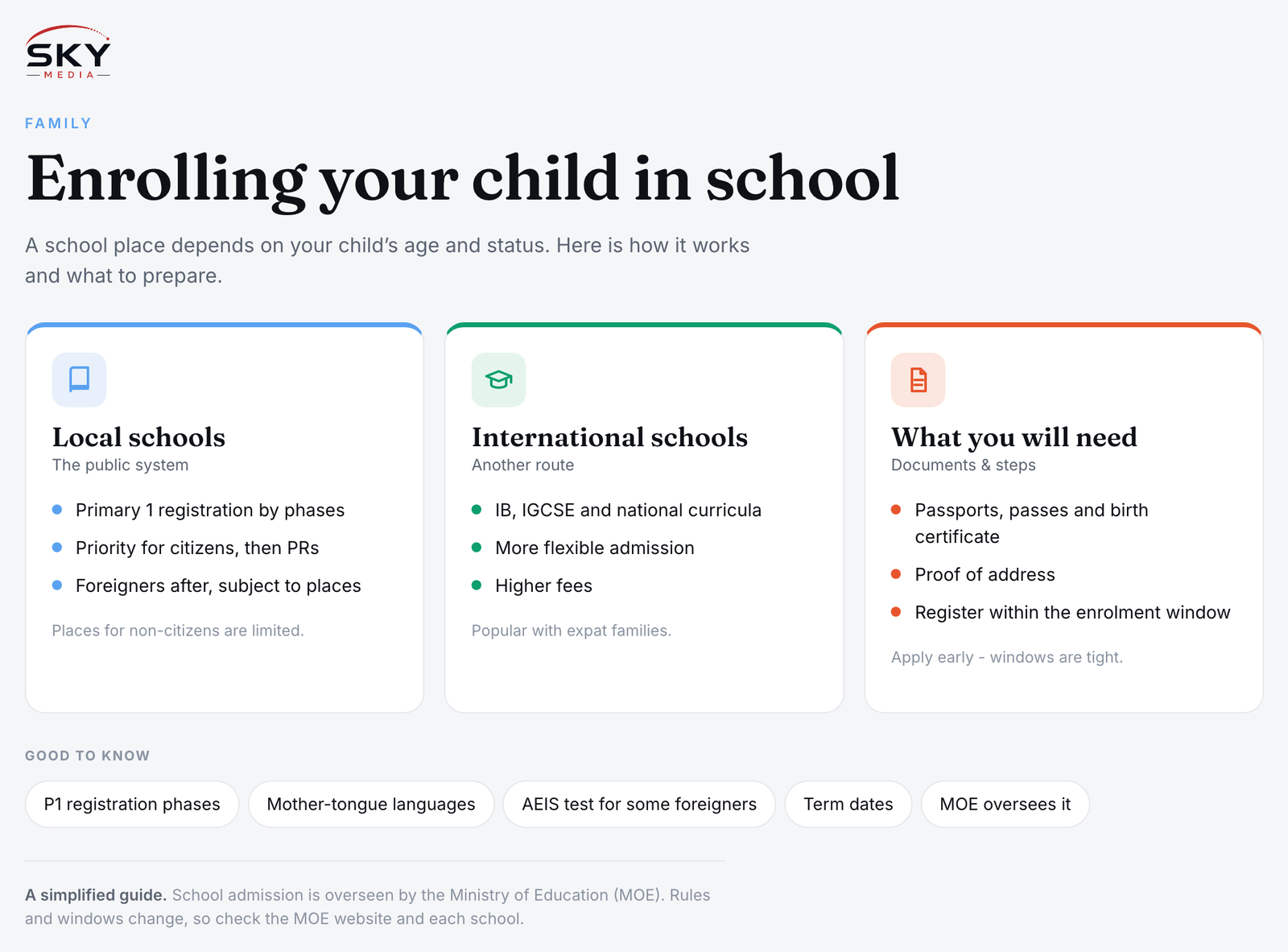
The school year starts in January
One thing shapes all your planning: the Singapore school year begins in January, not in the autumn as in many countries. If you arrive mid-year, your child may need interim arrangements before joining at the start of the next school year, or you may look to schools with rolling admissions, which are more common in the international sector. Build this timing into your relocation plan so you are not caught out.
Your pathway depends on residency
The single biggest factor is whether your child is a citizen, a Permanent Resident or a foreigner.
- Citizens and Permanent Residents access government schools through MOE’s registration exercise, which runs in phases with priority rules based on factors such as siblings and residence.
- Foreigners generally have two routes: apply to international or private schools, which handle their own admissions, or sit a centralised test to compete for a place in a government school.
Understanding which lane you are in tells you exactly what to do next.
For foreigners: the AEIS
To join a government primary or secondary school, foreign children usually sit the Admissions Exercise for International Students, known as the AEIS. It is a centralised test, typically covering English and mathematics, used to assess readiness and place students at a suitable level. Key points:
- The AEIS is held at set times of the year, with a supplementary exercise, sometimes called the S-AEIS, at another point. Check the current schedule with MOE.
- A place is not guaranteed, since it depends on performance and availability.
- Preparation matters, as the test has a defined format and standard.
Because of the fixed timing and the competitive nature, many families explore international schools in parallel as a reliable option, especially if they arrive mid-year or want continuity with a particular curriculum.
International and private schools
International schools set their own admissions processes, curricula and calendars, and often have places available at various points in the year. They are popular with globally mobile families for their flexibility and familiar curricula, though fees are typically high. If you go this route:
- Apply early, as sought-after schools maintain waiting lists.
- Prepare past school reports and records, which many will request.
- Check the curriculum and how it aligns with where you might move next.
For younger children: preschool via ECDA
If your child is below school-going age, you are looking at preschools and childcare centres rather than primary school. These are regulated by ECDA, and enrolment is handled directly with individual centres. Popular centres fill up, so:
- Start looking well before you need a place.
- Visit a few centres to compare approach, hours and location.
- Ask about waiting lists and enrolment steps.
Documents you will typically need
Whichever pathway applies, prepare:
- Your child’s passport and pass or Dependant’s Pass details.
- The child’s birth certificate.
- Past school records and report cards, ideally in English or with translations.
- Immunisation and health records.
- Proof of your residential address in Singapore.
A Student’s Pass is generally required for a foreign child studying here, and this is arranged with ICA, often coordinated by the school once a place is offered.
Pathways at a glance
| Your child’s status | How to enrol | Key step |
|---|---|---|
| Citizen or PR | MOE registration exercise for government schools | Register in the correct phase |
| Foreigner, government school | Compete for a place via a centralised test | Sit the AEIS or S-AEIS |
| Foreigner, private route | Apply directly to international or private schools | Apply early, submit records |
| Below school age | Enrol at a preschool or childcare centre | Register with an ECDA-regulated centre |
Start early, plan for timing
The two lessons that matter most are simple. First, identify your pathway based on residency, because it dictates every other step. Second, respect the calendar. With a January school year, fixed AEIS windows, and waiting lists at popular schools, early action is what secures a place. If you are arriving mid-year, line up an interim plan so your child keeps learning while you work towards the right long-term school.
It can feel daunting, but thousands of families do this every year. Get organised, gather your documents, and reach out to schools and the relevant authorities sooner rather than later. Your child will be settled in a classroom before you know it.
Common mistakes that cost families a place
Most enrolment problems are not about ability, they are about timing and paperwork. Knowing where other families slip up helps you sidestep the same traps and keep your options open.
- Leaving documents to the last minute: report cards and health records from an overseas school can take weeks to request, and official translations add more time. Start gathering these before you fly, not after you land.
- Assuming a test place is a school place: sitting the AEIS is only the first step. Even a strong result leads to a posting based on available vacancies, which may not be your nearest school, so stay flexible on location.
- Betting on a single option: families who apply to just one school, or rely solely on the government route, can be left stranded if a place does not come through. Running a private or international application in parallel gives you a fallback.
- Overlooking pass validity: your child usually needs a Student’s Pass to study here, and the timing has to line up with your own pass and the school’s offer. Confirm the current sequence with ICA and the school so there is no gap.
- Ignoring the mid-year gap: if you arrive after January, a term or two without a confirmed school is common. Line up tutoring, an online programme or a short-term place so learning does not stall.
How to choose the right route for your family
Once you know your pathway by residency, the harder question is often which type of school actually suits your child. Rather than defaulting to the most familiar option, weigh a few practical factors before you commit.
Think first about how long you expect to stay. If Singapore is a long-term or permanent move, a government school (via the registration exercise for citizens and PRs, or the AEIS for foreigners) can offer stability and lower fees. If your posting is short or you may relocate again, an international school with a portable curriculum such as the IB or a national system you recognise can make the next move smoother.
Next, consider your child’s age, language background and how quickly they adapt. A younger child often settles into a new system readily, while an older student close to major examinations may benefit from continuity with the curriculum they have already been following. Weigh commute and location too, since a shorter daily journey can matter more than a school’s reputation. Finally, be honest about budget: international school fees are typically high and can rise each year, so ask each school for its full current fee schedule, including registration, deposit and miscellaneous charges, and check what support is offered for children still building their English. When in doubt, confirm eligibility and current requirements directly with MOE, ECDA and ICA before you decide.
Explore more: School types in Singapore · Dependant’s Pass and family guide · Moving to Singapore checklist