

If your bank has mentioned an “EFS loan” while you were asking about business financing, it is referring to the Enterprise Financing Scheme, a government-supported programme run by Enterprise Singapore. An enterprise financing scheme loan is still a normal bank loan that you repay with interest, but the government shares part of the default risk with the lender. That risk-share is what makes banks more willing to lend to smaller and younger companies that might otherwise struggle to get credit.
This guide focuses on how EFS works and on its three most commonly used categories for SMEs: working capital, trade and fixed assets. For a wider look at every type of business borrowing, see our overview of business loans and financing in Singapore.
This is general information, not financial advice. Loan caps, risk-share percentages and eligibility criteria are set by Enterprise Singapore and are adjusted from time to time, so always check the current details on the Enterprise Singapore website and with your bank.
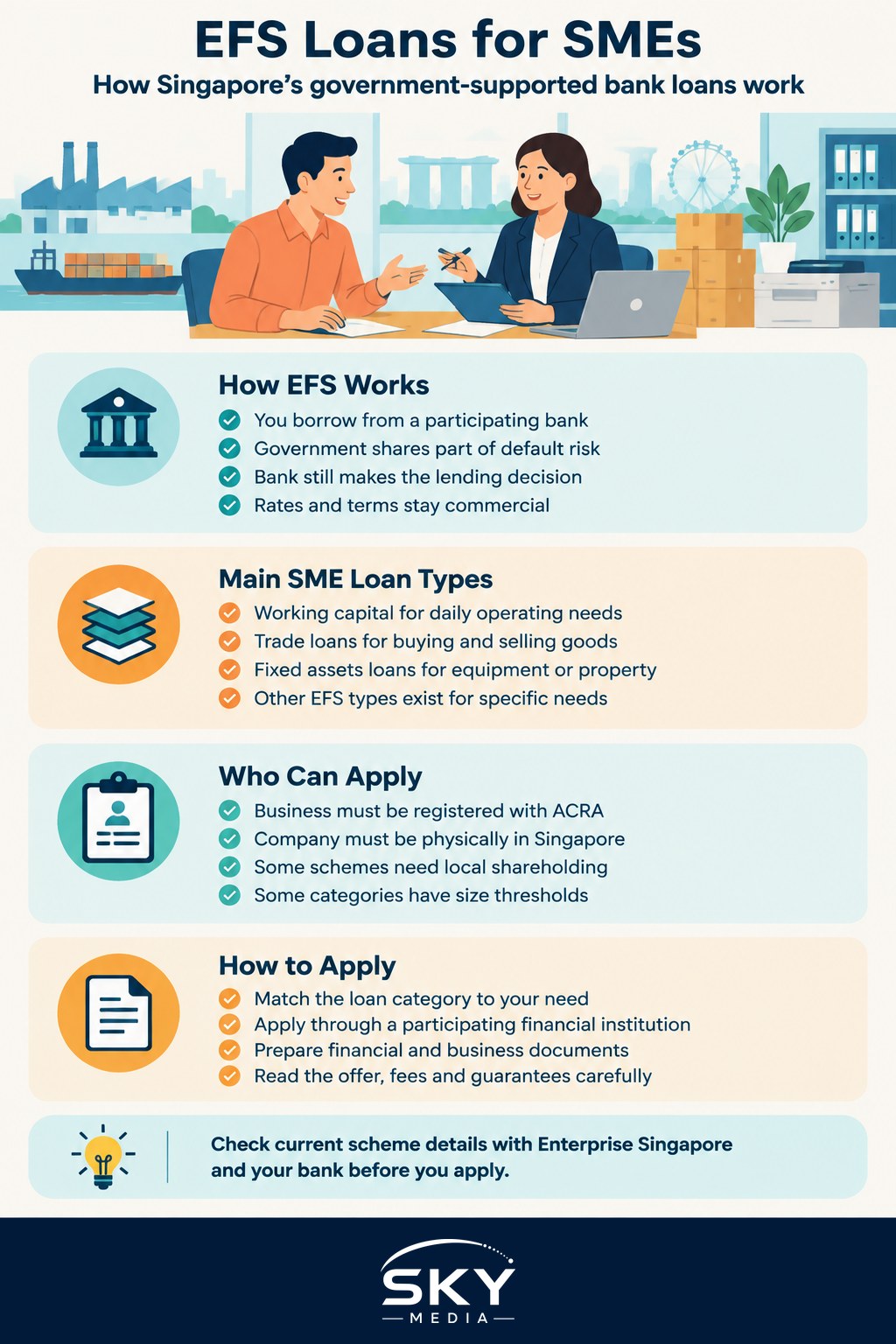
How the Government Risk-Share Works
Under EFS, you do not borrow from the government. You borrow from a participating financial institution (PFI), which is a bank or finance company that has signed up to the scheme. Enterprise Singapore then agrees to share a portion of the loss with the PFI if the borrower defaults.
What this means in practice:
- The bank decides. The PFI does its own credit assessment and decides whether to lend, how much and on what terms.
- The bank sets the interest rate. Rates are commercial and differ between lenders, so it pays to compare.
- You still owe the full amount. The risk-share protects the bank, not you. If your company defaults, the lender can still pursue repayment, including under any personal guarantee you signed.
- Risk-share levels vary. The share Enterprise Singapore takes on differs by loan category and has been changed over time, sometimes with higher support for young companies or during periods of economic stress.
Because the bank carries less risk, an EFS-backed loan may be easier to obtain, or available on better terms, than an unsupported loan of the same size. It is not guaranteed approval.
The Three Core Categories for SMEs
EFS is organised into several categories, each with its own purpose and limits. The three most relevant to everyday SME needs are:
| EFS category | What it funds | Typical use | Repayment pattern |
|---|---|---|---|
| SME Working Capital Loan | Day-to-day operating needs | Payroll, rent, inventory, bridging slow-paying customers | Term loan repaid in instalments |
| Trade Loan | Domestic and international trade activities | Paying suppliers, inventory for orders, trade financing instruments | Short-term, tied to trade cycles |
| SME Fixed Assets Loan | Purchase or upgrade of physical assets | Machinery, equipment, factory or commercial property for operations | Longer tenure matched to asset life |
There are also other EFS categories aimed at specific needs, such as venture debt for high-growth startups, project financing for overseas projects, mergers and acquisitions, and green loans. Check the Enterprise Singapore website for the current list.
SME Working Capital Loan
This is the category most small businesses encounter first. It covers general operating cash flow: paying staff, rent and suppliers while waiting for customers to pay. It is usually unsecured, which is why banks commonly ask directors for personal guarantees. It suits businesses with steady revenue that need a buffer, not businesses that are covering ongoing losses with no plan to recover.
Trade Loan
Trade financing helps when you must pay suppliers before your customers pay you. This can cover inventory and receivables financing as well as trade instruments such as letters of credit, depending on the bank’s products. Trade loans are often short-term and revolving, so they fit importers, exporters, distributors and companies with large purchase orders.
SME Fixed Assets Loan
Fixed assets loans fund equipment, machinery and, in some cases, property used for business operations. Because the assets last years, the repayment period is longer. The asset itself may serve as security, which can make the bank more comfortable.
Who Is Eligible
Eligibility rules differ by category and are updated periodically. The commonly applied criteria cover:
- Registration and presence. The business must be registered with ACRA (the Accounting and Corporate Regulatory Authority) and physically present in Singapore.
- Local shareholding. A minimum share of the company must be held by Singapore citizens or PRs.
- Company size. Some categories, particularly the SME Working Capital Loan, are limited to businesses below a group revenue or employee threshold.
Check the exact thresholds on the Enterprise Singapore website, because they matter for whether your business fits a particular category.
How to Apply
You apply through a PFI, not to Enterprise Singapore directly. The usual process looks like this:
- Decide what you need the money for. Matching the purpose to the right category makes the conversation with the bank faster.
- Approach one or more PFIs. The list of participating institutions is published by Enterprise Singapore. Your existing business bank is a sensible first stop, but compare offers.
- Prepare documents. Expect to provide financial statements, bank statements, management accounts, ACRA business profile, tax filings and details of directors and shareholders. For trade or asset loans, add invoices, contracts or quotations.
- Credit assessment. The bank reviews your cash flow, track record and repayment ability.
- Offer and acceptance. Read the letter of offer carefully, including interest rate, fees, tenure, guarantees and early repayment terms.
Some businesses use the GoBusiness portal to explore government assistance, but the loan application itself is completed with the lender.
Questions to Ask Before You Sign
- What is the effective interest rate, including processing and other fees?
- Is a personal guarantee required, and from whom?
- Is there a penalty for early repayment?
- Can the facility be restructured if cash flow tightens?
- How does this loan affect your ability to borrow more later?
If you are also investing in innovation activities, government tax incentives such as the Enterprise Innovation Scheme (EIS) tax deductions can work alongside financing. They are separate programmes with their own rules.
Common Mistakes to Avoid
- Borrowing the maximum by default. Take what the plan needs, not what is offered.
- Using a working capital loan for long-term assets. Short tenures on long-lived assets squeeze cash flow.
- Ignoring the personal guarantee. Directors can be personally liable, so understand the exposure before signing.
- Not keeping records up to date. Lenders rely on clean, current accounts. Late filings slow everything down.
An EFS loan can be a useful bridge for an SME with a sound plan. Treat the government risk-share as a door opener, not a safety net, and confirm current scheme terms with Enterprise Singapore and your bank before committing.
Frequently Asked Questions
Can a newly set-up company or start-up apply for an EFS loan? Eligibility depends on the category and the bank’s own credit assessment, so a new company may find it harder without a track record. Young companies are sometimes given extra consideration, so check current criteria with Enterprise Singapore. Prepare a clear plan and projections.
What should I do if my EFS loan application is rejected? Ask the bank for the main reasons, then fix the gaps, such as updating accounts or reducing existing debt, and consider applying to another participating lender. Compare category options too. Rejection by one bank does not decide the outcome elsewhere.
How long does it take to get approval for an EFS loan? It depends on the bank, how complete your documents are and the loan size, so there is no fixed timeline. Having updated accounts, bank statements and a clear purpose speeds things up. Ask your bank for an expected timeline when you apply.
Is an EFS loan the same as a government grant? No. A grant does not have to be repaid, while an EFS loan is a bank loan that you repay with interest and the government only shares the lender’s default risk. Check Enterprise Singapore and GoBusiness for current grants that may suit your project.
Can sole proprietorships or partnerships apply for EFS? Eligibility depends on the category and on the rules at the time, including registration with ACRA and local shareholding or ownership requirements. Check the current criteria on the Enterprise Singapore website. Your bank can also tell you whether your business structure qualifies.
Official sources: Enterprise Singapore
Further reading: Invoice Financing and Factoring for Singapore SMEs · What to Prepare Before Meeting an SME Banker