

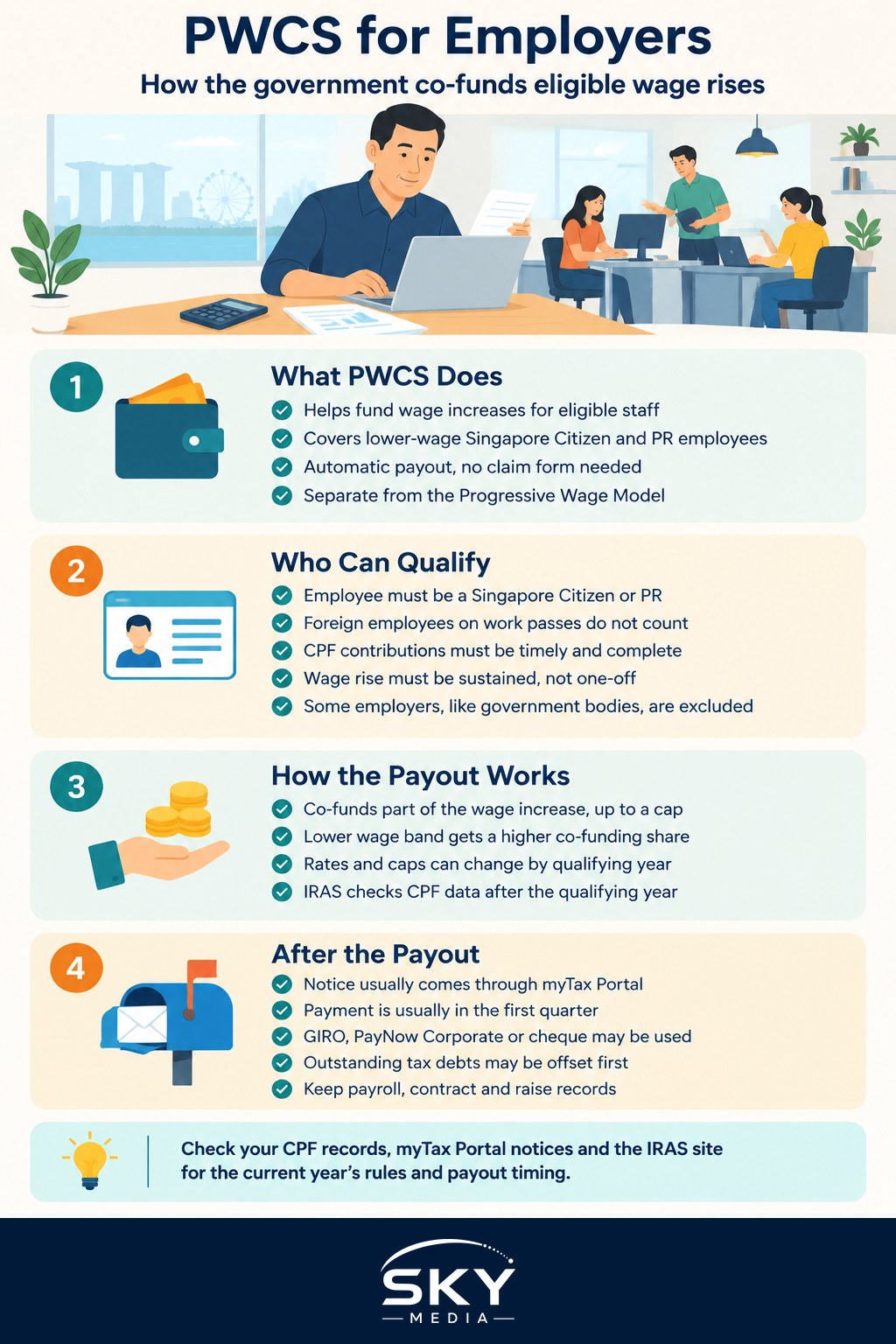
If you run a business in Singapore and you have raised the pay of your lower-wage staff, you may have received a payment from the government without filling in a single form. That payment is usually the progressive wage credit scheme (PWCS) at work. It is a time-limited government scheme that co-funds part of the wage increases employers give to lower-wage Singapore Citizen and Permanent Resident employees.
This guide explains how the scheme works from the employer’s side: who qualifies, how the co-funding tiers are structured, how the payout is calculated and paid, and what you should keep on file. It is general information, not tax or legal advice. The parameters have been adjusted in past Budgets, so always confirm the current details with IRAS (the Inland Revenue Authority of Singapore), which administers the payouts.
What the PWCS Is, and How It Differs From the Progressive Wage Model
The two names sound alike but they do different jobs.
- The Progressive Wage Model (PWM) sets mandatory wage ladders, training requirements and career progression for workers in specific sectors and occupations, such as cleaning, security and landscape. It tells employers the minimum they must pay. We cover the ladders in The Progressive Wage Model Explained.
- The Progressive Wage Credit Scheme is the money side. It helps employers absorb the cost of raising wages for lower-wage workers, whether those workers are covered by a PWM or not.
In short, the PWM is a rule you follow; the PWCS is a credit for paying more. A business outside PWM sectors can still qualify for the credit if it raises the pay of eligible lower-wage staff.
Who Qualifies: Employer and Employee Conditions
There is no application. Eligibility is worked out from the CPF contribution data you already submit each month. In broad terms, the scheme looks at:
- The employee’s status. The worker must be a Singapore Citizen or Permanent Resident. Foreign employees on work passes are not counted.
- CPF contributions. You must have made mandatory CPF contributions for the employee, and contributions must be paid on time and in full. Late or incomplete CPF payments are a common reason employers miss out.
- The employee’s gross monthly wage. The worker’s wage must fall at or below a wage ceiling set for that qualifying year. Wage ceilings have been revised over the life of the scheme, so check the figure for the year you are looking at.
- A wage increase that is sustained. The rise must be given in the qualifying year and maintained, not paid as a one-month bump and then withdrawn. The scheme compares wages across periods to confirm the increase holds.
- Length of employment. The employee generally needs to have worked for you for a minimum number of months in the comparison periods so that a genuine increase can be measured.
Some types of employers, such as government bodies, are excluded. If you are unsure whether your entity counts, IRAS publishes the full eligibility rules and a list of exclusions.
How the Co-Funding Tiers Work
The scheme does not pay the full wage rise. It co-funds a percentage of the increase, up to a cap. The key features of the structure are:
- Two wage bands. Workers on lower wages typically attract a higher co-funding percentage, while those in a higher (but still eligible) wage band attract a lower percentage.
- Percentages that change by year. The scheme was designed to taper, with co-funding generally stepping down over the qualifying years. Past Budgets have also enhanced the rates for particular years, so the percentage for one year may not match the next.
- A cap on the increase that counts. Only the wage increase up to a set amount is co-funded. Raising pay beyond that cap is still good for retention, but the extra portion will not attract more credit.
Because the percentages and ceilings are set by the government and revised, we do not quote them here. Look up the PWCS page on the IRAS website for the table that applies to your qualifying year.
A Quick Comparison: PWCS vs Related Schemes
Employers often confuse PWCS with other wage-related support. Here is how they differ in practice.
| Scheme or rule | What it is | Do you apply? | Who administers it |
|---|---|---|---|
| Progressive Wage Credit Scheme | Co-funds part of wage rises for eligible lower-wage local staff | No, payouts are automatic | IRAS, with CPF data |
| Progressive Wage Model | Mandatory wage ladders for specific sectors and jobs | Not a payout; you must comply | MOM |
| Local Qualifying Salary | Minimum pay for local staff to count towards foreign worker quotas | Not a payout; affects quota counts | MOM |
| Senior Employment Credit and similar wage offsets | Separate support tied to hiring or retaining specific groups | Usually automatic, rules differ | IRAS, with MOM |
How and When the Payout Arrives
This is the part many business owners find surprising. You do not need to submit claims. The process generally works like this:
- You pay wages and CPF as normal throughout the qualifying year, including any pay rises.
- IRAS computes eligibility after the qualifying year, using your CPF submissions to identify eligible employees and their sustained wage increases.
- You receive a notification letter, usually through myTax Portal, showing how much you are getting.
- The money is paid out, typically in the first quarter of the following year. If your business has a GIRO arrangement with IRAS for corporate tax, the payout is usually credited to that bank account. Otherwise it may be sent by PayNow Corporate (linked to your UEN, the Unique Entity Number) or by cheque.
Payout timing and channels can shift, so read the notification letter and the IRAS website for the current schedule. If you have outstanding tax debts with IRAS, the payout may be used to offset them first.
Practical Steps to Make Sure You Do Not Miss Out
Since everything runs off your CPF data, accuracy matters more than paperwork.
- Pay CPF on time and correctly. Wrong wage figures or late payments can lead to a lower payout or none at all for an employee.
- Report wages under the right categories. Ordinary wages and additional wages, such as bonuses, are treated differently. A bonus is not the same as a sustained rise in monthly pay.
- Plan raises as permanent changes. Build increases into the employee’s contract or salary record so they are clearly sustained.
- Link PayNow Corporate to your UEN. This tends to be the fastest non-GIRO route for government payouts.
- Keep records. Hold on to payroll records, contracts and letters confirming raises in case IRAS asks for supporting documents.
- Check your myTax Portal mail. Notifications land there, and a missed message can mean a missed query.
Common Questions From Employers
Does the payout count as taxable income? IRAS has generally stated that PWCS payouts are not taxable. Confirm the current treatment on the IRAS website or with your tax adviser.
What if I think the amount is wrong? IRAS provides a channel to raise queries about the computation. Have your CPF and payroll records ready so you can point to specific employees and months.
Is the scheme permanent? No. It was introduced as a time-limited scheme covering wage increases over a defined set of years. Check IRAS for whether the scheme still covers the current year before factoring it into a budget.
Putting the Credit to Work in Your Business
For small businesses, the scheme makes it easier to raise wages for cleaners, drivers, kitchen crew, retail assistants and admin staff without carrying the full cost alone. The best approach is to treat pay progression as a plan rather than a reaction: set clear raises tied to skills or responsibilities, record them properly, keep CPF accurate, and let the co-funding follow.
If you are also deciding how much to pay roles covered by sector ladders, read the Progressive Wage Model guide alongside the IRAS and MOM websites. Between the two, you will know both the minimum you must pay and the support you can expect for paying more.
Official sources: Ministry of Manpower (MOM)
Further reading: What Employers Need to Know About the Skills Development Levy · How Employers Should Respond to a TADM Salary Claim · Hiring Persons With Disabilities in Singapore: Support for Employers