

If you love competitive gaming, you may have heard it all from your parents: “It is just playing games”, “It is a waste of time” or “Focus on your studies”. Many parents in Singapore grew up without video games and see them mainly as a distraction. That worry usually comes from care, not from wanting to spoil your fun.
This guide is for students and young adults who want to explain esports to parents in a serious, respectful way. It also helps parents who want to understand what their child is talking about. The aim is not to win an argument but to build trust and agree on a plan that works for the whole family.
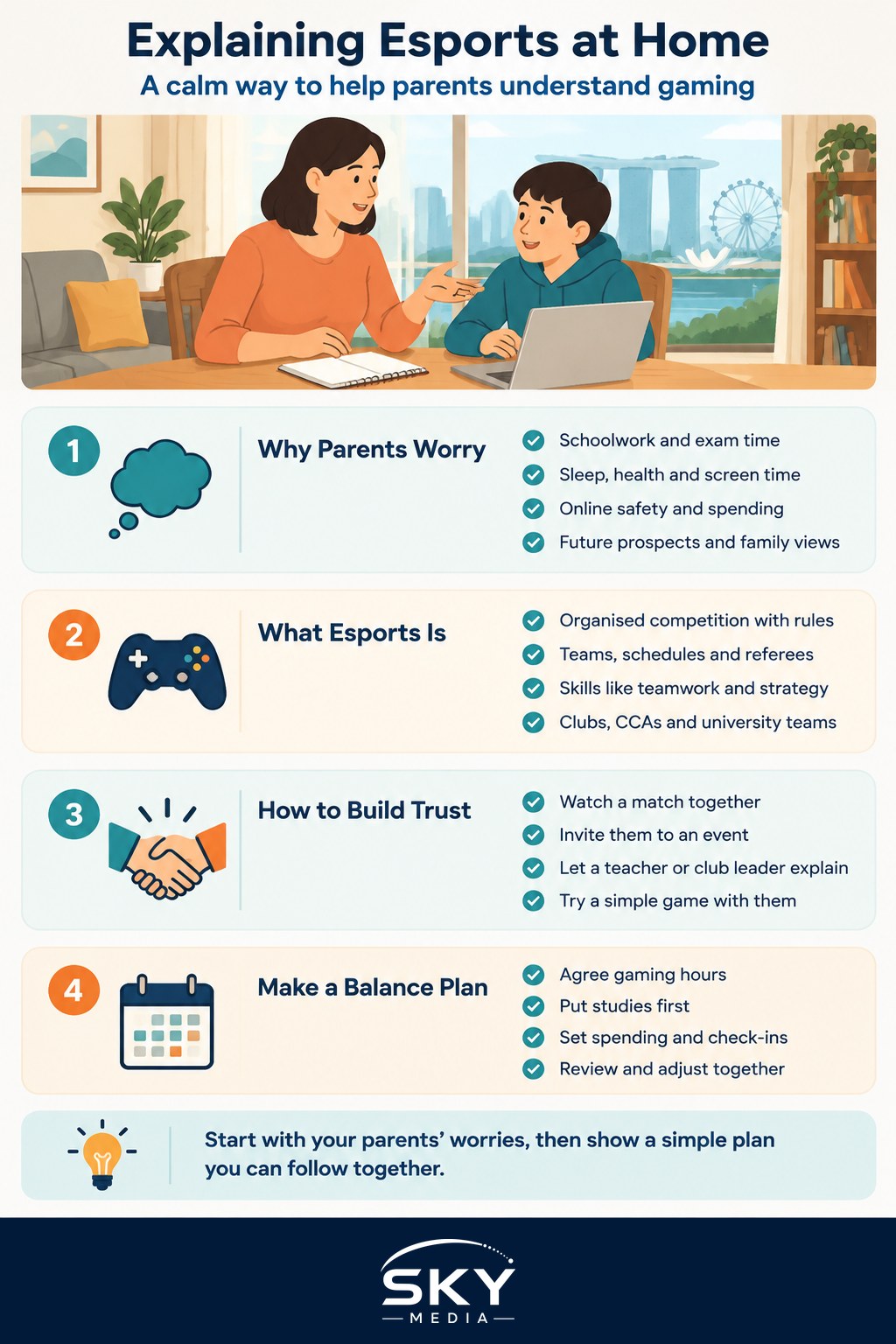
Understand Where Your Parents Are Coming From
Before you explain anything, think about what your parents are actually worried about. Common concerns include:
- Studies and exams. They fear gaming will take time from schoolwork.
- Health. Long hours sitting, late nights and eye strain.
- Safety online. Strangers, toxic chat, scams and in-game spending.
- Future prospects. They may not see how gaming leads anywhere useful.
- What others think. Relatives may ask about grades, not game rankings.
If you address these directly, the conversation feels like a partnership. If you dismiss them, it becomes a fight.
Explain What Esports Actually Is
Many parents imagine esports as one person playing alone for hours. Help them see the organised side.
- It is competitive and structured. Esports means organised competition in video games, with teams, rules, referees, schedules and leagues, much like a traditional sport.
- It involves real skills. Teamwork, communication, quick decision-making, strategy and staying calm under pressure.
- Schools and universities take part. Some schools run esports clubs or CCAs (co-curricular activities), and many universities have esports clubs.
- There is an ecosystem around it. Beyond players, people work in event organising, coaching, broadcasting, content creation, marketing and game development.
Keep it simple. One clear example from your own experience, such as how your team planned a strategy or handled a loss, is more convincing than statistics.
If you need help putting ideas plainly, our tips on how to explain difficult concepts simply apply here too.
Common Parent Worries and How to Respond
Use the table below to prepare calm, honest answers.
| What your parent might say | What is behind it | A response that builds trust |
|---|---|---|
| “Gaming is a waste of time.” | Unsure of the value | “I understand. Can I show you what my team actually does in a match and practice?” |
| “Your grades will drop.” | Worry about studies | “Let us agree a schedule. If my results slip, I will cut back.” |
| “You stay up too late.” | Health and sleep | “I will stop by an agreed time on school nights and keep my phone out of bed.” |
| “Who are you talking to online?” | Online safety | “You can meet my teammates, and I will tell you if anyone makes me uncomfortable.” |
| “You cannot make a living from this.” | Future security | “I know it is hard to go pro. I see it as a hobby that builds skills, and I am keeping my studies on track.” |
Notice that each response acknowledges the concern and offers something specific. Avoid exaggerated promises or claims about earnings.
Show, Do Not Just Tell
Parents often change their view after seeing esports for themselves.
- Watch a match together. Pick a short, well-produced broadcast and explain what is happening. Official tournament streams usually have commentary that explains the action for newcomers.
- Invite them to an event. If your school or a community group holds a tournament, ask them to come along.
- Introduce them to your teacher-in-charge or club leader. Hearing from a responsible adult can be reassuring.
- Let them try. A simple, friendly game played together can break the ice.
Propose a Balance Plan
Nothing builds trust like a clear plan that you stick to. Write it down together.
- Set gaming hours. Agree specific times on school days and weekends, and avoid late nights.
- Put studies first. Homework and revision come before practice, especially during exam periods.
- Build in health habits. Regular breaks, stretching, water, enough sleep and time away from screens. Our guides on eye care and screen comfort for gamers and wrist and hand stretches for gamers offer simple routines.
- Agree on spending. Decide whether in-game purchases are allowed and set a clear limit together.
- Keep communication open. Tell them about upcoming tournaments, results and any problems online.
- Review together. Check in after a month or at the end of a term, and adjust if needed.
If grades slip or health suffers, be willing to scale back without being asked. That shows maturity and makes it more likely your parents will support you later.
Scripts to Start the Conversation
Choose a calm moment, not right after an argument about screen time.
Opening:
“Can we talk about gaming? I know you are worried, and I want to explain why it matters to me and how I plan to manage it.”
Explaining the value:
“In my team, I am learning to communicate under pressure and to plan with others. I also enjoy it and it helps me relax after studying.”
Offering a plan:
“I have written down a schedule. Could you look at it with me and tell me what you would change?”
If they say no for now:
“Okay. Can we try a smaller plan for a few weeks and see how it goes?”
Connect Esports to Goals Your Parents Value
Parents often relax when they see how a hobby links to things they already care about. Think about which of these apply to you, and mention them honestly:
- Responsibility. Turning up to team practice on time, keeping commitments and leading others are habits that carry over to school and work.
- Communication. Calling plays and giving feedback to teammates builds confidence in speaking clearly.
- Planning. Reviewing past matches, setting improvement targets and tracking progress show discipline.
- Wider interests. Some students discover an interest in design, video editing, event planning or programming through gaming.
Be careful not to overstate these benefits. Your parents will trust you more if you are realistic and show the skills through your behaviour at home and at school.
For Parents Reading This
If you are a parent, asking questions with curiosity rather than judgement helps a lot. Ask your child what they enjoy, who they play with and what their goals are. Setting boundaries is still important, especially around sleep, studies and online safety, but those rules are more likely to be followed when your child feels heard.
When families explain esports to parents and children listen to each other, gaming can become a shared topic instead of a constant source of conflict. Patience, honesty and a plan you both agree on make all the difference.
Frequently Asked Questions
Is a career in esports realistic, or should I treat it as a hobby? For most players it is a hobby that builds skills, because very few become full-time professionals. Esports also has jobs off the stage, such as event organising, coaching and broadcasting. Be honest with your parents about the odds and keep your studies on track.
How much gaming time is reasonable on school days? There is no single right number, as it depends on your age, workload and sleep. A good rule is that homework, rest and family time come first, and gaming fits around them. Agree a schedule with your parents, and check with a doctor if you worry about health.
How can a parent tell if gaming is becoming unhealthy? Look for lost sleep, slipping grades, dropping other interests, irritability when asked to stop, or secretive spending. One bad week is not proof, but a lasting pattern is worth a calm talk. If it persists, a school counsellor or doctor can advise on next steps.
What if my parents still say no after I explain? Give it time instead of arguing again. Offer a smaller trial, such as limited hours for a few weeks, and keep your side of the deal. Asking a teacher, coach or club leader to speak with them can also help. Trust grows through actions more than words.
How do I reassure parents about going to tournaments or meeting teammates? Share the details: who runs the event, where it is, who you are going with and when you will be back. Let them meet your teammates or coach, and keep them updated. Parents worry less when they can see the people and the place involved.
Further reading: A Parent’s Guide to Esports Scholarships in Singapore