

Every family goes through rough patches. A job loss strains the household budget, a marriage starts to fray, a teenager stops talking, or caring for an elderly parent becomes overwhelming. In many of these moments, people do not know where to turn, and they assume help is only for those in crisis or on very low incomes.
A family service centre in Singapore is one of the most accessible places to start. These centres sit in the heart of neighbourhoods, are staffed by trained social workers and counsellors, and exist precisely for ordinary families facing ordinary but heavy problems. This guide explains what they do, who can use them and how to take the first step.
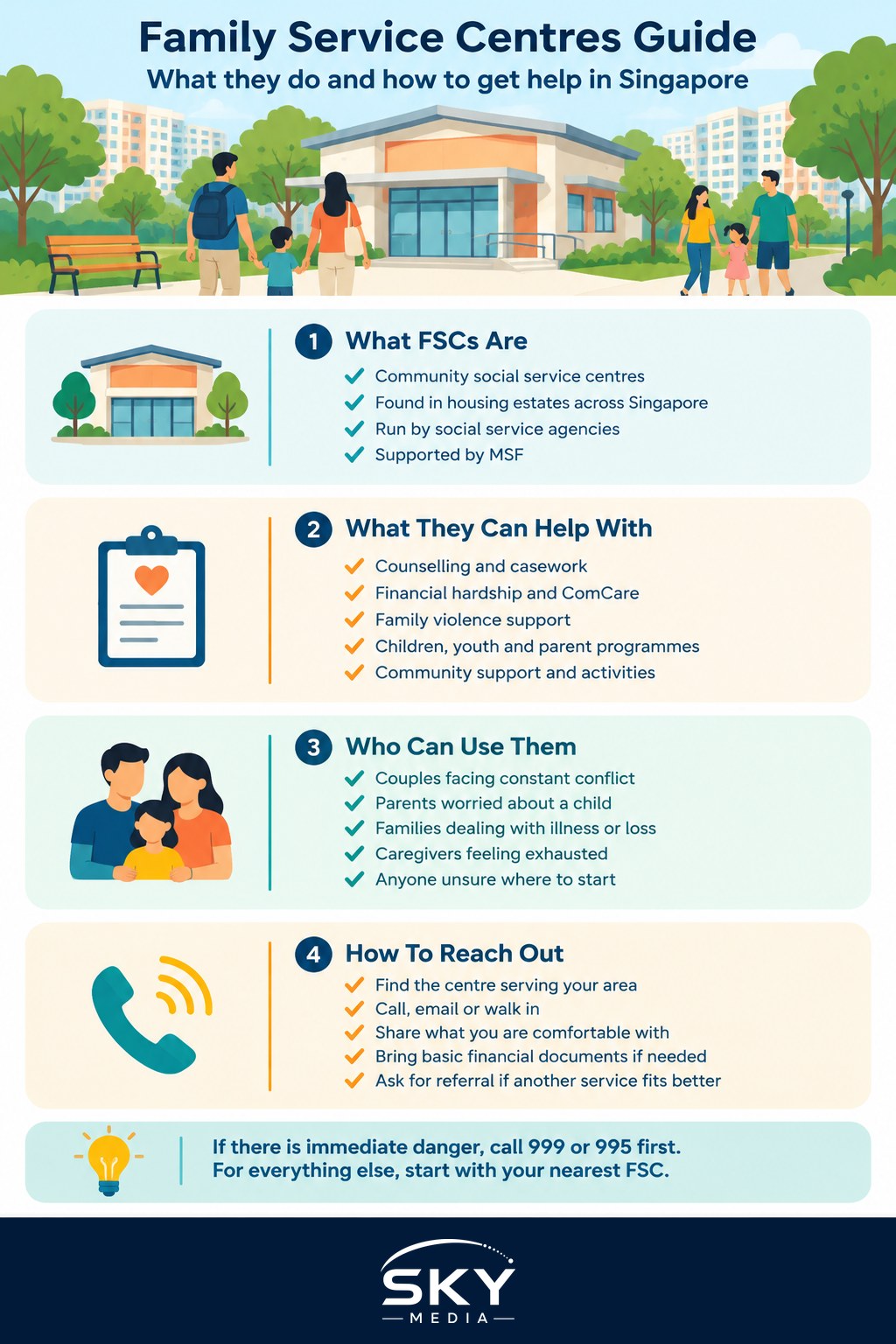
What a Family Service Centre Is
Family Service Centres (FSCs) are community-based social service centres located across Singapore’s housing estates. They are run by social service agencies, many of them non-profit and voluntary welfare organisations, and are supported by the Ministry of Social and Family Development (MSF).
Think of an FSC as a neighbourhood hub for family and personal difficulties. Rather than dealing with one narrow issue, social workers look at the whole situation: relationships, money, housing, caregiving, children’s needs and emotional wellbeing. They then help the family work out a plan and connect them to other services where needed.
For newcomers, including those from mainland China, it may help to compare an FSC to a community social work station or neighbourhood family support office: a local, government-supported place where trained staff help residents through family and life problems.
What Services FSCs Provide
Each centre’s programmes differ, but most FSCs offer some combination of the following:
- Casework and counselling. One-to-one or family sessions with a social worker to understand the problem and work through it. Common issues include marital conflict, parenting struggles, divorce, grief, stress and caregiving burden.
- Information and referral. Helping you understand which schemes and services exist and linking you to them, such as financial assistance, eldercare services, mental health support, legal aid or employment help.
- Support during financial hardship. FSCs work closely with Social Service Offices (SSOs), which administer ComCare, the government’s assistance for lower-income households. A social worker can help you understand your situation and what to apply for.
- Family violence support. Safety planning and referrals to specialised family violence services and protection options.
- Children and youth programmes. Some FSCs run programmes for children, teenagers and parents, such as parenting workshops, study support or youth groups.
- Community programmes. Support groups, talks and activities that build neighbourly networks and reduce isolation.
Services are generally free or heavily subsidised for those who need them. If a specific programme has a charge, the centre will tell you upfront.
FSCs and Other Places to Get Help
People often confuse FSCs with other support points. The table shows where each typically fits, though roles overlap and staff will redirect you if another service suits better.
| Where to go | Main focus | When to approach |
|---|---|---|
| Family Service Centre (FSC) | Counselling, casework, family and personal problems, linking to services | Relationship, parenting, caregiving or life stress issues, or when you are unsure where to start |
| Social Service Office (SSO) | Financial assistance applications such as ComCare | When you mainly need short-term or longer-term financial help |
| Active Ageing Centre | Activities, befriending and support for seniors | When an older family member needs social connection and community support |
| Emergency services (999 or 995) | Immediate danger or medical emergencies | When someone is at risk of harm right now |
If you are caring for a senior, our explainer on Active Ageing Centres covers what they offer alongside an FSC.
Who Can Use an FSC
FSCs serve residents in Singapore, and you do not need to be in crisis to approach one. Common situations include:
- Couples who argue constantly and want help communicating.
- Parents worried about a child’s behaviour, school refusal or online habits.
- Families coping with a death, illness or disability.
- Caregivers who feel exhausted and unsure what support exists.
- Households struggling to pay bills after a job loss.
- Individuals experiencing or witnessing violence at home.
- Newcomers who feel isolated and do not know how local systems work.
Eligibility for specific financial schemes depends on criteria set by the relevant agency, such as citizenship or residency status, income and household circumstances. The FSC itself can still listen, advise and point you to the right place, even if a particular scheme does not apply to you. Check details with MSF or the relevant agency, as rules can change.
How to Approach an FSC for the First Time
Reaching out is often the hardest part. Here is what the process usually looks like.
- Find your nearest centre. MSF’s website lists FSCs, and you can search by area. You are usually directed to the one serving your neighbourhood, but you can contact any FSC to ask.
- Make contact. Call, email or walk in during opening hours. Some centres also accept online enquiries. You can say something simple, such as “I am having problems at home and would like to talk to someone.”
- Initial conversation. A social worker will ask about your situation to understand what help you need. Share as much as you feel comfortable with.
- Working together. If ongoing support makes sense, you may be assigned a caseworker who meets you regularly, sets goals with you and coordinates help with other agencies.
- Referrals. If another service fits better, such as a specialist counselling centre or a hospital social worker, the FSC can link you there.
Bring basic documents if your issue involves finances, such as your NRIC or pass, recent payslips or bills. It is fine to go without them for a first chat.
Privacy, Language and Common Worries
Confidentiality. Social workers keep what you share confidential, with important exceptions. If there is a serious risk to someone’s safety, especially a child or a vulnerable adult, they may need to involve other authorities. Ask the social worker to explain how your information will be used.
Language. Many FSC staff speak English and Mandarin, and some speak Malay, Tamil or dialects. Ask when you call if you prefer a particular language.
Stigma. Seeking help is not a sign of failure. Families from every background use FSCs, and early support often prevents small problems from becoming bigger ones.
Timing. If there is immediate danger, call 999 for the police or 995 for an ambulance first. FSCs are not emergency services.
Strong families build habits that keep everyone connected, and our guide to staying connected with your child as they grow has ideas that complement any professional support.
If you are carrying a load that feels too heavy, consider picking up the phone or walking into your neighbourhood FSC. A conversation with a social worker can make the next step much clearer.
Official sources: Ministry of Social and Family Development (MSF)
Further reading: The Family Justice Courts Explained: What Families Can Expect · Becoming a Foster Family