

When a bank refuses to reverse a charge you dispute, or an insurer turns down a claim you believe is valid, it can feel like you have nowhere to go short of court. For many consumers in Singapore, that is where FIDReC comes in. The Financial Industry Disputes Resolution Centre is an independent body set up to help resolve disputes between consumers and financial institutions affordably and without lawyers. This guide explains what FIDReC Singapore handles, how its process works, and how to prepare your case.
This is general information, not legal or financial advice. FIDReC’s rules, claim limits and fees are published on its official website and can change, so check the current details there before you file.
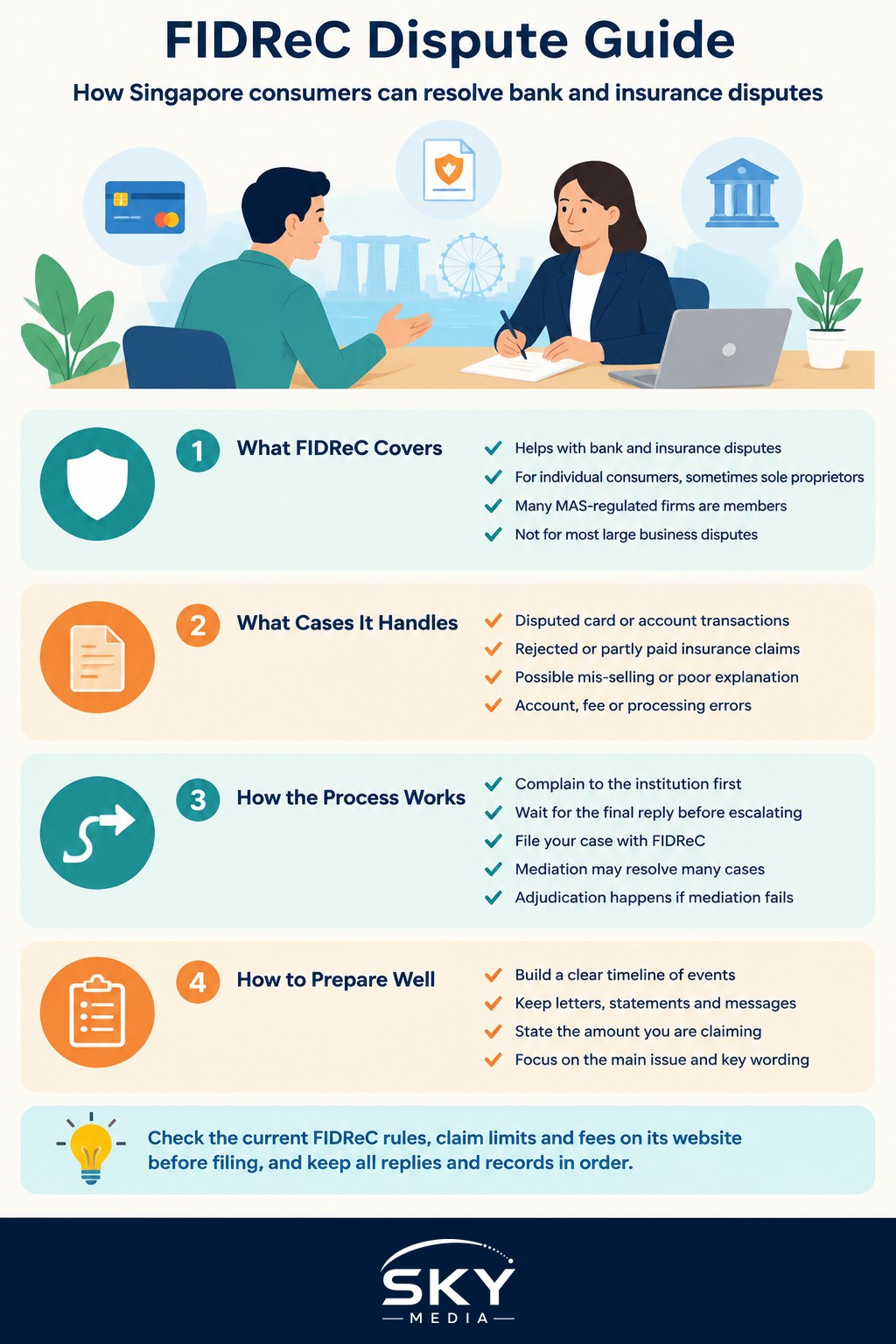
What FIDReC Is and Who It Covers
FIDReC is an independent, specialised dispute resolution centre for the financial sector, supported by the Monetary Authority of Singapore (MAS), Singapore’s central bank and financial regulator. Many financial institutions regulated by MAS, including banks, insurers, licensed financial advisers, capital markets services firms and some payment and credit businesses, are members. You can check whether a particular institution is a member on FIDReC’s website.
FIDReC is designed for individual consumers and, in some cases, sole proprietors. Larger businesses usually have to use other channels.
Disputes FIDReC Can and Cannot Handle
FIDReC generally deals with disputes about how a financial institution handled your product or account, such as:
- Unauthorised transactions or disputed charges on cards and accounts
- Insurance claims that were rejected or partially paid
- Allegations that an investment or insurance product was mis-sold or poorly explained
- Errors in processing transactions, fees charged contrary to agreed terms or problems with account administration
- Certain third-party motor insurance property damage claims, under specific rules
It generally will not handle:
- Complaints about an institution’s commercial decisions, such as its pricing, fees or interest rates in general, or a decision to decline a loan or credit card application
- Complaints purely about investment performance, where you simply lost money in a market downturn
- Cases already decided by a court, or currently before a court or another dispute resolution body
- Claims above FIDReC’s published claim limit, unless both parties agree otherwise under its rules
There is a claim limit per claim, and it has been raised before. Check FIDReC’s website for the current figure and whether it differs for certain types of claim.
The Process, Step by Step
The process has a clear sequence, and skipping steps usually leads to delays.
- Complain to the financial institution first. Write to the bank, insurer or adviser and set out your complaint clearly. Institutions have internal complaint handling processes and must respond within a set period. Keep copies of everything.
- Receive the institution’s final reply. If it rejects your complaint, or does not respond within the time allowed, you can escalate. Note the date of the final reply, because FIDReC has a time limit for lodging a case after it.
- Lodge your case with FIDReC. Submit online or through the channels listed on its website. Provide a summary of the dispute, the amount involved, what outcome you want and supporting documents.
- Case management and mediation. A FIDReC case manager reviews the case, may seek information from both sides and helps you and the institution try to reach a settlement. Many cases end here.
- Adjudication if mediation fails. If no settlement is reached, the case can go before an independent adjudicator, or a panel for larger claims, who hears both sides and decides. There is a case fee for adjudication, published on FIDReC’s website.
- The decision. If you accept the adjudicator’s award, it is binding on the financial institution. If you do not accept it, you remain free to pursue other options, such as the courts.
Mediation vs Adjudication vs Going to Court
| Stage | What happens | Cost to you | Is the outcome binding? |
|---|---|---|---|
| Mediation at FIDReC | A case manager helps both sides negotiate a settlement | Generally free for consumers, check current rules | Only if both sides agree to a settlement |
| Adjudication at FIDReC | An independent adjudicator hears the case and decides | A published case fee | Binding on the institution if you accept it; you may reject it |
| Civil courts, including Small Claims Tribunals where applicable | A judge or tribunal decides under the law | Court fees, possibly legal fees | Binding on both parties, subject to appeal rules |
For disputes that do not involve a financial institution, such as with a neighbour, contractor or landlord, other routes like community mediation are usually more appropriate.
How to Prepare a Strong Case
FIDReC looks at the facts and documents, not how upset you are. Preparation makes a real difference.
- Build a timeline. List key dates: when you bought the product, when the problem occurred, when you complained, and every response.
- Collect documents. Policy documents, product brochures, account statements, transaction records, emails, chat logs, call reference numbers and the institution’s letters.
- Be specific about what you want. State the amount claimed and how you calculated it.
- Stick to the main issues. A focused complaint is easier to assess than a long narrative.
- Write down conversations. If something was said by a representative, note the date, name and what was said as soon as you can.
- Read your policy or terms carefully. Many insurance disputes turn on specific wording, such as exclusions, waiting periods or what counts as pre-existing.
Tips for Common Dispute Types
Disputed card transactions or scams. Report unauthorised transactions to your bank immediately and make a police report where relevant. Singapore’s framework for e-payments sets out responsibilities for banks and users, and how quickly you report can affect liability. Check MAS and your bank’s terms for the current rules.
Rejected insurance claims. Ask the insurer for the specific clause it relied on. Get a doctor’s report or other evidence addressing that clause before escalating.
Mis-selling complaints. Gather the product summary, any risk disclosure you signed, records of your financial needs analysis and notes of what the representative told you. The question is usually whether the product was suitable and properly explained, not whether it lost money.
Practical Points to Remember
- FIDReC is impartial; it does not act as your lawyer or advocate.
- You do not need a lawyer, although you may seek independent advice for complex or high-value cases.
- Time limits apply at each stage, so act promptly.
- Accepting a settlement or award usually ends the matter, so read the terms carefully before agreeing.
Disagreements with large institutions can feel daunting, but a calm, documented approach and a clear understanding of the process give you the best chance of a fair outcome. For other kinds of disagreements, see our guide to resolving neighbour disputes.
Official sources: Monetary Authority of Singapore (MAS)
Further reading: How SDIC Deposit Insurance Protects Your Bank Savings · How to Use Your Bank’s Kill Switch to Freeze Your Accounts