

Singapore’s banks are tightly regulated and widely seen as safe, so most people never think about what would happen if one failed. That is exactly what SDIC deposit insurance Singapore arrangements exist for. The Deposit Insurance Scheme, run by the Singapore Deposit Insurance Corporation (SDIC), protects ordinary savers’ money up to a set limit if a member bank or finance company cannot pay back its depositors.
This guide explains what the scheme covers, which accounts and products fall outside it, and how to arrange your savings so more of your money is protected. It is general information, not financial advice. Coverage limits and rules can change, so always confirm current details on the official SDIC website.
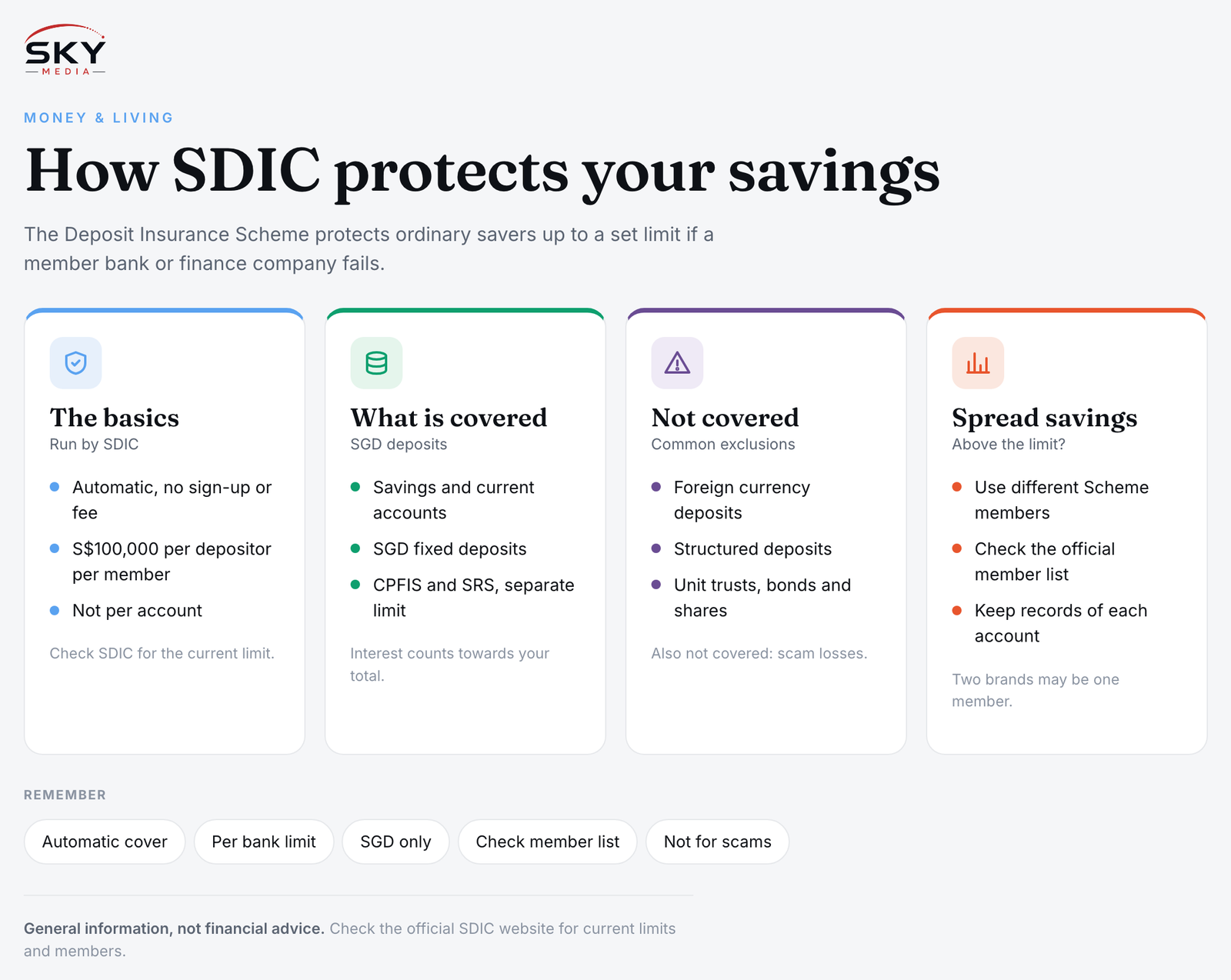
What SDIC and the Deposit Insurance Scheme Are
SDIC is a company set up under Singapore law to administer two protection schemes: the Deposit Insurance Scheme for bank deposits and the Policy Owners’ Protection Scheme for certain insurance policies. This article focuses on deposits.
Under the Deposit Insurance Scheme, banks with a full banking licence and finance companies in Singapore are generally required to be Scheme members. Members pay premiums into a fund. If a member fails, SDIC uses that fund to compensate insured depositors up to the coverage limit, so ordinary savers are not left waiting for the full liquidation process.
As of the latest revision, the limit is S$100,000 per depositor per Scheme member. That means up to S$100,000 of your eligible deposits at each member bank is covered, not S$100,000 per account. SDIC has revised the limit before, so check the current figure on its website.
You do not need to apply or pay anything. Coverage is automatic for eligible deposits at member institutions. Members are expected to show that they are Scheme members, for example through the SDIC decal at branches or a notice on their websites, and SDIC publishes the full list.
What Is Covered
In general, the scheme covers Singapore dollar deposits held by individuals and many non-bank depositors at Scheme members, including:
- Savings accounts
- Current accounts
- Fixed deposits in Singapore dollars
- Monies and deposits under the CPF Investment Scheme (CPFIS) and Supplementary Retirement Scheme (SRS) placed as deposits with Scheme members. These have their own separate coverage limit, distinct from your regular deposits, so check SDIC’s current rules on how this works.
Joint accounts and trust or client accounts have specific rules for how coverage is shared among the people involved. If you hold significant sums in these, read SDIC’s guidance or ask your bank.
What Is Not Covered
Many products sold at bank counters are not deposits and are not insured. The most common exclusions include:
- Foreign currency deposits, such as US dollar or RMB accounts and time deposits
- Structured deposits, which are linked to investment performance
- Investment products such as unit trusts, bonds, shares and exchange-traded funds
- Deposits held by banks and some financial institutions themselves
- Deposits at institutions that are not Scheme members, including some foreign bank branches with restricted licences
If you hold foreign currency savings, such as those described in our guide to holding RMB time deposits in Singapore banks, be aware that they sit outside the scheme. The same applies to products covered in structured deposits explained.
Investment products held in custody by a bank are not deposits, but they are usually held separately from the bank’s own assets. That separation is a different form of protection from deposit insurance, and how it works depends on the product. Ask the bank or check with the Monetary Authority of Singapore (MAS) for general guidance.
Covered vs Not Covered at a Glance
| Product | Covered by Deposit Insurance Scheme? | What to keep in mind |
|---|---|---|
| SGD savings and current accounts | Yes, up to the limit per bank | Combined with other eligible deposits at the same bank |
| SGD fixed deposits | Yes, up to the limit per bank | Interest is included within the overall limit |
| Foreign currency deposits | No | Consider currency and bank risk separately |
| Structured deposits | No | Treated as investment products |
| Unit trusts, bonds, shares | No | Market risk applies; not a deposit at all |
| CPFIS and SRS deposits at members | Yes, under a separate limit | Check SDIC for current rules |
How the S$100,000 Limit Applies in Practice
The key point is that the limit applies per depositor, per Scheme member. A few examples, assuming the limit is S$100,000:
- One bank, several accounts: if you have S$70,000 in savings and S$60,000 in a fixed deposit at the same bank, your total is S$130,000. Only S$100,000 is insured.
- Two banks: if you hold S$90,000 at one member and S$90,000 at another, both amounts are fully covered.
- Interest: accrued interest counts towards your total insured amount.
One subtle trap: some banking brands belong to the same licensed institution. Two names you see on apps or branches may count as one Scheme member. Check SDIC’s member list carefully rather than relying on brand names.
How to Spread Savings Sensibly
For most people, the scheme already covers all of their cash. If you hold more than the limit in Singapore dollars, for example after selling a property, receiving an inheritance or building up a large emergency fund, consider these steps:
- Spread cash across different Scheme members so each holding is at or below the limit.
- Check the member list to confirm each institution is a separate member.
- Keep records of each account, so your family can locate them if needed.
- Match the product to the purpose. Emergency savings belong in accessible, insured deposits. Longer-term money may sit in other products, but understand that those are not insured.
- Strengthen account security. Deposit insurance protects you against a bank failing, not against scams. Features such as a bank money lock protect against fraud, which is a far more common risk for individuals.
What Happens If a Bank Fails
Bank failures in Singapore are rare, and MAS supervises banks closely. If a Scheme member did fail, SDIC would aim to compensate insured depositors promptly, either through direct payment or by transferring insured deposits to another bank. SDIC’s website explains how this process would work and how depositors would be contacted.
You would not need to file a complicated claim for typical accounts. Keeping your contact details up to date with your bank and storing basic account records makes things smoother.
Common Questions
Do I need to sign up? No. Coverage is automatic for eligible deposits at Scheme members.
Is my digital bank covered? Only if it is a Scheme member. Check SDIC’s list.
Are foreign nationals covered? Coverage depends on the deposit and the institution, not your nationality. Eligible deposits held by foreign residents at Scheme members are generally covered on the same basis.
Does it cover losses from scams? No. Deposit insurance protects against institution failure only.
For the most up-to-date limits, member list and exclusions, refer to the official SDIC website, and treat deposit insurance as one part of a broader plan for keeping your savings safe.
Official sources: Singapore Deposit Insurance Corporation
Further reading: How to Write, Deposit and Stop a Cheque in Singapore · How to Choose a Savings Account in Singapore · How FIDReC Resolves Disputes With Banks and Insurers