

Heading out with a baby in Singapore is easier than in many cities, partly because nursing rooms are fairly common. Whether you breastfeed, pump or bottle-feed, a clean, quiet, air-conditioned room to feed and change your baby can make the difference between a relaxed outing and a rushed one. This nursing room Singapore guide covers where rooms are typically found, how to locate one quickly, what to expect inside, and the simple etiquette that keeps them pleasant for everyone.
Breastfeeding in public is legal and widely accepted here, and many parents feed wherever they are comfortable. Nursing rooms are simply an option for those who prefer privacy, a cooler space or a place to pump.
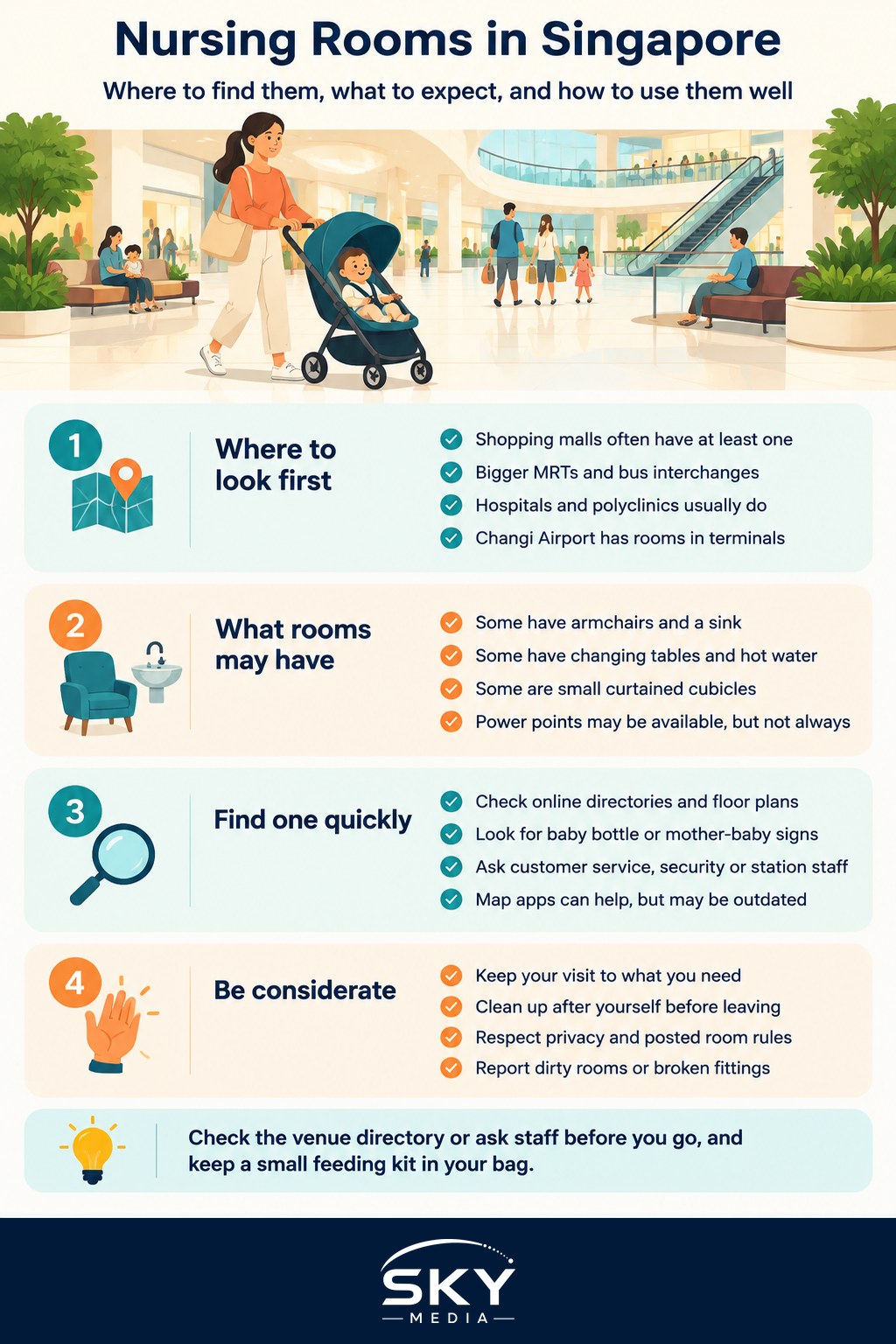
Where Nursing Rooms Are Typically Found
Facilities vary a lot, so it helps to know where to look first.
| Location | What to expect | Tips |
|---|---|---|
| Shopping malls | Most larger malls have at least one room, often near family restrooms, the customer service counter or the children’s floor | Check the mall directory board or website before you go; ask customer service if signs are unclear |
| MRT stations and bus interchanges | Some larger stations and interchanges have nursing rooms, but many smaller stations do not | Look at station maps or ask the station control room; plan feeds around bigger stops |
| Hospitals and polyclinics | Usually available for patients and visitors, especially in women’s and children’s areas | Ask at the information counter; rooms may be busy during clinic hours |
| Changi Airport | Nursing rooms in the terminals, in public and transit areas | Check the airport’s website or app for the nearest one to your gate |
| Attractions, museums and libraries | Many family-oriented venues have a room or a baby care area | Check the venue’s visitor information page in advance |
| Workplaces | Many employers provide a lactation room for staff who pump | Ask HR early about access, booking and fridge storage |
Rooms differ in size and fittings. Some are spacious, with armchairs, a sink, a diaper-changing table and a hot water dispenser. Others are a small curtained cubicle with a single chair. A few have power points for breast pumps, but do not count on it.
How to Find a Nursing Room Quickly
When your baby starts fussing, you do not want to wander three floors searching. A few strategies:
- Plan ahead for regular spots. For the malls, stations and clinics you use often, note where the rooms are. Once you know, you will not need to search again.
- Check websites and directories. Most malls list nursing rooms in their online directory or on the floor plan. Attractions and hospitals usually mention them under visitor or accessibility information.
- Look for the sign. Rooms are usually marked with a baby bottle or mother-and-baby symbol, sometimes labelled “nursing room”, “baby care room” or “family room”.
- Use map apps carefully. Some map apps and parenting communities share nursing room locations. These can be helpful but are not always updated, so treat them as a starting point.
- Ask. Customer service staff, security officers and station staff are generally happy to point you in the right direction.
If a room is locked, there may be a call button or a sign telling you to ask the service counter for access. Some rooms are locked to keep them clean and reserved for parents.
What to Bring on Outings
Even the best nursing room will not have everything. A compact kit in your diaper bag covers most situations:
- A nursing cover or light scarf, for privacy if the room is a shared space or if you end up feeding elsewhere.
- Burp cloths and wet wipes.
- A change of clothes for the baby, and a spare top for yourself in case of leaks or spit-up.
- Nursing pads if you use them.
- Diapers, a changing mat and disposal bags, since not every room has a changing table.
- For pumping: your pump, a fully charged battery or power bank compatible with the pump, bottles or storage bags and a small cooler bag with ice packs.
- For bottle-feeding: formula pre-measured in a container and a flask of hot water, because not every room has a water dispenser.
- Hand sanitiser and a bottle of water for yourself. Feeding in a warm climate can leave you thirsty.
Comfortable clothing makes feeding anywhere much easier. Our guide to nursing-friendly outfit ideas has suggestions that suit Singapore’s heat.
Nursing Room Etiquette
Nursing rooms are shared spaces used by many parents in a day. A few considerate habits keep them pleasant:
- Keep your visit to what you need. Feeding can take time, and that is fine, but avoid using the room for long phone calls or as a waiting area if others are queuing.
- Respect privacy. Knock or wait if the door is closed or a curtain is drawn. If cubicles are shared, keep conversation low.
- Clean up after yourself. Wipe the changing table, throw away used diapers in the bins provided, and do not leave bottles or wipes behind.
- Check the room’s rules. Some rooms are meant for mothers only; others welcome fathers and other caregivers. Respect posted signs. If a room is for mothers only, look for a family room or ask staff about alternatives.
- Keep older siblings calm. If you bring a toddler in, keep them close and quiet so other parents can feed in peace.
- Report problems. If a room is dirty, out of supplies or has broken fittings, let the management know. It helps the next parent.
Pumping at Work and on the Go
For working parents who express milk, regular access to a private, clean space matters. Many workplaces in Singapore provide a lactation room, and there is national guidance encouraging employers to support breastfeeding employees. Practical arrangements differ by company, so:
- Talk to HR or your manager before returning to work about where you can pump, how often you need breaks and where to store milk.
- Block time in your calendar for pumping sessions so meetings do not clash.
- Label your milk clearly if you use a shared fridge, and use your own cooler bag if there is no dedicated fridge.
For advice on milk storage times and hygiene, follow guidance from your doctor, a lactation consultant or HealthHub, the Ministry of Health’s health information portal. This article is general information, not medical advice.
When There Is No Nursing Room Nearby
Sometimes you will be somewhere without a room, such as a hawker centre, a park or a small neighbourhood mall. Options include:
- Feeding discreetly with a cover in a quiet, shaded corner.
- Finding a café or a fast food outlet with air-conditioning and asking for a corner table.
- Using a family car, if you drove, with the engine and air-conditioning running in a safe, legal parking spot.
- Timing outings so the next feed falls when you are near a known nursing room.
Remember that you have every right to feed your baby when they are hungry. Nursing rooms are a convenience, not a requirement.
Making Outings With Baby Easier
Knowing where to find a nursing room in Singapore takes a lot of pressure off early outings. Start with short trips to places you know have good facilities, build confidence, and gradually expand your map of reliable rooms. Before long, heading out with your baby will feel as routine as any other errand.
Further reading: Finding Clean Public Toilets in Singapore · How to Breastfeed Comfortably in Public in Singapore