
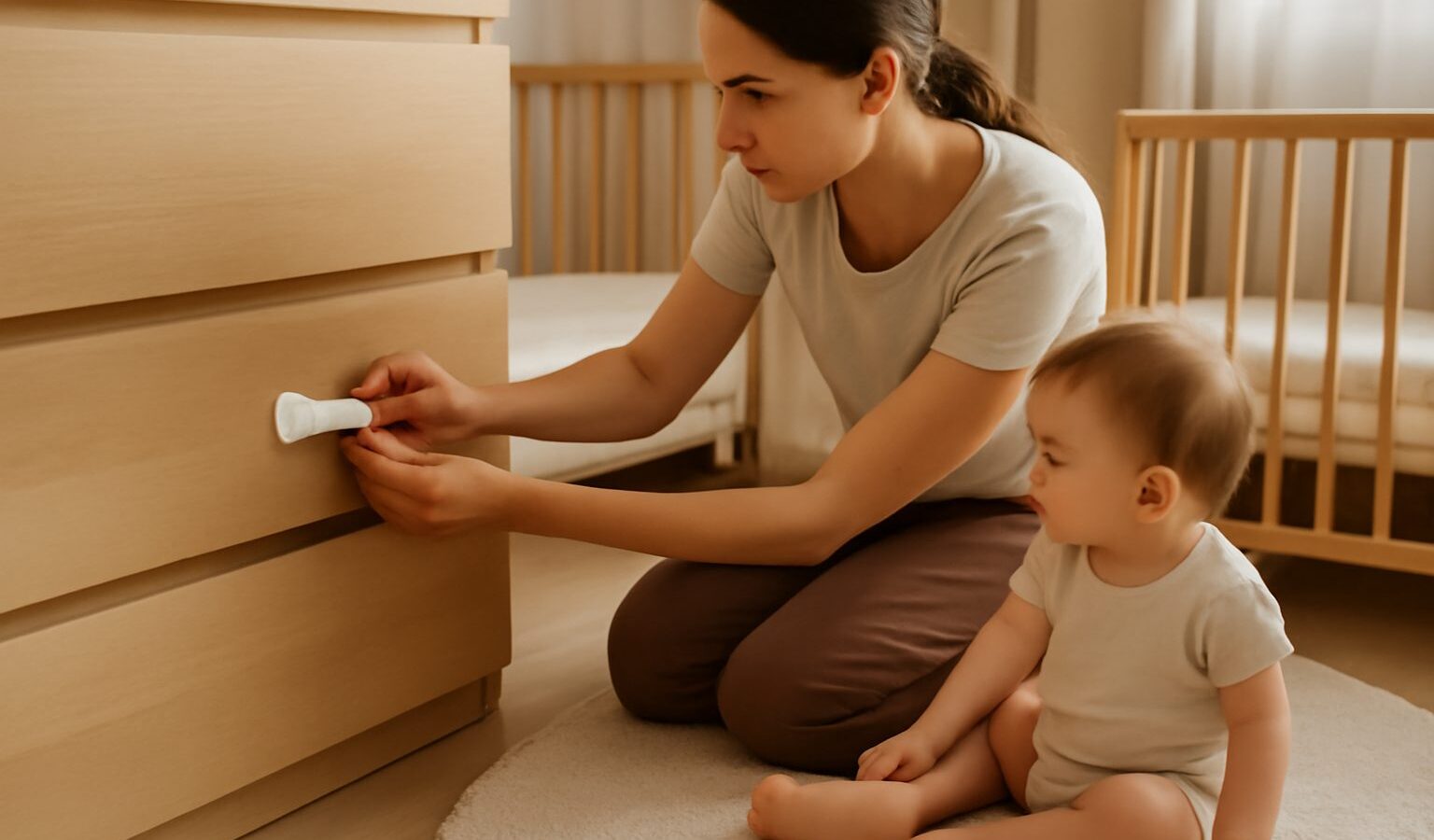
Most childproofing checklists are written for houses with stairs, backyards and swimming pools. A typical Singapore family lives somewhere very different: a high-rise flat with casement windows, a service yard full of laundry gear, a heavy household shelter door and a compact kitchen that opens onto the living room. If you want a properly childproof HDB flat, it helps to walk through it the way your child will, one room at a time.
This guide covers the hazards that are specific to common HDB layouts and the simple fixes most families use. Every home and every child is different, so treat it as a starting point, and get down to your child’s eye level in each room to spot what this list misses.

Start With Windows, the Biggest High-Rise Risk
In a high-rise flat, windows deserve more attention than anything else. Young children climb with surprising speed, and a sofa, bed, toy box or laundry basket placed under a window becomes a ladder.
- Install window grilles or child-safe window restrictors on every window a child can reach, including bedrooms and the kitchen. Many families choose invisible grilles (thin steel cables) or conventional grilles. Ask your contractor about the product’s load rating and check with HDB and your town council if you are unsure what is allowed on your block’s facade.
- Keep furniture away from windows. Move beds, sofas, shelves and step stools so they cannot be used to climb up to a sill.
- Lock windows that do not need to open, and keep the keys out of reach.
- Check casement window fittings. HDB reminds owners to inspect and maintain their windows, including the rivets on aluminium casement windows, because a loose panel is a danger to everyone below as well as inside. Look up HDB’s current window safety guidance for what owners are responsible for.
Never rely on a mosquito screen to hold a child’s weight. Screens keep insects out, nothing more.
Living Room and Bedrooms
Living areas in HDB flats are often compact, so furniture tends to sit close together. That is good for supervision but creates climbing routes.
- Anchor tall furniture such as bookshelves, wardrobes, TV consoles and display cabinets to the wall with anti-tip straps. If you have a hacked or partition wall, ask your contractor which walls can safely take wall anchors.
- Mount or secure the TV. A TV on a low console can be pulled over.
- Cover unused power points and tidy cables behind furniture. Singapore’s three-pin sockets have switches, which helps, but children quickly learn to flip them.
- Watch blind and curtain cords. Tie looped cords up high or switch to cordless blinds, especially near cots and beds.
- Pad sharp corners on coffee tables and TV consoles, and keep small objects such as coins, button batteries and magnets off low surfaces.
In bedrooms, keep the cot away from windows, cords and wall shelves. Store medicines, cosmetics and helper or grandparent medications in a high, closed cabinet rather than on a bedside table.
Kitchen and Service Yard
The kitchen is usually where hot, sharp and toxic things live together, and in many HDB flats it connects straight to the service yard, where the washing machine and drying racks are.
- Fit a safety gate at the kitchen entrance if your layout allows it, or keep the kitchen door closed while cooking.
- Turn pot handles inward and use the back burners. If you use a gas stove, learn where the gas valve is and keep the knob area clear of a child’s reach where possible. Induction hobs reduce open-flame risk but still get hot.
- Use cabinet latches on lower cabinets holding knives, cleaning products, dishwasher tablets and plastic bags.
- Secure the service yard. Laundry poles, pole holders and drying racks are tempting to climb. Keep step stools out of the yard, keep the yard door closed and never leave a pail of water standing.
- Check for an old refuse chute hopper. Some older flats still have an in-kitchen refuse chute opening. If yours does, make sure the cover closes properly and stays shut.
Washing machines with front-loading doors should be kept closed when not in use, and many models have a child lock setting worth switching on.
Bathrooms and the Household Shelter
Bathrooms in HDB flats are usually small and wet, which means slips and water are the two main concerns.
- Never leave water in pails or tubs. Young children can drown in very shallow water, and pails are common in local bathrooms for washing and mopping.
- Lay non-slip mats on the floor and inside the shower area.
- Keep the bathroom door closed or fit a simple high latch.
- Store cleaning products and razors up high, not under the sink.
- Set water heaters sensibly. Storage and instant heaters can deliver very hot water, so test the temperature before every bath.
The household shelter (often called the bomb shelter or HS) has a very heavy steel door that can crush small fingers. Many families use it as a storeroom, which adds the risk of things falling from shelves. Keep the door shut when not in use, consider a door stopper so it cannot swing on fingers, and do not store heavy items on high shelves inside. Remember that HDB has rules about what changes can be made to the shelter, so do not drill or modify the shelter walls or door. Check HDB’s guidance before any work.
The Main Door, Gate and Corridor
HDB flats usually have a metal gate in front of the main door, and many families leave the door open for airflow. That gate is now your front line.
- Keep the gate locked and the key out of reach.
- Watch for finger traps in both the door and the gate hinges. Door stoppers and finger guards help.
- Clear the corridor area. Shoe racks, potted plants and bicycles outside your unit can tip or be climbed, and corridor rules are set by your town council.
- Teach lift and corridor rules early. Children should not run ahead to the lift or press buttons alone.
Room by Room Childproofing Summary
| Area | Main hazard for young children | Practical fix |
|---|---|---|
| Windows | Climbing and falls from height | Grilles or restrictors, furniture moved away, locks |
| Living room | Tipping furniture and TVs | Anti-tip straps, wall-mounted TV, corner guards |
| Kitchen | Burns, sharp objects, chemicals | Safety gate, cabinet latches, inward pot handles |
| Service yard | Climbing laundry fixtures, standing water | Closed yard door, no stools, empty pails |
| Bathroom | Slips and shallow water | Non-slip mats, empty tubs, high latch |
| Household shelter | Heavy door, falling stored items | Door kept shut, heavy items stored low |
| Main door and gate | Escaping, pinched fingers | Locked gate, finger guards, keys out of reach |
Doing It During a Renovation or Move
If you are buying or renovating, childproofing is cheaper to plan before the carpenter starts. Built-in wardrobes can be fixed securely, power points can be placed higher, and grilles can be included in the quote. Our guide to renovating your HDB flat explains the permit side, and it is worth knowing which walls you can touch.
Layout matters too. A 3-room flat with a kitchen beside the living area needs a different gate setup from an executive flat with a separate dining room, so it helps to understand how HDB flat types differ when planning where gates and barriers go.
If you keep plants by the window or along the corridor, check whether any are toxic if chewed, and keep heavy pots off ledges. Our guide on gardening in an HDB flat has ideas for placing plants safely.
Keep Reviewing as Your Child Grows
Childproofing is never finished. A crawling baby, a walking toddler and a curious five-year-old each reach new places, so walk through the flat every few months and adjust. Brief grandparents, helpers and visitors on your house rules, especially about windows, the gate and medicines. No setup replaces supervision, but a well childproofed home gives you more room to breathe while your child explores.
For questions about your child’s development or a specific injury, speak to your paediatrician or polyclinic, and check HealthHub for general child safety resources.
Further reading: Playpens and Baby Gates: Do You Need Them in an HDB Flat? · How to Childproof a Balcony for Kids in Singapore