

If you live in Singapore on a pass sponsored by your husband, wife or partner, and that person is hurting, threatening or controlling you, you may feel trapped. Many people in this situation stay silent because they fear losing their pass, their children or their only source of money. This guide explains where to find foreign spouse family violence help, what protection is available to you, and how to get advice about your immigration status without putting yourself at further risk.
This is general information, not legal advice. Rules and procedures can change, so please confirm your own situation with the official bodies and support services named below.
If you are in immediate danger, call the police on 999. If you cannot speak safely, you can send an SMS to 71999, which the Singapore Police Force provides for emergencies where calling is not possible.
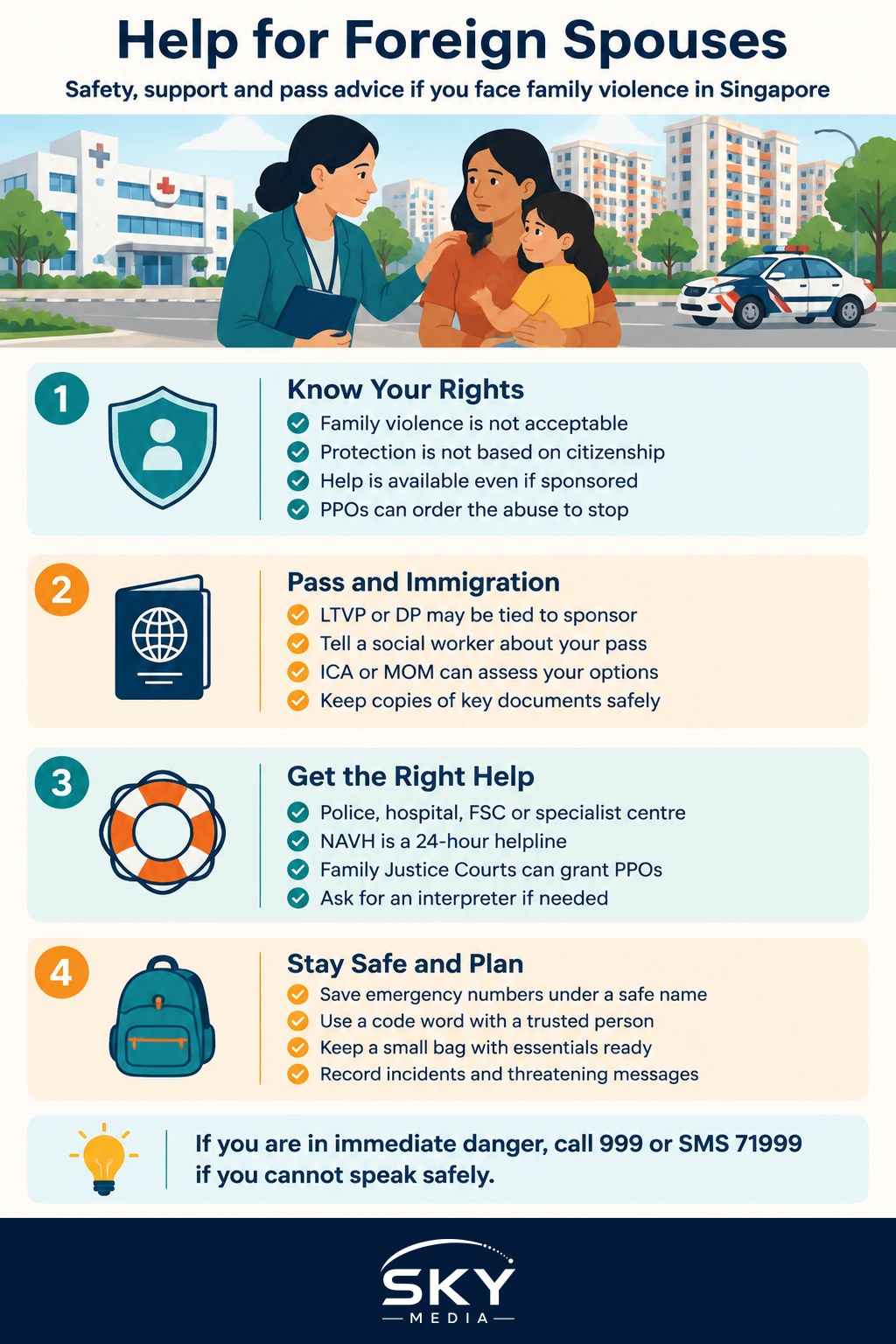
You Have the Right to Protection, Whatever Your Pass
Family violence is not a private matter in Singapore, and it is not acceptable under the law. It can include physical harm, threats, sexual abuse, keeping you locked in, harassment and, in many cases, emotional or psychological abuse and controlling behaviour such as taking away your passport or phone.
Protection under Singapore’s family violence laws is generally linked to your family relationship with the abuser, not to your citizenship. In practice, this means a foreign wife or husband can usually seek help from the police, hospitals, social service agencies and the Family Justice Courts. The courts can grant a Personal Protection Order (PPO), which orders the abuser to stop the violence, and related orders such as an Expedited Order in urgent cases. Our guide to family violence and personal protection orders explains the court process step by step.
A few points that worry many foreign spouses:
- Seeking help does not automatically cancel your pass. Reporting abuse to the police or a social worker is not a breach of your pass conditions.
- Your abuser does not control your safety. Even if they threaten to “send you home”, they cannot simply deport you. Immigration decisions are made by the authorities, not by your sponsor.
- You can bring your children with you to safety. Custody is decided by the courts, and leaving a violent home to protect yourself and your children is something social workers and courts understand.
When Your Pass Depends on the Abuser
This is the part that most guides miss. Many foreign spouses hold one of two kinds of pass:
- Long-Term Visit Pass (LTVP or LTVP+), issued by the Immigration & Checkpoints Authority (ICA), usually sponsored by a Singaporean or PR spouse. See our explainer on the LTVP+ scheme for foreign spouses.
- Dependant’s Pass (DP), issued by the Ministry of Manpower (MOM), linked to a spouse who holds an Employment Pass or S Pass.
Because the pass is tied to your sponsor, you may fear that leaving them, or the sponsor withdrawing support, will end your right to stay. Here is what generally helps:
- Tell your social worker about your pass early. Family violence specialist centres and Family Service Centres (FSCs) regularly help foreign spouses and know how to raise immigration concerns with the right agency.
- Ask about extending or changing your pass. ICA and MOM can consider individual circumstances. Where there are ongoing court proceedings, such as a PPO, divorce or custody case, it may be possible to remain in Singapore for those proceedings. Whether this applies to you depends on the agency’s assessment, so ask the agency directly or through your social worker.
- Keep copies of your documents. If you can do so safely, photograph your passport, pass card, marriage certificate and your children’s birth certificates, and store them somewhere your abuser cannot reach, such as a trusted friend’s phone or a cloud account with a new password.
- Check before working. If you need to support yourself, do not start a job until you have confirmed whether your current pass allows it. Work permission depends on MOM rules for your pass type, and working without the right permission can cause serious problems.
| Your situation | Who to contact first | What they can help with |
|---|---|---|
| In danger right now | Police (999, or SMS 71999) | Immediate safety, police report, emergency response |
| Injured or need medical care | Hospital A&E or a doctor | Treatment and medical records that can support a PPO |
| Need shelter, counselling or a plan | Family violence specialist centre or FSC | Safety planning, crisis shelter referral, court support |
| Worried about your LTVP | ICA, ideally through your social worker | Advice on your pass and options to remain |
| Worried about your Dependant’s Pass | MOM, ideally through your social worker | Advice on your pass and any change of pass |
| Want a protection order | Family Justice Courts | PPO and related orders |
Where to Get Help
You do not need to know which agency to call. Start with any one of these and they will connect you:
- National Anti-Violence and Sexual Harassment Helpline (NAVH): a 24-hour helpline for anyone experiencing or witnessing violence or abuse, set up by the Ministry of Social and Family Development (MSF). Check the MSF website for the current number and online reporting options.
- Family violence specialist centres and protection centres: these agencies specialise in family violence cases and can help with safety planning, counselling and court applications.
- Family Service Centres: neighbourhood social service hubs found across HDB towns. Our guide to Family Service Centres explains how to walk in or get referred.
- Women’s support organisations and legal clinics: some non-profit groups offer free or low-cost legal advice and help for women of all nationalities. Your social worker can refer you.
If English is not your first language, ask for an interpreter or a social worker who speaks your language. Many agencies serve clients who speak Mandarin, Bahasa Indonesia, Vietnamese, Tagalog and other languages. Mainland Chinese spouses can also contact the Embassy of the People’s Republic of China in Singapore for consular help, such as replacing a passport that was taken or destroyed.
Making a Safety Plan
Even if you are not ready to leave, a safety plan can protect you:
- Save emergency numbers in your phone under a harmless name.
- Agree a code word with a trusted friend or neighbour that means “call the police”.
- Keep a small bag with essentials, copies of documents, some cash and any medication somewhere you can reach quickly.
- Know the safest exits at home, and avoid rooms with weapons or no way out (such as the kitchen or bathroom) during an argument.
- Keep a private record of incidents: dates, what happened, photos of injuries and any threatening messages. This can support a PPO application.
- Use a phone or computer your abuser cannot check when you search for help, and clear your browser history if needed.
Thinking About the Longer Term
Once you are safe, there will be bigger questions: housing, money, your children and whether to stay in Singapore. Take these one at a time with professional help. A social worker can help you understand financial assistance you may qualify for, a lawyer can explain divorce, maintenance and custody, and ICA or MOM can explain your pass options.
You are not alone, and what is happening is not your fault. Many foreign spouses have rebuilt safe lives after leaving abuse. The first step is simply reaching out to one person or one service who can help.
Frequently Asked Questions
Can my husband get me deported if I report abuse? No, he cannot decide that himself. Immigration decisions are made by the authorities, not by a sponsor, and reporting abuse to the police or a social worker is not a breach of your pass conditions. Tell your social worker about your pass early so they can raise it with ICA or MOM.
What documents should I keep copies of before leaving an abusive spouse? If it is safe, photograph your passport, pass card, marriage certificate and your children’s birth certificates. Store them where your abuser cannot reach, such as a trusted friend’s phone or a cloud account with a new password.
Can I start working if my spouse’s pass supports me and I need income? Not until you confirm that your current pass allows it. Work permission depends on MOM rules for your pass type, and working without the right permission can cause serious problems. A social worker can help you check before you take any job.
Who can take my children if I leave home to stay safe? Custody is decided by the courts, not by the abuser. Leaving a violent home to protect yourself and your children is something social workers and courts understand. A family violence specialist centre or lawyer can explain custody and what to do next.
What can I do to stay safer if I am not ready to leave yet? Make a safety plan. Save emergency numbers under a harmless name, agree a code word with a trusted friend, keep a small bag of essentials ready, and record incidents privately with dates, photos and messages, which can support a protection order application.
Official sources: Ministry of Social and Family Development (MSF)