
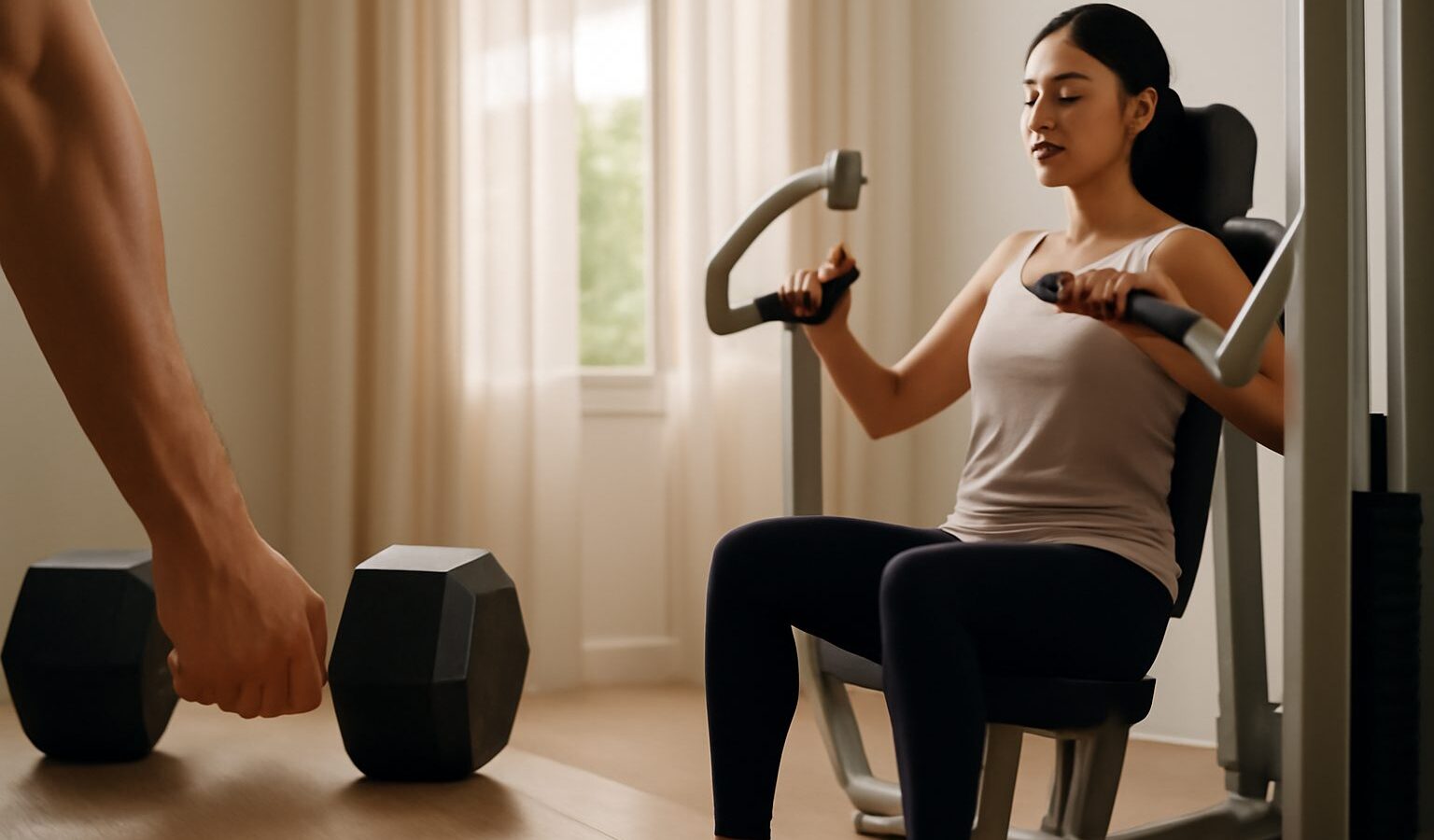
Walk into any gym in Singapore, from an ActiveSG sports centre to a commercial chain, and you face the same friendly fork in the road: the free-weights area with its dumbbells, barbells and benches, and the rows of resistance machines with their pins and cables. The free weights vs machines question in Singapore trips up a lot of beginners who worry they will pick the wrong one and waste their effort. The good news is that there is no wrong choice here. Both build strength, both have real strengths and weaknesses, and the best routines usually use a bit of each. This guide breaks down how they differ, who each suits, and how to combine them so you can train with confidence.
First, a safety note: this is general information, not medical or coaching advice. If you are new to exercise, older, returning after a break, or managing a health condition, please consult a doctor before starting a new exercise programme. Warm up properly, add load gradually, keep your form clean, and stop if something hurts in a sharp or unusual way.
What Free Weights and Machines Actually Are
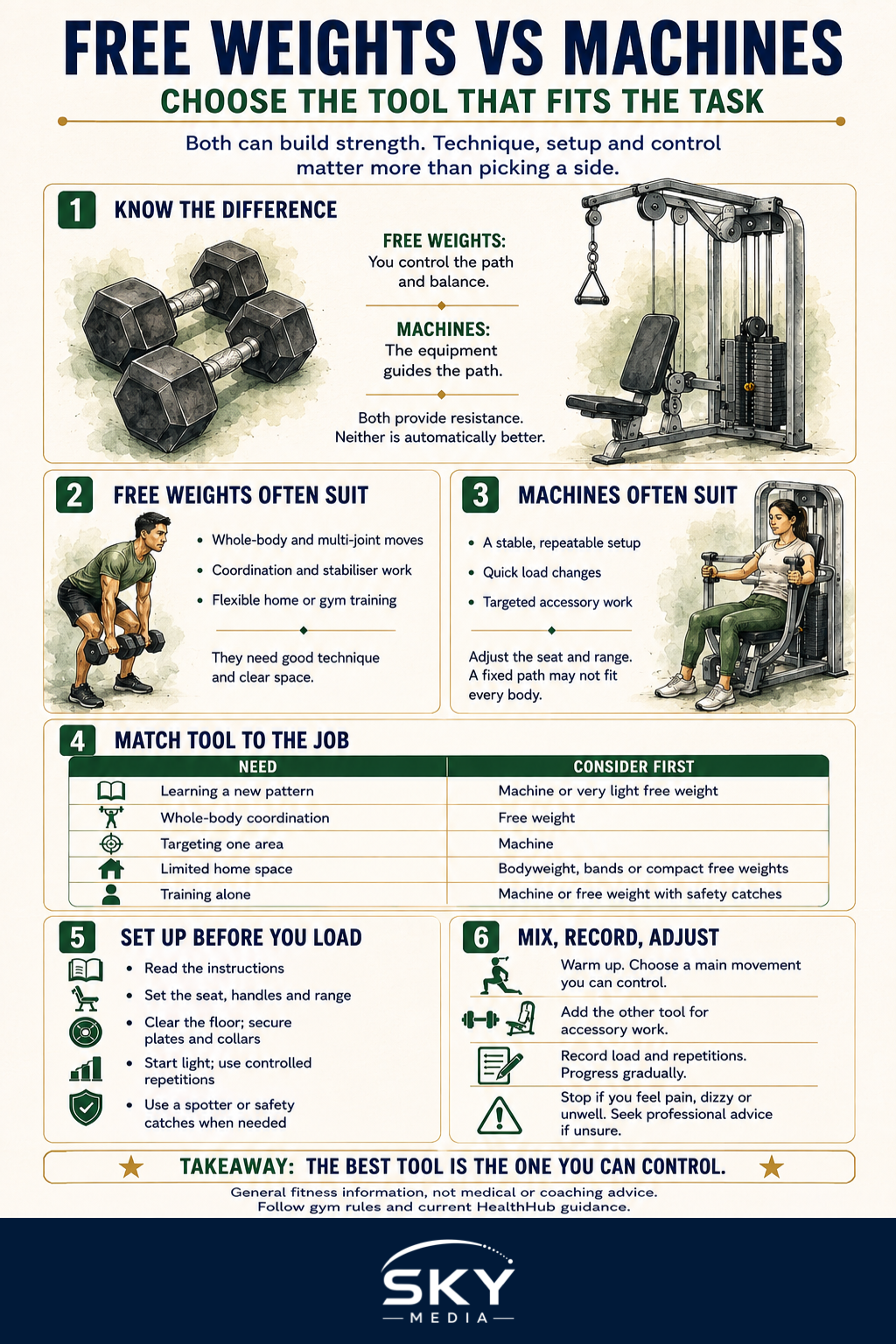
Free weights are exactly what they sound like: weights that move freely in space, with nothing guiding the path. Dumbbells, barbells, kettlebells and the plates you load onto a bar all count. Because nothing holds the weight on a track, your own muscles have to control the movement in every direction, which recruits the smaller stabilising muscles alongside the big ones you are targeting.
Machines, by contrast, guide the weight along a fixed path using pulleys, cams or levers. You sit or lie in a set position, adjust the seat, select a load with a pin, and push or pull through a groove the machine has decided for you. That fixed path is the whole point: it keeps the movement predictable and takes much of the balancing work out of your hands, so you can focus on simply moving the resistance.
Neither is inherently better. They are different tools, and understanding what each does well helps you use both wisely rather than picking a side.
The Case for Free Weights
Free weights shine because they train your body the way it moves in real life. Since you control the weight in all directions, you build coordination, balance and stabiliser strength that carry over to sport and daily tasks such as lifting groceries or a child. Big free-weight movements like squats, deadlifts, presses and rows work many muscles at once, which is efficient for building overall strength and is a big reason they anchor most serious programmes.
They are also flexible and space-friendly. A pair of adjustable dumbbells can drive a full workout, which makes free weights the natural choice if you are setting up a home gym in an HDB flat where space is tight. In a busy ActiveSG gym, the free-weights area often frees you from queueing for a specific machine, since a set of dumbbells opens up dozens of exercises.
The trade-off is that free weights demand more technique. Because you control the path, poor form has more room to creep in, and heavy barbell lifts are safest when you have learned the movement and, ideally, have a spotter or safety rails. For a beginner, that means investing a little time up front to learn good technique, whether from a coach, a beginner class or careful practice with light loads before adding weight.
The Case for Machines
Machines are wonderfully beginner-friendly. Because the path is fixed, they are easier to learn, and it is harder to lose control of the weight, which makes them a reassuring place to start building strength while your confidence grows. You simply adjust the seat, pick a moderate load, and move through the guided range, which lets you feel the target muscle working without juggling balance at the same time.
They are also excellent for isolating specific muscles. If you want to target one area, a machine can load it directly with less involvement from surrounding muscles, which is useful for building up a lagging area or training around a niggle under proper guidance. Changing the resistance is quick too, just move a pin, so machines suit circuits and higher-repetition work where you want to switch loads fast.
The limitations mirror the strengths. Because the machine does the stabilising for you, it trains those balancing muscles less, and the fixed path may not suit everybody’s body proportions perfectly. Machines also take up space and are fixed in place, so what is available depends on the gym. Even so, for learning the ropes safely and training hard without a spotter, machines earn their place.
Free Weights vs Machines: A Side-by-Side Look
Here is a simple comparison to help you match the tool to your needs. Use it as a general guide rather than a strict rulebook, since the right mix depends on your goals and experience.
| Factor | Free weights | Machines |
|---|---|---|
| Learning curve | Steeper; technique matters | Gentle; guided and easy to start |
| Stabiliser and balance work | High, trains supporting muscles | Low, machine does the balancing |
| Real-life carryover | Strong, mimics natural movement | More isolated, less functional |
| Safety without a spotter | Needs care on heavy lifts | Generally forgiving and controlled |
| Space and cost at home | Compact and affordable options | Bulky and usually costly |
| Muscle isolation | Harder to isolate one muscle | Easy to target a specific area |
Notice that the columns are not winners and losers but a set of trade-offs. A tool that is weak in one row is often strong in another, which is precisely why blending them works so well.
How to Combine Both in a Singapore Gym
For most people, the smartest approach is not either-or but both. A common and sensible pattern is to use machines to warm up and learn a movement pattern safely, then bring in free weights for your main compound lifts once your form is solid. Alternatively, anchor your session with a few big free-weight exercises for overall strength, then finish with machines to target specific muscles or to push a muscle safely when you are tired and balance is fading.
In an ActiveSG gym, this flexibility is a gift, because the public gyms typically stock both a free-weights area and a range of machines, so you can mix freely at low cost. Book your session through the ActiveSG app, and remember that facilities, equipment and availability vary by centre and can change, so check the current details for your gym. If you are unsure how a piece of equipment works, ask the staff, read the instructions on the machine, and start light. Whichever you lean on, consistency over weeks and months is what actually builds strength, so pick the combination you enjoy enough to keep doing.
Explore more
If you are just starting out, our guide to strength training for beginners in Singapore walks you through the first steps, and building muscle in Singapore explains how to keep progressing. Planning to train at home instead? See setting up a home gym in Singapore for how to choose your first equipment.