

You can draw. Your portfolio looks good. Then the first client email arrives asking “how much for a few illustrations?” and you have no idea what to say. For a freelance illustrator Singapore work is as much about business as it is about art: how you price, what rights you hand over, what goes into the contract and where the next job comes from. This guide covers that business side, not drawing technique. It is general information, not legal or financial advice.
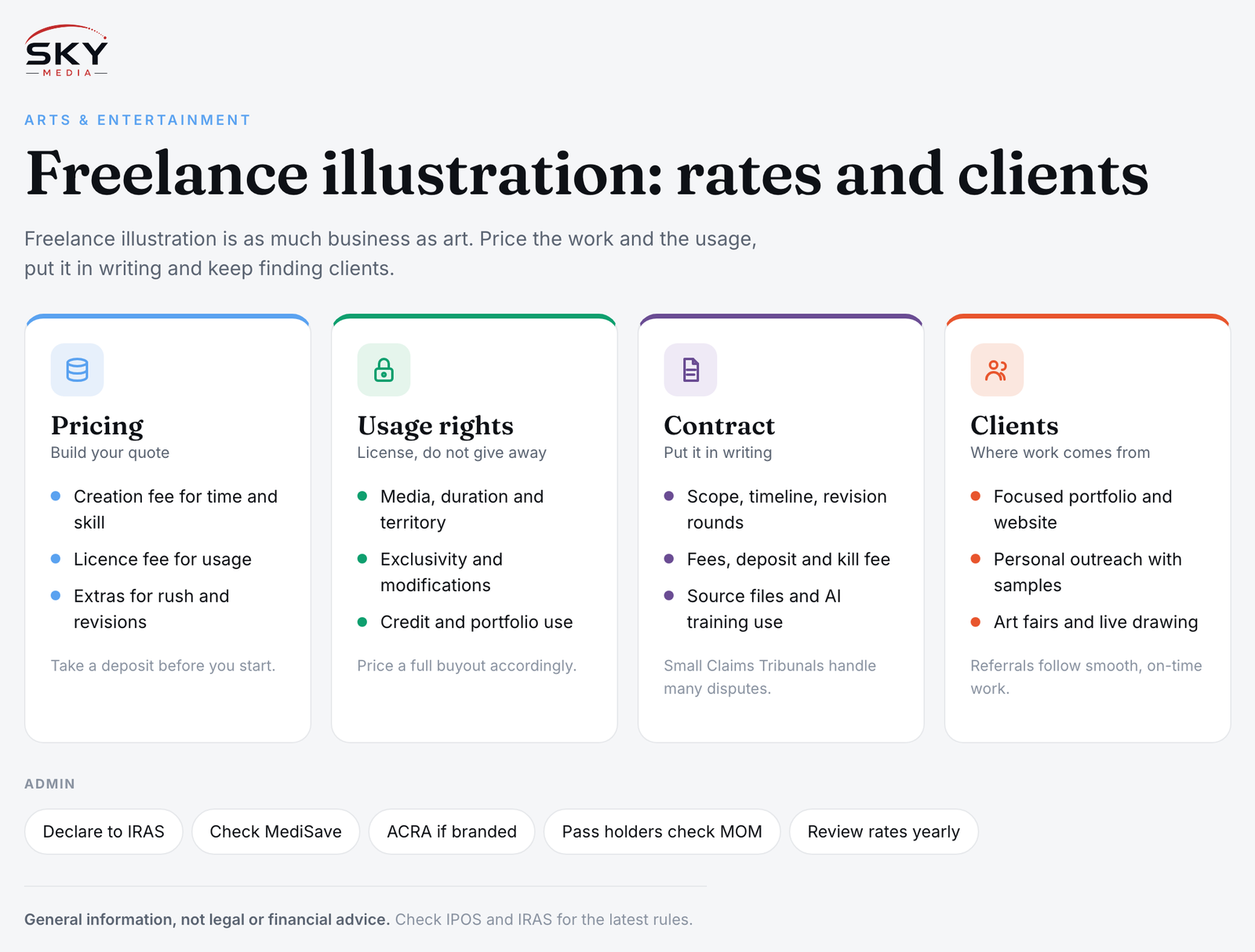
How Illustration Pricing Actually Works
Illustration is not priced like a haircut. Two pieces that take the same hours can be worth very different amounts, because the fee pays for two things: your time and skill to make the work, and the right to use it. A spot illustration for an internal newsletter and the same drawing on a national ad campaign are not the same job.
Most illustrators build a quote from these parts:
- Creation fee. Your time for sketches, revisions and final art. Work out an hourly or day rate that covers your living costs, software, hardware, CPF and tax, then estimate hours honestly.
- Usage or licence fee. What the client may do with the art: where (social, print, packaging, outdoor), for how long, in which countries, and whether they get exclusivity.
- Extras. Rush jobs, extra revision rounds, source files, and commercial use of a character you designed all justify extra charges.
Do not copy a number from an online forum. Rates vary hugely by experience, style, industry and client size. Look at your own costs, ask more experienced illustrators in local creative communities what range they work in, and raise your rates as your portfolio and demand grow. For the general method behind setting a number, see How to Set Your Freelance Rates in Singapore.
Choosing a Pricing Model
Different jobs suit different structures. Here is how the common ones compare.
| Pricing model | Works best for | Watch out for |
|---|---|---|
| Per piece (flat fee) | Book covers, editorial spots, posters with a clear brief | Scope creep if the number of revisions is not fixed |
| Day or hourly rate | On-site live drawing, studio support, storyboarding sessions | Clients questioning hours; keep a simple time log |
| Creation fee plus licence | Brand mascots, packaging, advertising campaigns | Explaining usage clearly so the client sees the value |
| Project package | Full sets, such as an illustrated report or a series of social posts | Underquoting when the “set” quietly grows |
| Royalty or revenue share | Picture books, merchandise, some publishing deals | Payment can be slow and small; read reporting terms carefully |
Whatever model you choose, put a deposit in place. Many illustrators ask for a portion upfront before starting, with the balance on delivery of final files. It filters out clients who are not serious and protects you if a project is cancelled halfway.
Usage Rights: The Part Beginners Give Away
Under Singapore copyright law, the creator is generally the first owner of the copyright in their work unless a contract or employment arrangement says otherwise. The details can be nuanced, so check the guidance from IPOS (the Intellectual Property Office of Singapore) or ask a lawyer for anything high value.
In practice, this means you usually license rather than sell outright. Spell out:
- Media: digital only, print only, or both. Packaging, merchandise and outdoor ads are usually charged higher.
- Duration: one year, three years, or perpetual.
- Territory: Singapore only, Southeast Asia, or worldwide.
- Exclusivity: can you resell the image or reuse it? Exclusive rights cost more.
- Modifications: may the client edit, crop or recolour your work, or create new art from your character?
- Credit and portfolio use: your right to be credited and to show the work in your portfolio after launch.
If a client wants a full copyright buyout, that is a legitimate request, but price it accordingly. Signing away every right for a small flat fee is one of the most common regrets among new illustrators.
What to Put in an Illustration Contract
A contract does not need to be long. A clear one-to-three page agreement or a detailed written quote that the client accepts in writing is far better than a casual chat message. Cover:
- Scope. Number of pieces, sizes, format, colour or black-and-white, style references.
- Timeline. Sketch date, feedback window, final delivery date, and what happens if the client is late with feedback.
- Revisions. How many rounds are included at sketch stage and at final stage, and the fee for extra rounds.
- Fees and payment. Deposit, balance, due dates, accepted payment methods (PayNow, bank transfer) and a late payment clause.
- Usage rights. Everything from the section above.
- Kill fee. What you are paid if the client cancels after work has started, often linked to the stage reached.
- File delivery. Whether source files are included or charged separately.
- AI and training use. Increasingly, illustrators state whether the client may use the work to train AI tools. If it matters to you, write it in.
Send a proper invoice with a reference number, your details, the job description and the payment terms. If a client simply will not pay, start with polite written reminders, then a formal letter of demand. Singapore’s Small Claims Tribunals handle many smaller contract disputes; check the State Courts website for current limits and procedures. For more on chasing payment, read Freelance Contracts and Getting Paid.
Finding Illustration Clients in Singapore
Good work does not market itself. Most freelance illustrators combine several channels.
- A focused portfolio. Show the kind of work you want more of. If you want children’s book jobs, lead with narrative spreads, not logo sketches. Keep a simple website plus one or two active social profiles.
- Direct outreach. Make a short list of agencies, publishers, cafes, local brands and event organisers whose visual style fits yours. Send a brief, personal email with three relevant samples and a link, not a generic mass message.
- Art markets and fairs. Local zine fests, craft markets and comic conventions let you sell prints and meet art directors, small business owners and other illustrators in person.
- Live illustration. Live drawing at corporate events, weddings and launches is a niche where clients book you directly. It also generates content that brings in more work.
- Referrals and repeat clients. Deliver on time, communicate clearly, and make revisions painless. A designer who enjoyed working with you will pass your name on.
- Freelance marketplaces. Useful for practice and early income, but expect heavy price competition. Treat them as a start, not the whole plan.
For general outreach strategies that apply across creative fields, see How to Find Freelance Clients in Singapore.
Admin You Cannot Ignore
Once illustration becomes real income, the paperwork follows.
- Tax. Self-employed income must be declared to IRAS (the Inland Revenue Authority of Singapore) in your annual tax filing. Keep records of income and business expenses such as software subscriptions, tablets and art supplies.
- CPF MediSave. Self-employed persons may be required to contribute to their MediSave account depending on their income. Check the current rules with the CPF Board.
- Business registration. Many freelancers work under their own name, but if you trade under a brand name or grow larger, you may need to register a business with ACRA (the Accounting and Corporate Regulatory Authority) through Bizfile. Confirm what applies to you on the ACRA website.
- Pass holders. If you are in Singapore on a work pass or dependant pass, whether you may freelance depends on MOM rules for your specific pass. Check with MOM before taking any paid work.
Set aside part of every payment for tax, and track jobs, invoices and payment dates in a simple spreadsheet.
Raising Your Rates Over Time
Review your rates yearly. A permanently full calendar, clients accepting every quote instantly and constant burnout all suggest you are underpriced. Raise rates for new clients first and give existing clients notice.
Explore more: Building a Freelance Portfolio