

If you enjoy thinking a few moves ahead, moving units across a grid, and watching a careful plan come together, tactical RPGs might become your favourite genre. Getting into tactical rpgs in Singapore is straightforward, since the genre runs happily on consoles, PCs, and handhelds, and it does not demand fast reflexes or expensive hardware. This guide explains what these games are, what makes them tick, and how to start without getting stuck.
What A Tactical RPG Is
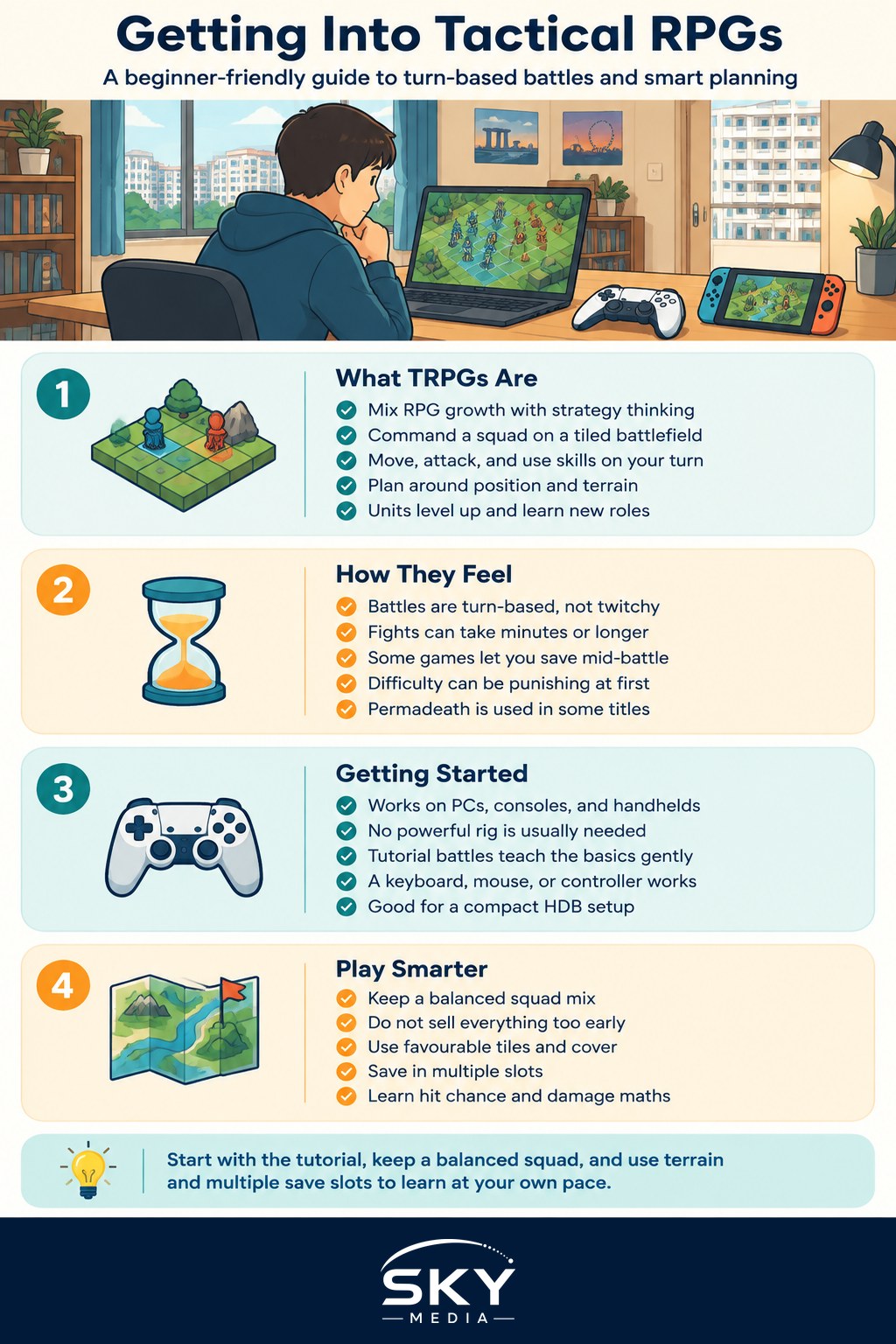
A tactical RPG, sometimes shortened to TRPG or SRPG, blends the character growth of a role-playing game with the map-based thinking of a strategy game. Instead of a single hero swinging a sword, you command a squad of characters across a battlefield, often divided into squares or tiles. On your turn, you move each unit, decide who attacks whom, and use skills to gain an edge. Then the enemy takes its turn, and the back-and-forth continues until one side wins.
The satisfaction comes from position and planning. High ground might give a bonus to accuracy. Flanking an enemy from the side or back can deal extra damage. Some units are fragile but hit hard, so you protect them behind sturdier front-liners. Over a campaign, your characters level up, learn new abilities, and often change classes or roles, which keeps every battle feeling fresh.
If you want the wider picture of how strategy games work, our guide on getting into strategy games is a good companion, since tactical RPGs sit at the crossroads of strategy and role-playing.
How It Compares To Other Genres
Tactical RPGs are close relatives of both traditional role-playing games and pure strategy titles. Compared with a standard JRPG, a tactical RPG usually swaps free-roaming exploration for a series of set battles, each one a puzzle to solve. Compared with a large-scale strategy game, it is more intimate, since you care about individual named characters rather than faceless armies.
If you are coming from other role-playing games, our overview of getting into rpgs covers the shared foundations like levelling, gear, and party building. Fans of story-heavy Japanese role-players may also enjoy getting into jrpgs, which shares a lot of DNA with the tactical branch. And if you like the idea of managing bigger empires and long-term planning, what are 4x strategy games explores a grander scale.
What To Expect Before You Start
Turns take time, and that is by design. A single battle can last from a few minutes to over an hour, depending on the map and difficulty. This makes tactical RPGs a great fit for relaxed sessions where you want to think rather than react. If you play on a commute or in short bursts, look for titles that let you save mid-battle.
Difficulty can be a real factor. Some tactical RPGs are famous for punishing mistakes, and a poorly placed unit can lead to a lost fight. Many modern games soften this with adjustable difficulty, rewind features, or the option to retry a battle. There is nothing wrong with using these tools while you learn the ropes.
Permadeath is worth knowing about. In some games, a fallen character is gone for good, which raises the stakes on every decision. Others simply knock characters out until the battle ends. Check which style a game uses, because it changes how cautiously you should play.
Getting Started In Singapore
You do not need a powerful rig for this genre. Because the action is turn-based, tactical RPGs run smoothly on modest laptops, older consoles, and handhelds, which suits a compact HDB setup or a player on a budget. A basic controller or a keyboard and mouse both work well.
Here are some tips to make your first campaign go smoothly.
- Play the tutorial battles properly. Tactical RPGs stack up systems quickly, and the early missions teach movement, cover, and skills at a gentle pace.
- Keep a balanced squad. Mix sturdy front-line units, ranged attackers, and a healer or support so you can handle different situations.
- Do not sell everything. Gear and resources matter, and hoarding a little early on saves regret later.
- Use terrain. Standing on favourable tiles and forcing enemies onto weak ones is often the difference between a win and a wipe.
- Save in multiple slots. This protects you if a battle goes sideways and lets you learn from mistakes without losing hours.
Take your time learning the maths behind hit chances and damage. Understanding why an attack has a certain accuracy helps you make smarter calls and avoid frustrating misses at the worst moment.
Enjoying The Long Game
Tactical RPGs reward patience and cleverness rather than twitch skill, which makes them welcoming for players of all ages and reaction speeds. The joy is in the slow build, watching a raw recruit grow into a battle-hardened veteran and pulling off a plan you spent ten minutes setting up. Start on a comfortable difficulty, take breaks between long battles, and let yourself experiment. Once the systems click, few genres feel as consistently rewarding, and there is always a tougher map waiting for when you are ready.
Frequently Asked Questions
What is permadeath in tactical RPGs? Permadeath means a fallen character is gone for good, which raises the stakes on every decision. Other games simply knock characters out until the battle ends. Check which style a game uses before you start, since it changes how cautiously you should play.
How long does one tactical RPG battle take? A single battle can last from a few minutes to over an hour, depending on the map and difficulty. If you play on a commute or in short bursts, look for titles that let you save mid-battle. This pace suits relaxed sessions where you want to think.
How is a tactical RPG different from a regular JRPG? A tactical RPG usually swaps free-roaming exploration for a series of set battles on a grid, each one a puzzle to solve. A standard JRPG leans more on exploration and a party menu-driven fight. The two share a lot, so fans of one often like the other.
What makes a good squad in a tactical RPG? Balance. Mix sturdy front-line units, ranged attackers and a healer or support so you can handle different situations. Use terrain too, since favourable tiles and flanking can decide a fight. Do not sell everything, as gear and resources matter later.
Can I play tactical RPGs on a modest laptop or handheld? Yes. Because the action is turn-based, they run smoothly on modest laptops, older consoles and handhelds. A basic controller, or a keyboard and mouse, works well. Check each game’s requirements before buying, especially for newer titles.