
Selling original paintings one at a time limits how many people can own your work. Prints solve that, but cheap reproductions can make good art look flat and fade within a few years. Giclee printing is the fine art standard for reproductions that hold colour and detail. If you are researching giclee printing in Singapore, this guide walks you through the full process: capturing your artwork, choosing paper, picking a print shop and editioning your prints properly.
What Giclee Printing Means
“Giclee” (pronounced zhee-clay, from a French word meaning to spray) refers to high-quality inkjet printing using pigment-based archival inks on archival paper or canvas. It is not a separate machine type so much as a standard of materials and care:
- Pigment inks resist fading much better than the dye inks in most home and office printers.
- Archival papers are acid-free, so they do not yellow or become brittle as quickly.
- Wide colour range: professional printers use many ink colours to reproduce subtle tones.
- High-resolution files capture fine brushwork and texture.
Done well, a giclee print can look very close to the original and last for decades when displayed away from direct sun and humidity. Claims about exact lifespans come from the ink and paper makers’ own testing, so treat them as estimates.
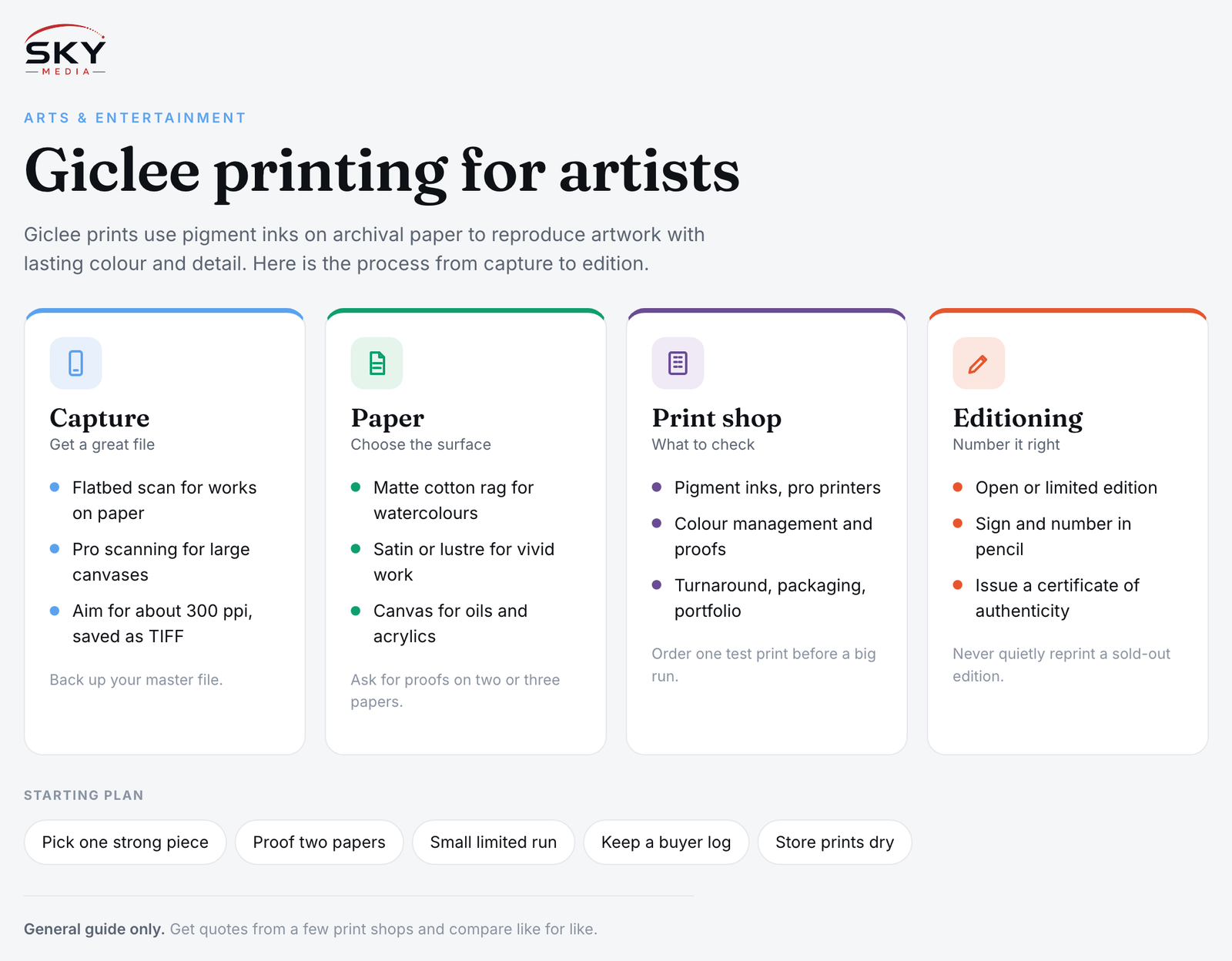
Step One: Capturing Your Artwork
The print can only be as good as the digital file. You have three main options:
- Flatbed scanning suits works on paper that fit the scanner bed, such as watercolours, drawings and small prints. Scan at a high resolution so you can print at full size or larger.
- Professional large-format scanning or reproduction photography suits large canvases, textured paintings and work that cannot lie flat. Many fine art print shops offer this, using controlled lighting to avoid glare and colour shifts.
- Photographing it yourself can work for smaller pieces if you are careful with even lighting, a straight-on camera angle and a colour reference card. Our guide on how to photograph your artwork and crafts covers the basics.
Whichever route you choose, aim for a file that gives roughly 300 pixels per inch at your largest intended print size, saved in a lossless format such as TIFF. Keep this master file safe and backed up; it is a valuable asset.
Colour Correction and Proofing
Raw scans rarely match the original exactly. Colour correction adjusts the file so the print looks like the painting under normal light.
- Use a calibrated screen if you edit files yourself, otherwise what you see will not match the print.
- Ask for a test proof, usually a small strip or reduced-size print, and compare it with the original side by side in daylight.
- Expect one or two rounds of adjustment for tricky colours like deep blues, bright greens and metallic tones.
- Save the approved file so reprints stay consistent across your edition.
Some shops include proofing in their service; others charge separately. Ask before you commit.
Choosing Paper and Canvas
Paper choice changes the feel of a print dramatically. Here is how the main types compare.
| Material | Look and feel | Suits | Things to know |
|---|---|---|---|
| Smooth matte cotton rag | Soft, flat finish with no shine | Watercolours, illustration, drawings | Rich but slightly muted blacks; sensitive to handling marks |
| Textured matte (cold press style) | Visible paper tooth | Watercolours and painterly work | Texture can compete with very fine detail |
| Satin or lustre photo rag | Gentle sheen, deeper blacks | Vivid paintings, digital art, photography | Some glare under strong lighting |
| Gloss | High shine, strongest contrast | Bold graphic work | Shows fingerprints and reflections; less “fine art” feel |
| Canvas | Woven texture, can be stretched | Reproducing oil and acrylic paintings | Usually stretched or framed; check the coating for protection |
Ask print shops for paper sample books or small test prints on two or three papers. Seeing your own image on each is the fastest way to decide.
In Singapore, humidity is a real concern for paper. Store unframed prints in sealed sleeves with silica gel, and see our guide to protecting paintings and art prints from humidity before you stock up.
Choosing a Print Shop in Singapore
Singapore has a mix of dedicated fine art printers, photo labs and general print shops that offer giclee printing. Quality varies widely, so check:
- Inks and printers used. Ask whether they print with pigment inks on professional large-format printers.
- Paper range. A good shop stocks several archival papers and can explain the differences.
- Colour management. Do they calibrate their equipment and offer proofs?
- Scanning or reproduction services, if you need them, and whether they will give you the master file.
- Turnaround and minimum orders. Some shops print single copies; others prefer batches.
- Packaging. Prints should be handled with gloves and shipped flat or rolled in tubes with protective tissue.
- Portfolio and reviews. Look at examples of other artists’ work they have printed.
Get quotes from two or three shops, and order a single test print before placing a large run. Prices depend on size, paper, quantity and services, so compare like for like.
Editioning Your Prints
Editioning is how you tell buyers how many prints exist, which affects value and trust.
- Open edition: no fixed limit. Good for affordable prints and posters.
- Limited edition: a fixed number, for example 50, and you never print more of that image at that size and paper. Each print is numbered, such as 12/50.
- Artist’s proofs (AP): a small number of prints outside the main edition, traditionally kept by the artist. Keep this small and be transparent about it.
Good practice for limited editions:
- Decide the edition size before printing and record it.
- Sign and number each print in pencil, usually below the image.
- Issue a certificate of authenticity listing title, edition number, size, paper, ink type and date.
- Keep a log of which number went to which buyer.
- Do not quietly reprint a sold-out limited edition. If you want more prints, release a clearly different size or version and label it as such.
Copyright and Selling
You keep copyright in your original artwork when you make prints, and selling a print does not transfer it to the buyer. If you are reproducing someone else’s artwork or photograph, you need their permission first.
If you plan to sell regularly, our guide on turning a hobby into a business covers the practical side of pricing, registering and finding buyers. Selling at craft markets, online shops and through commissions all work well with a small run of good giclee prints.
A Simple Starting Plan
- Choose one strong piece that people already respond to.
- Get it professionally scanned or photographed.
- Order proofs on two papers and compare them with the original.
- Print a small limited edition in one size.
- Sign, number and issue certificates.
- Store spares flat, sleeved and dry.
Start small, learn what sells, and build your print catalogue from there.
Further reading: Where to Frame Art, Prints and Posters in Singapore