
If you grew up in mainland China, there is a good chance you have played Dou Dizhu on a phone or watched relatives argue over a game of Guandan. For newcomers to Singapore, these games can be a comforting piece of home and an easy way to make friends. For Singaporeans curious about them, they are fast, social and surprisingly strategic. This guide explains the basic guandan rules, how Dou Dizhu works, and how to find people to play with locally.
House rules vary a lot between provinces, families and apps, so treat this as a starting point and always agree the rules before the first hand.
Dou Dizhu: Fight the Landlord in Brief
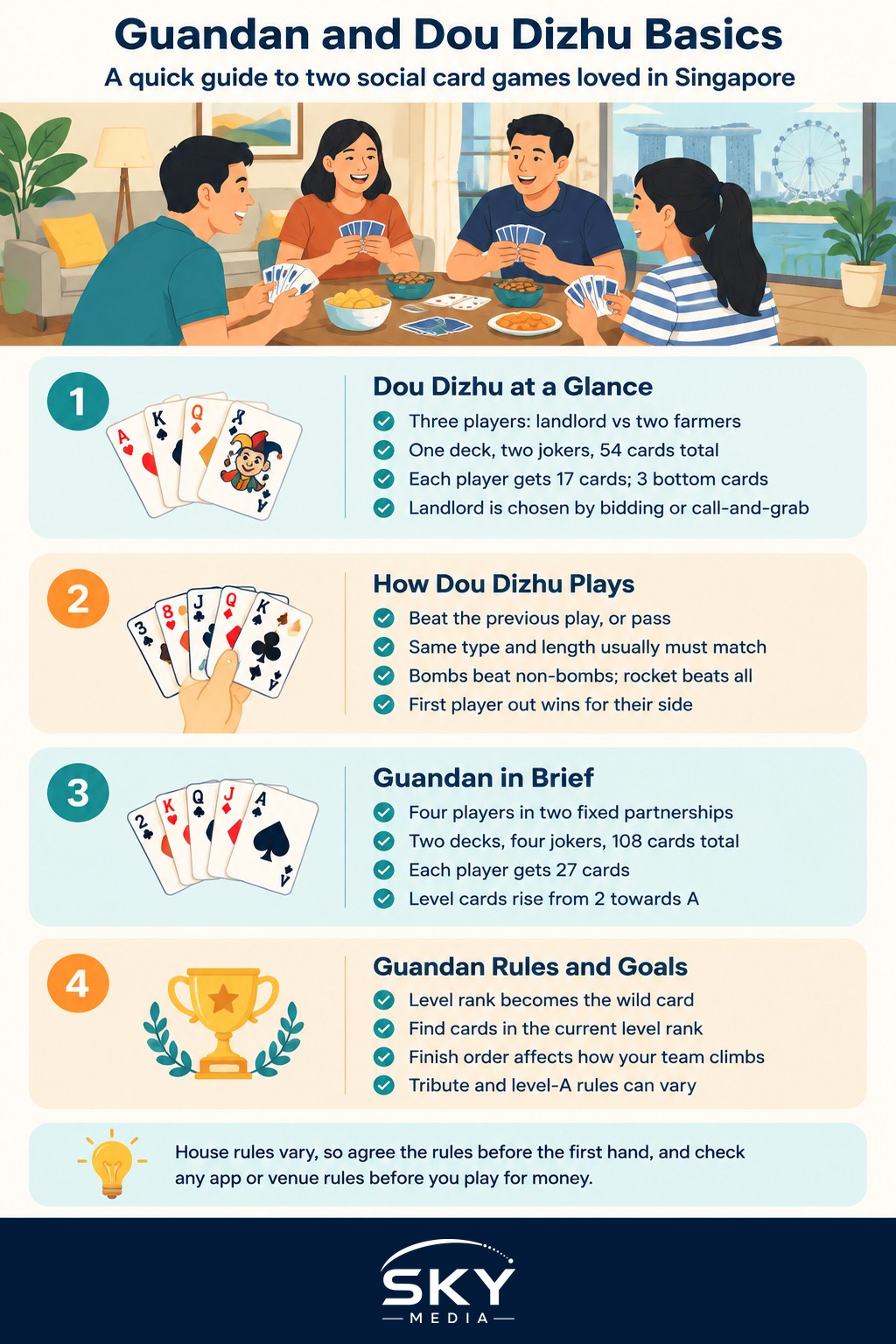
Dou Dizhu (斗地主) means “Fight the Landlord”. It is a three-player game where one player, the landlord, plays alone against the other two, who team up as farmers or peasants.
The deck and the deal
- One standard 52-card deck plus two jokers, 54 cards in total.
- Each player gets 17 cards. Three cards are left face down as the “bottom cards”.
Choosing the landlord
Players take turns to bid, usually 1, 2 or 3 points, or to pass. The highest bidder becomes the landlord, picks up the three bottom cards, shows them to everyone, and leads first. Many apps use a “call and grab” variation instead of point bids.
Card ranking
From low to high: 3, 4, 5, 6, 7, 8, 9, 10, J, Q, K, A, 2, small joker, big joker. Suits do not matter.
Common combinations
- Single card, pair, or triple
- Triple with one single, or triple with a pair
- Straight: at least five cards in sequence, from 3 up to A only (2s and jokers cannot be used)
- Consecutive pairs: at least three pairs in sequence, such as 334455
- Airplane: two or more consecutive triples, optionally with matching “wings” of extra singles or pairs
- Four of a kind with two extra cards
- Bomb: four of a kind played alone
- Rocket: both jokers together, the strongest play in the game
How play works
The leader plays any valid combination. Each following player must play a higher combination of the same type and length, or pass. A bomb beats any non-bomb combination, a higher bomb beats a lower one, and the rocket beats everything. When two players pass in a row, the last player to play leads again with anything they like.
The first player to empty their hand wins for their side. If the landlord goes out first, the landlord wins. If either peasant goes out first, both peasants win. Bombs and rockets usually double the score, which is where the excitement comes from.
Guandan: The Four-Player Partnership Game
Guandan (掼蛋) comes from Jiangsu province and has spread across China as a popular game for colleagues, friends and family gatherings. It is a team game for four players in two fixed partnerships, with partners sitting opposite each other, rather like bridge.
The deck and the deal
- Two full decks including all four jokers, 108 cards in total.
- Each player is dealt 27 cards.
Levels and the level card
This is the part that confuses newcomers most. Each team has a level, starting at 2 and climbing towards A. Each hand is played at the current level of the team that won the previous hand.
- The rank matching the current level becomes the level card. It ranks above A and just below the jokers. If you are playing at level 5, every 5 becomes a high card.
- The two hearts of that rank are wild cards, often called “逢人配”. They can stand in for any card except a joker to complete a combination.
Card ranking
Outside the level card, ranking runs 2 (lowest), 3, 4 up to K, A, then the level card, small jokers and big jokers. An A can also be used low in the straight A2345.
Valid combinations
- Single, pair, triple
- Triple with a pair (like a full house)
- Straight: exactly five consecutive cards
- Three consecutive pairs, such as 556677
- Steel plate (钢板): two consecutive triples, such as 777888
- Bombs: four or more cards of the same rank, with more cards beating fewer
- Straight flush: five consecutive cards of the same suit, which beats a five-card bomb but loses to a bomb of six or more
- Four jokers together, the highest play in the game
Play follows the same principle as Dou Dizhu: beat the previous play with the same type, or use a bomb, or pass.
Finishing order and moving up
The order in which players run out of cards matters. Your team climbs levels based on where both partners finish. Under commonly used rules:
- Partners finish first and second: the team goes up three levels
- First and third: up two levels
- First and last: up one level
Tribute
Before the next hand, the player who finished last gives their highest card (not a wild card) to the winner, who hands back a lower card, usually 10 or below. If the paying side holds both big jokers, they may be allowed to refuse tribute. Rules for tribute and for winning at level A differ between groups, so confirm them first.
Guandan and Dou Dizhu Compared
| Feature | Dou Dizhu | Guandan |
|---|---|---|
| Players | 3, one against two | 4, two fixed teams |
| Cards | One deck plus 2 jokers (54) | Two decks plus 4 jokers (108) |
| Cards per player | 17, landlord gets 20 | 27 |
| Wild cards | None in the classic game | Hearts of the level rank |
| Goal | Empty your hand first for your side | Help your team finish high and climb from 2 to A |
| Typical length | A few minutes per hand | A full match can take an evening |
Tips for Learning Quickly
- Start with Dou Dizhu. It has fewer special rules, so it teaches you the “beat it or pass” rhythm.
- Count the big cards. Keep track of jokers, 2s and bombs that have been played. This is the heart of strategy in both games.
- Do not break bombs too early. Saving a bomb for the right moment often decides a hand.
- In Guandan, play for your partner. Sometimes passing so your partner can go out first is better than winning the trick yourself.
- Practise on an app. Many mobile apps let you play against computer opponents before you join a real table. Check the app’s privacy settings and in-app purchases.
Where to Find Players in Singapore
Card groups in Singapore tend to form through community networks rather than dedicated venues.
- Friends and colleagues. Many mainland Chinese newcomers find games through WeChat groups for their workplace, hometown, university alumni or condo.
- Community clubs and residents’ networks. Some community clubs run interest groups for card and board games. Ask at your local CC or check the People’s Association’s official channels for current activities.
- Clan and hometown associations. Some associations organise social gatherings where card games are common.
- Board game cafes. Some will let you bring your own cards or teach groups. Our guide on where to play board games in Singapore has ideas, and if your group also enjoys tile games, see where to play mahjong and Chinese chess.
- Your own home. Hosting is the simplest option. Two decks of cards and a table are all you need for Guandan.
A note on stakes: these games are best enjoyed for fun. Gambling in Singapore is regulated, and the Gambling Regulatory Authority of Singapore oversees the rules. If your group is thinking about playing for money, check what is permitted first, and keep it friendly. A good game, some snacks and a bit of noise at the table are what make these games memorable.
Frequently Asked Questions
Which is easier for a beginner, Guandan or Dou Dizhu? Dou Dizhu is easier, since it has fewer special rules and teaches the beat-it-or-pass rhythm. Guandan adds levels, wild hearts and tribute, so it is best learned afterwards. Agree the house rules before the first hand either way.
What are the wild cards in Guandan? The two hearts of the current level rank are wild cards, often called 逢人配. They can stand in for any card except a joker to complete a combination. At level 5, for example, every 5 becomes a high card, and the heart 5s are wild.
How does a Guandan team move up levels? Under commonly used rules, partners finishing first and second go up three levels, first and third up two, and first and last up one. Tribute rules and winning at level A differ between groups, so confirm them first.
Can I practise on a phone app before playing at a real table? Yes, many mobile apps let you play against computer opponents first. Check the app’s privacy settings and in-app purchases before you start, and remember that house rules in apps may differ from those your family or friends use.
Is it okay to play Guandan for money in Singapore? Gambling in Singapore is regulated, and the Gambling Regulatory Authority of Singapore oversees the rules. If your group is thinking of playing for money, check what is permitted first. These games are best enjoyed for fun with some snacks.