

For many Muslim savers, building wealth is not only about returns. It is also about staying true to their faith. Shariah investing in Singapore is the practice of putting money to work in a way that follows Islamic principles, avoiding businesses and structures that Islam does not permit. This article is general information and education only, not financial or religious advice, and it is not tailored to your situation. Before you act, consider your own circumstances, speak to a licensed, MAS-regulated financial adviser, and consult a knowledgeable religious teacher or scholar on matters of faith.
The core principles, explained simply
Shariah-compliant investing rests on a handful of ideas that shape what a person may and may not do with their money. These are broad principles, and Islamic scholars can differ on the finer points, so treat the summary below as a respectful starting point rather than a ruling.
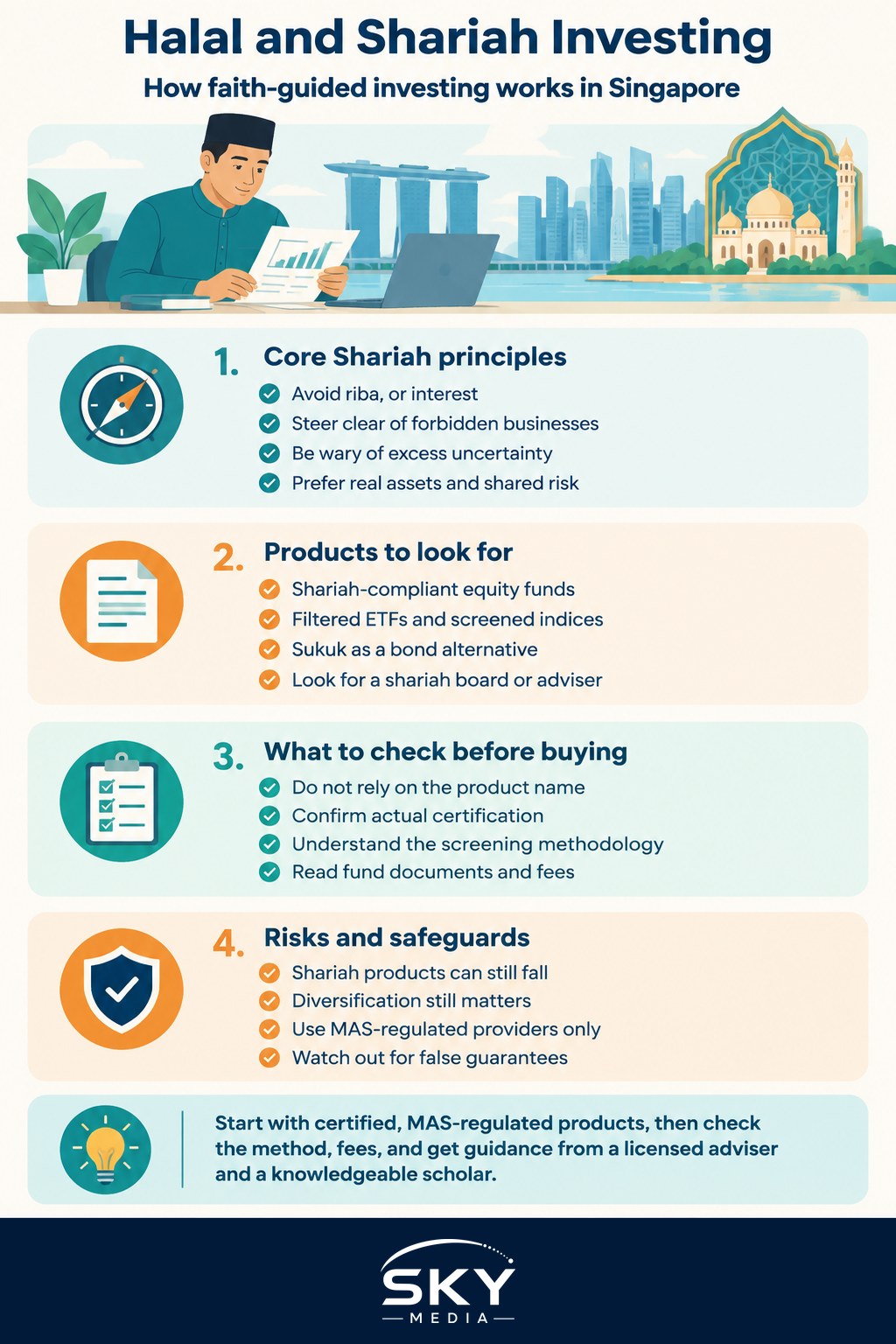
First, there is the avoidance of riba, usually translated as interest. Earning or paying interest is not permitted, which affects how Muslims view conventional bonds, savings accounts, and heavily indebted companies.
Second, there is the avoidance of certain business activities. Money should not be earned from things Islam prohibits, such as alcohol, pork, gambling, conventional interest-based lending, and adult entertainment. A company that makes most of its income from these areas would not pass a shariah screen.
Third, there is a discomfort with excessive uncertainty, known as gharar, and with pure speculation, known as maisir. This is one reason many scholars are cautious about highly speculative products.
Fourth, there is an emphasis on real economic activity and shared risk. Islamic finance leans towards arrangements where profit and loss are genuinely shared, rather than a guaranteed return regardless of what happens to the underlying business.
Because company finances are rarely perfectly clean, shariah screening also looks at financial ratios, such as how much debt or interest income a business carries relative to its size. Where a small amount of income comes from non-compliant sources, some methodologies allow the investor to give away that portion to charity, a process often called purification. The exact thresholds and rules are set by scholars and vary between index providers and funds.
How shariah-compliant products work in practice
In practice, most retail investors do not screen every company themselves. Instead they use products that have already been reviewed. Common building blocks include shariah-compliant equity funds and exchange-traded funds that track a filtered index, and sukuk, which are often described as the Islamic alternative to bonds. Rather than paying interest, sukuk are structured around ownership of real assets and the income they produce, which is how they aim to stay within the rules.
A genuinely shariah-compliant fund will normally have a shariah board or an appointed shariah adviser that reviews its holdings and issues certification. This is the single most important thing to check. Do not assume a product is compliant because its name sounds Islamic or because it mentions ethical values. Look for the actual certification, understand who issued it, and read what the methodology screens for.
It also helps to understand where shariah investing overlaps with, and differs from, broader values-based investing. If you are curious about the wider field of investing with principles in mind, our guide to ESG and sustainable investing in Singapore covers related ground, though the screens and the underlying philosophy are not the same.
The risks are the same as any investment
It is important to be honest here. Choosing a shariah-compliant product does not remove investment risk. Your capital is still at risk, the value can still fall, past performance is not a guide to future returns, and there are no guaranteed returns. A shariah screen governs what you may own, not whether it will make money.
Because the eligible universe is smaller, shariah portfolios can also end up more concentrated in certain sectors, such as technology or healthcare, and lighter in others, such as conventional banks. That can change how the portfolio behaves compared with a broad market fund. Diversification still matters, and understanding exactly what you are buying still matters.
As with any investment in Singapore, deal only with entities that are licensed and regulated by the Monetary Authority of Singapore. Check the MAS Financial Institutions Directory before you commit, and check the MAS Investor Alert List for names to avoid. Be especially wary of anyone promising guaranteed or unusually high returns while wrapping the pitch in religious language, as scammers do misuse faith to build trust.
A practical way to begin
If shariah investing appeals to you, a calm and steady approach tends to serve people best. Get the basics of investing clear first, since the same fundamentals apply. Our overview of how to start investing in Singapore and the primer on investing basics for beginners in Singapore are useful companions to this piece.
From there, define what compliance means to you, ask your religious adviser about anything you are unsure of, and only use certified products from MAS-regulated providers. Read the fund documents, understand the fees, and be clear about the certification behind any product before you part with a single dollar.
Faith and finance can sit together comfortably when you go in informed and unhurried. Take your time, ask questions, verify everything against current official sources, and get personalised guidance from both a licensed financial adviser and a knowledgeable scholar before you invest.
Frequently Asked Questions
Does a fund’s Islamic-sounding name mean it is shariah-compliant? No, a name alone proves nothing. Look for the actual certification from a shariah board or appointed shariah adviser, find out who issued it, and read the screening methodology in the fund documents. If you cannot find these, treat the claim with caution.
What is purification in shariah investing? Purification means giving away to charity the small portion of a company’s income that comes from non-compliant sources. Some screening methodologies allow this for minor amounts. The exact rules vary between scholars, index providers and funds, so read the fund’s own approach.
Can non-Muslims invest in shariah-compliant funds? Generally yes, since these funds are investment products open to anyone who meets the provider’s requirements. Some investors choose them for their screening rules or ethical approach. Their risks are still those of any investment, so read the fund documents.
How do sukuk differ from ordinary bonds? Sukuk are structured around ownership of real assets and the income they produce, rather than paying interest on a loan. This is how they aim to stay within Islamic rules. They still carry risks, including the issuer failing to pay, so read the terms carefully.
Do scholars all agree on what counts as shariah-compliant? No, scholars can differ on finer points, including financial ratio thresholds and how screening is done. That is why different funds and index providers can reach different conclusions. If matters of faith are involved, consult a knowledgeable religious teacher.