
If you have just moved here, one of the first habits to pick up is tray return. In Singapore, clearing your own table after eating is not just good manners at hawker centres, food courts and coffeeshops. It is a legal requirement, backed by enforcement from the National Environment Agency (NEA), the government body that looks after public hygiene and runs most hawker centres.
This guide explains what tray return in Singapore actually requires, where the rule applies, how the halal and non-halal return points work, and what happens if you walk away from a messy table. If you want the wider picture of how hawker life works, start with our guide to adjusting to hawker and food court culture. This article focuses only on the clean-up part.
Why Tray Return Became Mandatory
For many years, Singapore relied on cleaners to clear tables at food centres. Diners got used to leaving trays, bowls and tissues behind. Over time, campaigns encouraged people to return trays voluntarily, but take-up was patchy.
During the Covid-19 period, keeping shared tables clean became a public health priority, and the government moved from encouragement to rules. NEA introduced mandatory table cleanliness at hawker centres first, then extended it to coffeeshops and food courts. The rule is set under Singapore’s public health legislation, so it carries the same weight as other hygiene laws.
The aim is simple: a table should be clean and ready for the next diner the moment you leave. Cleaners still wash crockery and wipe tables, but not pick up after every diner.
What the Rule Requires You to Do
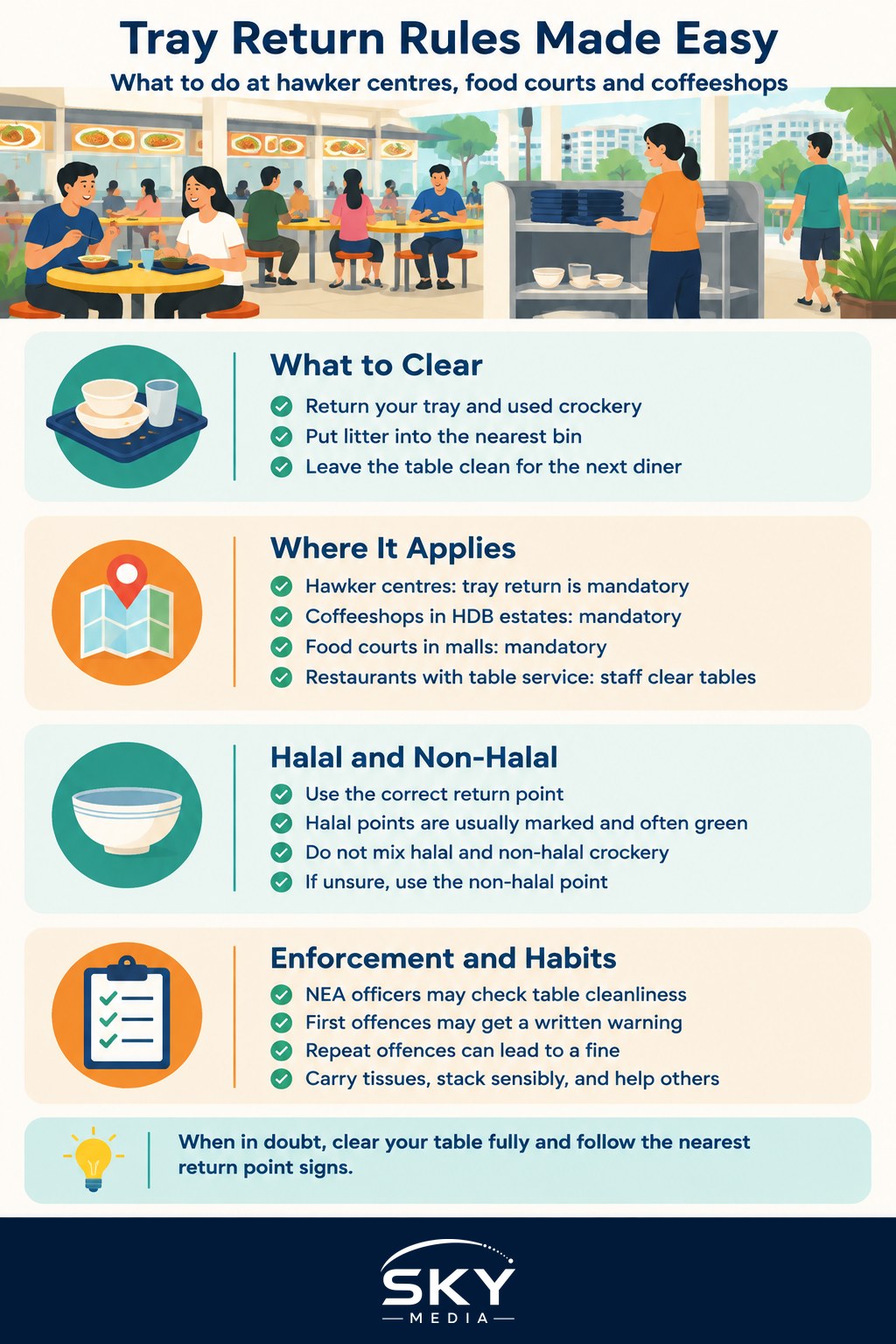
The core obligation is that diners must leave their table clean after eating. In practice, that means:
- Return your tray and used crockery (plates, bowls, cups, cutlery) to a tray return point, rack or station.
- Clear your own litter, such as used tissues, wet wipes, straws, bones you set aside on the table, drink cans, plastic bags and disposable packaging, into the nearest bin.
- Leave nothing behind on the table that the next person would have to deal with.
A few points that often confuse newcomers:
- It applies to takeaway packaging too. If you bought food in disposable containers and ate at the table, the empty containers go in the bin.
- It applies even if you did not use a tray. A single bowl of noodles or one cup of kopi still needs to be returned.
- Food you brought from outside counts. If you eat your own food at a hawker table, you still clear up after yourself.
- You are not expected to scrub the table, but wiping up an obvious spill with a tissue is considerate.
Where Tray Return Applies
The rule covers the places most people eat cheaply every day. The table below shows how it looks across common venues.
| Venue | Is tray return expected? | What to look for |
|---|---|---|
| NEA-managed and other hawker centres | Yes, mandatory | Tray return stations around the centre, often with halal and non-halal sections |
| Coffeeshops (kopitiams) in HDB estates | Yes, mandatory | Smaller racks or trolleys near the stalls or walls |
| Air-conditioned food courts in malls | Yes, mandatory | Return counters or racks near the exits or stall clusters |
| Restaurants with table service | No, staff clear tables | Simply leave the table as you would anywhere else |
Some food courts, school canteens and workplace cafeterias have their own house rules on top of the law. If there is a sign, follow it. For a fuller sense of how these venues differ in price and service, see our comparison of food courts, hawker centres and restaurants.
Halal and Non-Halal Return Points
This is the part newcomers most often get wrong, and it matters to many diners.
Muslim diners eat food prepared to halal requirements, and that includes the crockery and trays used. To avoid cross-contamination, most hawker centres and many food courts separate their tray return points:
- Halal return points are usually marked with a halal sign and often colour-coded, commonly in green.
- Non-halal return points are for everything else, including any dish containing pork or lard, or food from stalls without halal certification.
- Some centres colour-code the trays and crockery themselves, so you can match the colour of your tray to the right rack.
How to get it right:
- Check where your food came from. If the stall displays a halal certificate from MUIS (the Islamic Religious Council of Singapore), its crockery goes to the halal rack.
- If you ordered from both a halal and a non-halal stall, return each set of crockery to its own point. Do not stack them together.
- When unsure, return to the non-halal point. Putting non-halal crockery in the halal rack is the mistake to avoid, because it means the halal crockery has to be treated as contaminated.
Getting this right is a small act of respect that regulars notice and appreciate.
How Enforcement Works
NEA officers and appointed enforcement staff, sometimes alongside volunteer ambassadors, patrol food centres to observe whether diners clear their tables. Enforcement generally follows an escalating approach:
- A first offence typically results in a written warning.
- Repeat offences can lead to a fine.
- Persistent offenders may face prosecution in court.
The exact penalties and procedures are set by NEA and can change, so check the NEA website for the current position rather than relying on word of mouth. In daily life, most people never meet an officer. The real pressure is social: Singaporeans now largely expect everyone to clear up, and an abandoned tray stands out.
Who is given leeway
NEA has indicated that people who genuinely cannot return their trays, such as some elderly diners or persons with disabilities, are not the target of enforcement. If you see an older auntie or uncle struggling, offering to return their tray for them is a kind and very local gesture. Cleaners may also help diners who need assistance.
Practical Habits That Make Tray Return Easy
A few routines make the rule second nature:
- Spot the return point when you sit down. Most centres have several, and finding the closest one before you finish saves wandering with a full tray.
- Stack sensibly. Put cutlery and small cups on the tray, plates underneath, and keep liquids from sloshing.
- Carry a packet of tissues and bin it after use. Tissues left on the table count as litter, even if you also used them to reserve the seat. Our article on hawker centre etiquette explains the “chope” seat-reserving habit.
- Drain soup carefully. Some return stations have a bin or drain for leftover liquids and food scraps; use it if provided, and otherwise leave the bowl upright on the rack.
- Clear for the whole group. If you ate with friends or colleagues, agree who carries what so nothing is left behind.
- Help children learn it. Kids often enjoy carrying their own bowl to the rack, and it builds the habit early.
Common mistakes to avoid
- Leaving drink cans or plastic bottles on the table because “the drinks uncle will collect them”.
- Returning the tray but leaving a pile of tissues and straws behind.
- Mixing halal and non-halal crockery in one rack.
- Placing used trays on an empty neighbouring table instead of the return point.
What Newcomers Should Take Away
Tray return in Singapore is easy once you know the logic: whatever you brought to the table, or that the stall gave you, leaves with you. Crockery goes to the correct return point, rubbish goes to the bin, and the table is ready for the next person. It may feel unusual for the first week, then it becomes automatic.
For more on settling into everyday eating out, see our guide on how to order at a hawker centre, and check NEA’s official website for the latest rules on table cleanliness.
Official sources: National Environment Agency (NEA)