
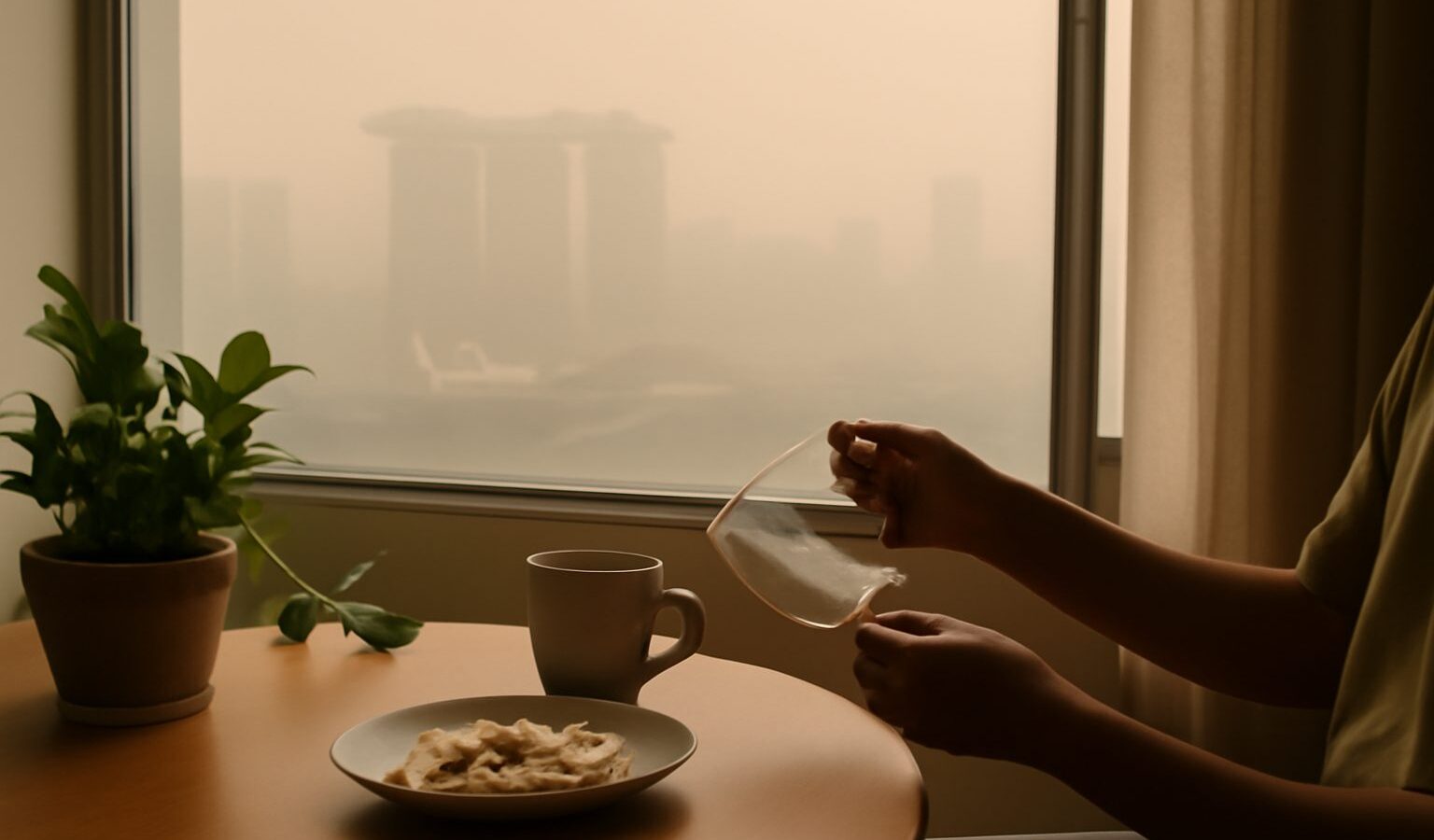
Some years, usually around the middle of the year, the sky over Singapore turns a flat, milky grey, the sun looks strangely dim, and the air carries a faint burnt smell. This is the haze, and for anyone new to the country it can be unsettling the first time it settles in. Understanding haze Singapore begins with knowing what causes it, how the authorities measure and report air quality, and what sensible precautions look like. The good news is that Singapore has a well established system for tracking the situation and telling people what to do, and the key habit for residents is simply to follow the official readings and advice rather than rumour.
What Causes the Haze
The haze that affects Singapore is largely transboundary, meaning it drifts in from beyond the country’s borders. It is mainly caused by land and forest fires in the wider region, including fires linked to the clearing of land for agriculture. When large areas of vegetation and peat burn, they release enormous amounts of smoke and fine particles into the air, and prevailing winds can carry that smoke across the region.
The haze tends to be more likely during drier stretches of the year, often in the middle months when the weather in parts of the region is hot and dry and fires spread more easily. Dry conditions make fires harder to control and allow smoke to build up and travel. Because it depends on fires elsewhere and on wind and weather patterns, the haze is not a fixed annual event. Some years bring little or none, while others see longer or more intense episodes. That variability is exactly why residents are encouraged to check current conditions rather than assume a pattern.
It is worth remembering that the haze is a regional issue that Singapore cannot solve on its own. The country participates in regional cooperation on the problem, but from a resident’s point of view the practical focus is on staying informed and protecting your health during an episode.
How Air Quality Is Measured and Reported
In Singapore, air quality information is provided by the National Environment Agency, or NEA. The main headline indicator most people watch is the Pollutant Standards Index, usually shortened to PSI. The PSI is a single number that summarises the level of several key air pollutants so that the public has a simple, consistent way to understand how clean or polluted the air is.
During haze episodes, the pollutant of greatest concern is fine particulate matter known as PM2.5. These are tiny particles small enough to be breathed deep into the lungs, which is why NEA reports PM2.5 readings alongside the PSI. NEA typically publishes readings for different regions of the island, such as north, south, east, west and central, because conditions can vary across Singapore. It also provides both current readings and forecasts, so people can plan ahead.
The PSI is grouped into descriptive bands that run from good air quality at the low end up to hazardous at the high end, passing through moderate and unhealthy ranges in between. Rather than fixating on a single figure, the useful thing is to note which band the reading falls into, because NEA pairs each band with general guidance on activity and health. The official readings and the accompanying advisories are the authoritative source, and they are updated regularly during an episode. You can find them on the NEA website and the myENV app.
Reading the Bands and What They Broadly Mean
Because the exact figures and thresholds are set and updated by NEA, the sensible approach is to treat the bands qualitatively and let the official advisory tell you the specifics. Broadly speaking, the lower bands describe air that is fine for normal activities, the middle bands signal that sensitive groups should start to take it easier, and the higher bands call for most people to reduce exertion and time outdoors. The table below sets out that general shape. It is a plain-language guide only, not a set of official numbers, so always confirm the current reading and advice with NEA.
| PSI band (general) | What it broadly signals | General suggested response |
|---|---|---|
| Good to Moderate | Air quality is largely fine | Carry on with normal activities |
| Unhealthy (lower part) | Air may affect sensitive groups | Vulnerable people ease off strenuous outdoor activity |
| Unhealthy (higher part) | Air can affect the wider public | Most people reduce prolonged or heavy outdoor exertion |
| Very Unhealthy to Hazardous | Air quality is poor for everyone | Minimise outdoor activity and stay indoors where possible |
The vulnerable groups usually highlighted in advisories include the elderly, pregnant women, young children, and people with existing heart or lung conditions such as asthma. These groups are generally advised to be more cautious at lower thresholds than the general population. When in doubt, take the more careful option and follow the specific NEA advisory for the current reading.
Health Precautions During a Haze Episode
The general precautions during haze are practical and familiar, and health guidance for Singapore comes from HealthHub and the Ministry of Health, so those are the sources to rely on for medical advice. In broad terms, the common sense measures include the following.
- Stay indoors when the air is poor. Reducing time outside, and reducing heavy physical exertion outdoors, lowers how much polluted air you breathe in.
- Keep indoor air cleaner. Closing windows during bad spells helps, and an air purifier with a suitable filter can reduce fine particles indoors. Many people run one in the bedroom during an episode.
- Consider a proper mask outdoors. When air quality is poor and you must go out, a well fitted mask designed to filter fine particles offers more protection than a loose surgical or cloth mask. Follow current official guidance on when masks are advised.
- Watch for symptoms. Irritated eyes, a scratchy throat, coughing or breathlessness can occur. People with asthma or other conditions should keep their medication handy and seek medical attention if symptoms are serious.
- Look after vulnerable household members. Pay extra attention to children, older relatives, and anyone with a chronic condition, and follow HealthHub and MOH advice for these groups.
- Stay hydrated and rest. Simple self care helps you cope with a poor air spell.
If you or someone in your household feels unwell, do not tough it out. Seek medical advice, and follow the guidance issued by HealthHub and MOH, which is tailored to the situation and updated as needed.
Staying Informed and Prepared
The single most useful habit is to check the official source directly rather than react to hearsay on social media. NEA provides current PSI and PM2.5 readings, forecasts, and health advisories, and it is the body that speaks for the government on air quality. During an episode, readings can change through the day as winds and fires shift, so it is worth checking more than once if you have outdoor plans.
Being prepared before the season also helps. Keeping a couple of suitable masks at home, knowing whether your home has an air purifier or where to get one, and knowing where to look for readings all reduce stress when a haze spell arrives. Schools, workplaces and event organisers in Singapore generally follow NEA guidance too, so official advisories often shape whether outdoor activities go ahead. By treating the haze as a manageable, well monitored situation and deferring to NEA, the Meteorological Service Singapore for weather, and HealthHub and MOH for health, residents can get through even a hazy stretch calmly and safely.
Explore more
For the bigger picture of how the seasons and skies here behave, read our overview of Singapore’s weather and climate. To see how the country plans for a cleaner, more resilient environment, see our explainer on the Singapore Green Plan and sustainability, and for how Singapore adapts to a changing climate, our guide to coastal protection and climate adaptation.