

The jump from preschool to Primary One is one of the biggest changes in early childhood, and settling into Primary One takes most children a few weeks, not a few days. Bigger campus, longer days, a canteen instead of a snack served to them, and dozens of new faces. It is completely normal for a child to be excited one morning and clingy the next. It is normal for parents to feel a lump in the throat at the school gate too.
This is a warm, general guide to help your family ease into the first term. It is not a checklist to race through, and it is certainly not a verdict on how your child will do for the next six years. Go gently, and remember that “settled” often arrives quietly, long before your child announces it.
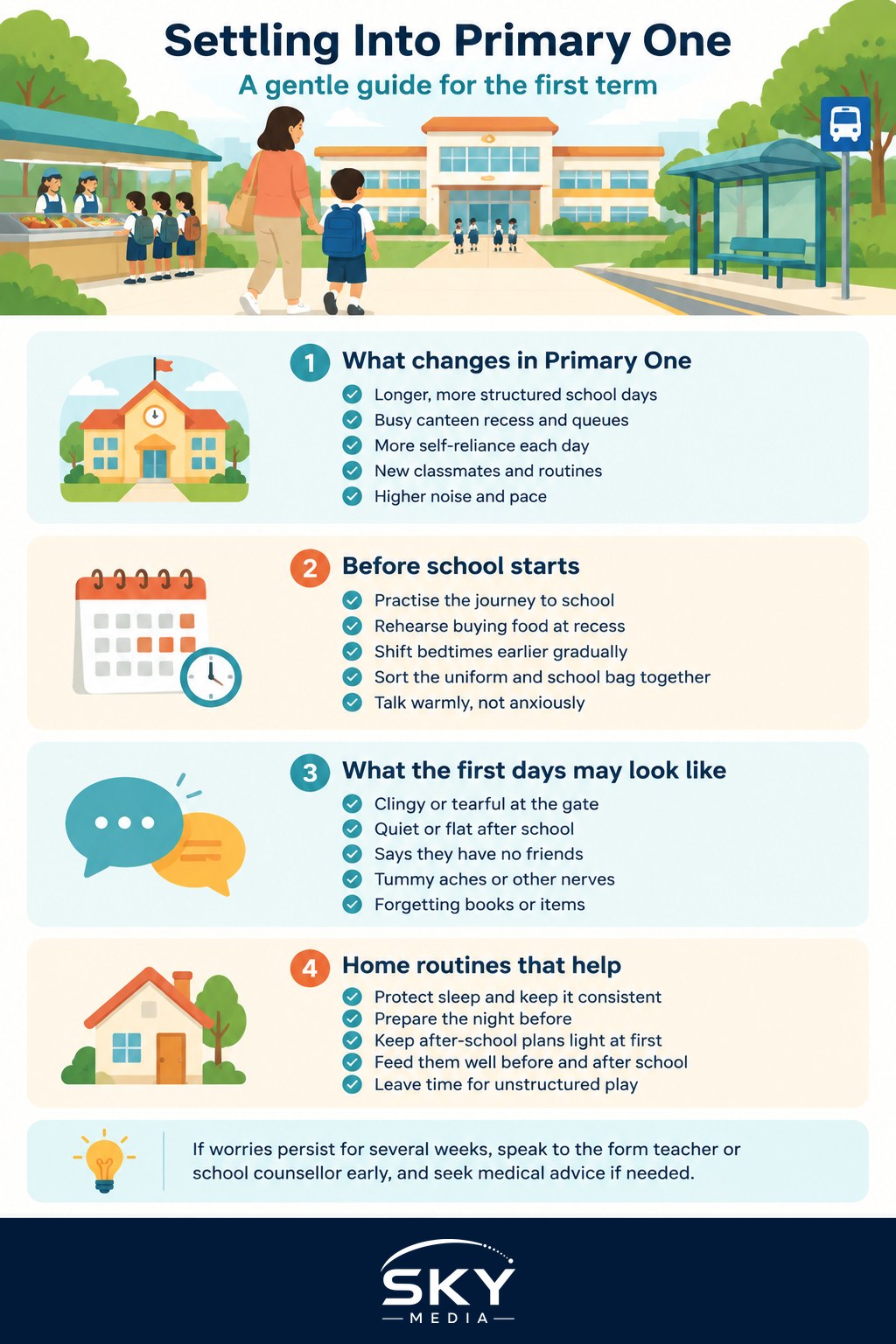
What Actually Changes in Primary One
Preschool in Singapore is usually small, cosy and closely supervised. Primary school, whether an MOE school near your HDB block or one a bus ride away, is a bigger world with its own rhythms. Understanding what is new helps you support your child without over-explaining.
The main shifts your child is adjusting to include:
- A longer, more structured day with fixed lessons, timetables and bells.
- Recess in a busy canteen, where they buy food, queue, and manage their own time and money.
- More self-reliance, from packing the right books to remembering where the toilet is.
- New social ground, where old preschool friends may be in other classes.
- Higher noise and pace, which can be tiring for a six or seven year old.
None of this needs to be frightening. Children are remarkably adaptable when the adults around them stay calm. Your job is not to remove every bump, but to be a steady base they can return to.
The Weeks Before School Starts
A little gentle preparation goes a long way, and it works best when it feels like play rather than drilling. In the weeks before term begins, you might:
- Practise the journey. Walk or take the bus to school once or twice so the route feels familiar.
- Rehearse recess. Let your child carry coins, order at a hawker stall, and open their own water bottle and food containers.
- Shift bedtimes earlier gradually, so the early wake-up is not a shock on day one.
- Sort uniforms and the bag together, naming items and letting your child pack, so they feel some ownership.
- Talk warmly, not anxiously. Answer questions simply and avoid loading the conversation with your own worries.
If your child is nervous, acknowledge it rather than brushing it aside. “It makes sense to feel unsure about a new place” is far more settling than “There is nothing to worry about.” Building everyday self-reliance now pays off; our guide on helping your child build independence has simple ideas that suit this age.
The First Days and What They Might Look Like
Expect a wide range of reactions, and expect them to change from day to day. Some children stride in on day one and dissolve into tears in week three, when the novelty fades and tiredness sets in. This is normal, not a sign that something has gone wrong.
Reading the small wobbles kindly, rather than as problems to fix, helps you respond well:
| Settling-in wobble | What it often means | What tends to help |
|---|---|---|
| Clingy or tearful at the gate | Missing the security of home and you | A short, warm, predictable goodbye; a confident exit |
| Very quiet or flat after school | Tired and overstimulated, not unhappy | Downtime, a snack, and no rapid-fire questions |
| Says “I have no friends” | Friendships are still forming, early days | Reassurance that friendships grow slowly over weeks |
| Tummy aches with no clear cause | Nerves showing up in the body | Calm routines; mention to a doctor if it persists |
| Forgetting books or items | Still learning to organise a bigger day | A simple picture checklist by the door, not scolding |
When your child comes home, resist the urge to interview them. A tired child rarely gives a useful report at 1.30pm. Offer food, quiet and a cuddle first. The stories usually come out later, over dinner or at bedtime.
Routines That Make Home the Calm Part
Children settle faster when home is predictable. You cannot control the classroom, but you can make the hours around it steady and unhurried.
A few anchors that help most families:
- Protect sleep. A well-rested child copes with almost everything better. Keep bedtimes consistent, even when the day has been long.
- Prepare the night before. Bag packed, uniform out, shoes by the door. Mornings then become calm rather than frantic.
- Keep after-school light at first. The adjustment itself is hard work. There is no need to fill every afternoon with enrichment right away; our note on avoiding over-scheduling your child explains why breathing room matters.
- Feed them well. A proper breakfast and a familiar recess food they can manage make a real difference. Ideas in building healthy family mealtimes suit busy school nights.
- Guard some unstructured play. Free, screen-light play helps children decompress and process a big new world.
Consistency is more reassuring than perfection. If a routine slips, simply pick it up again the next day without drama.
When Your Child Is Still Struggling
Most children settle within the first term. Some take longer, and a few need a little extra support, which is nothing to be ashamed of. Primary One is a genuine transition, and children who have recently faced other changes, such as a house move or a new sibling, may need more time. Our guide on helping your child cope with change may help you make sense of it.
Trust your instincts and reach out early rather than waiting for a crisis. Consider speaking to the form teacher or the school’s counsellor if, several weeks in, your child shows:
- Persistent distress or dread about school that is not easing.
- A big, lasting change in sleep, appetite or mood.
- Ongoing physical complaints with no clear medical cause.
- Complete withdrawal from friends and activities they used to enjoy.
Teachers see this every year and are usually glad to partner with you. If worry or low mood is affecting your child day to day, it is sensible to speak to your GP or paediatrician, who can advise on next steps. For family mental wellbeing support in Singapore, mindline (1771) offers a listening ear. This article is general information and not a substitute for advice from a professional who knows your child. If persistent anxiety is the bigger picture, our guide on managing your child’s anxiety offers gentle, everyday strategies.
A Calmer Start for the Whole Family
Settling into Primary One is a shared journey, and your own steadiness is one of the most powerful things you can offer. Children read our faces closely, so a confident, cheerful goodbye tells them the school gate is safe ground.
Keep your expectations kind. The goal for the first term is simply that your child feels secure, knows they belong, and trusts that home is waiting at the end of the day. Academics will follow once that foundation is in place. Celebrate the small wins, a friend’s name mentioned, a recess handled alone, a morning without tears, and let the rest unfold at its own pace.
The early years of the school journey are long, and this is only the beginning. When the time comes, the same calm approach will carry you through later milestones, including the PSLE years. For now, breathe, trust the process, and give your child, and yourself, the grace to settle in slowly.
Related across Sky Media: Helping Your Child Settle Into a Singapore School · Helping Your Child with Homework in Singapore
Frequently Asked Questions
What should my child bring to school on the first day of Primary One? Follow the school’s own list, since requirements vary by school. Pack the bag together the night before and name every item. Include a water bottle and containers your child can open alone, and check the school’s instructions on food and money.
How do I help my child make friends in a new class? Encourage small steps like asking a classmate to play or sharing a snack. Ask about classmates’ names at home and arrange playdates if you can. Remind your child that friendships grow slowly over weeks.
What if my child is struggling to keep up with lessons in the first term? Speak to the form teacher early to find out what they see in class. Look at routines, sleep and workload at home before adding extra help. Many children need time to adjust, so avoid labelling your child.
Should I send my child to student care after school? It depends on your family’s working hours and who can collect your child. Student care can offer supervision and a routine, but a full day may be tiring at first. Ask the school or the centre about arrangements and visit if possible.
How can I help my child manage pocket money and buy food at the canteen? Practise with coins at home and at a hawker stall, and show how to queue and count change. Agree a simple budget and explain which foods are suitable. Check the school’s canteen rules.
Official sources: Ministry of Education (MOE)
Further reading: Why Your Primary 1 Child Is So Tired After School and How to Help · Deferring Primary One Entry in Singapore: When It Is Allowed · Teaching Your Primary One Child to Buy Food at Recess