

For many families, Chinese composition in Singapore is the part of Mother Tongue that causes the most groans at the study table. Children who chat happily in Mandarin can freeze when asked to write a full piece, and parents whose own Chinese is a little rusty often feel unsure how to help. The good news is that composition is a skill you build step by step, and you can support your child even if you are learning alongside them.
This guide keeps things practical and encouraging. It is general guidance for parents, not a formal teaching method, and every child learns at a different pace. Follow your child’s level, keep the pressure low, and celebrate progress rather than perfection.
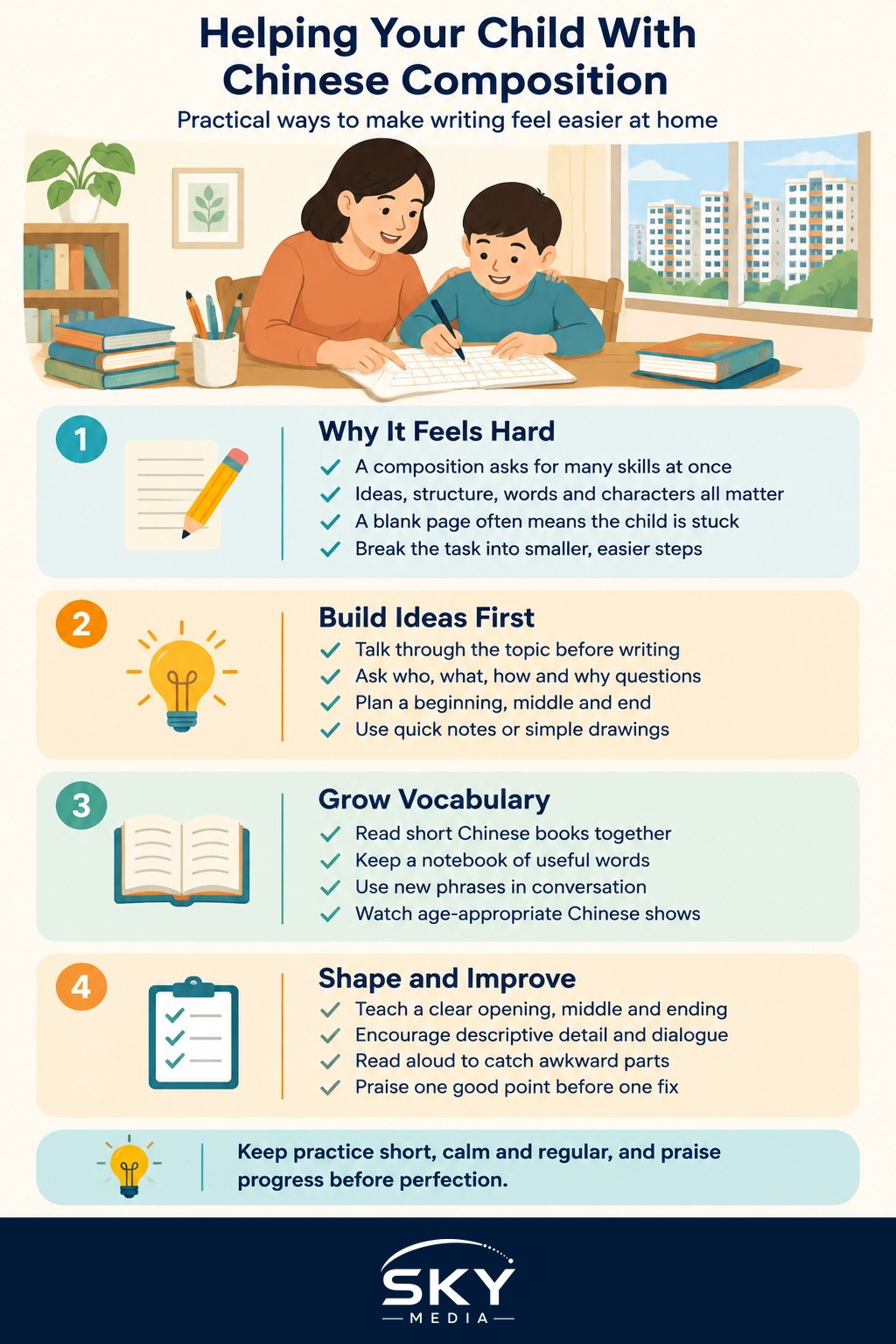
Why Composition Feels Hard
Writing a composition asks a child to do several things at once: think of ideas, organise them in order, choose the right words, and get the characters correct. That is a heavy load, especially in a language they may use less at home than English. When any one of those steps breaks down, the whole piece can stall, and the child concludes they are “bad at Chinese”.
Understanding this helps you respond kindly. A blank page usually means your child is stuck on ideas or structure, not that they are lazy. Once you break the task into smaller parts, it becomes far less scary. This connects to the wider goal of keeping up your child’s Chinese in Singapore, where everyday exposure makes writing much easier.
Build Ideas Before Words
Most struggling writers do not have a language problem first, they have an ideas problem. Before your child writes a single sentence, help them think about what to say. This planning stage is where you can help even if your Mandarin is basic, because you can talk it through in whatever language works.
Try these gentle prompts:
- Look at the picture or topic together and ask simple questions: Who is there? What happened? How did they feel? What happened in the end?
- Encourage a beginning, middle and end. Even a rough three-part plan gives the writing a spine.
- Draw or jot quick notes for each part before writing full sentences.
- Talk about feelings and reactions, since emotion and detail are what make a composition come alive.
When ideas come first, the writing flows more naturally. You are teaching a thinking habit that also helps with English writing and, more broadly, with building your child’s vocabulary across both languages.
Grow Vocabulary the Everyday Way
Good compositions use lively, specific words rather than the same few tired ones. Vocabulary grows best through repeated, low-stress exposure rather than cramming long lists the night before an exam.
Practical ways to feed your child’s word bank:
- Read together in Chinese, even short storybooks, and pause to enjoy nice phrases.
- Keep a small notebook of useful words and expressions your child likes, and revisit them.
- Encourage your child to reuse a new phrase in speech during the week, so it sticks.
- Watch age-appropriate Chinese shows and chat about them afterwards in Mandarin where you can.
Exposure matters more than drilling. A child who hears and uses lively Chinese regularly will naturally reach for better words when they write. If your family speaks mostly English at home, our guide on raising bilingual children offers ways to weave more Mandarin into daily life.
Teach Structure and Editing
Once ideas and words are flowing, help your child shape the piece. Talk about how a strong opening sets the scene, how the middle builds the events, and how a satisfying ending wraps things up, often with how the character felt or what they learned. Many Singapore pupils are taught to include descriptive detail and dialogue, so encourage your child to show rather than only tell.
Editing is where good writing is made, so build it into the routine gently:
- Read the piece aloud together to catch missing words and awkward sentences.
- Check that events are in a sensible order.
- Look out for common slips in characters and punctuation, and let your child make the corrections themselves.
- Praise one specific thing they did well before suggesting one thing to improve.
Keep feedback small and kind. A child who feels every composition is torn apart will start to dread writing, while a child who hears “I loved this part” will want to write more.
Keep It Positive and Consistent
Short, regular practice beats occasional marathon sessions. A little writing each week, even a few sentences about their day or a simple story, builds confidence and fluency over time. If your child is genuinely struggling despite steady support, a chat with their Chinese teacher can pinpoint where the gap is, and you can decide together whether extra help would suit. Our article on choosing a Chinese tuition centre for your child can help if you go that route.
Above all, protect your child’s relationship with the language. When writing in Chinese feels safe, supported and even a little fun, the marks tend to follow. Your calm encouragement, more than any perfect model essay, is what helps your child grow into a confident writer.