

When an elderly parent comes home from hospital with a feeding tube, a wound that needs dressing or a list of new medicines, many families realise that love and good intentions are not the same as clinical skill. That is usually the moment people start looking up private nurse Singapore options.
A private nurse can be the right answer, but not always. This guide explains when nursing care makes sense, how it differs from a domestic helper or a general home care visit, and what to check before you let someone into your parent’s home. For a wider view of the choices available, see our overview of elderly care options.
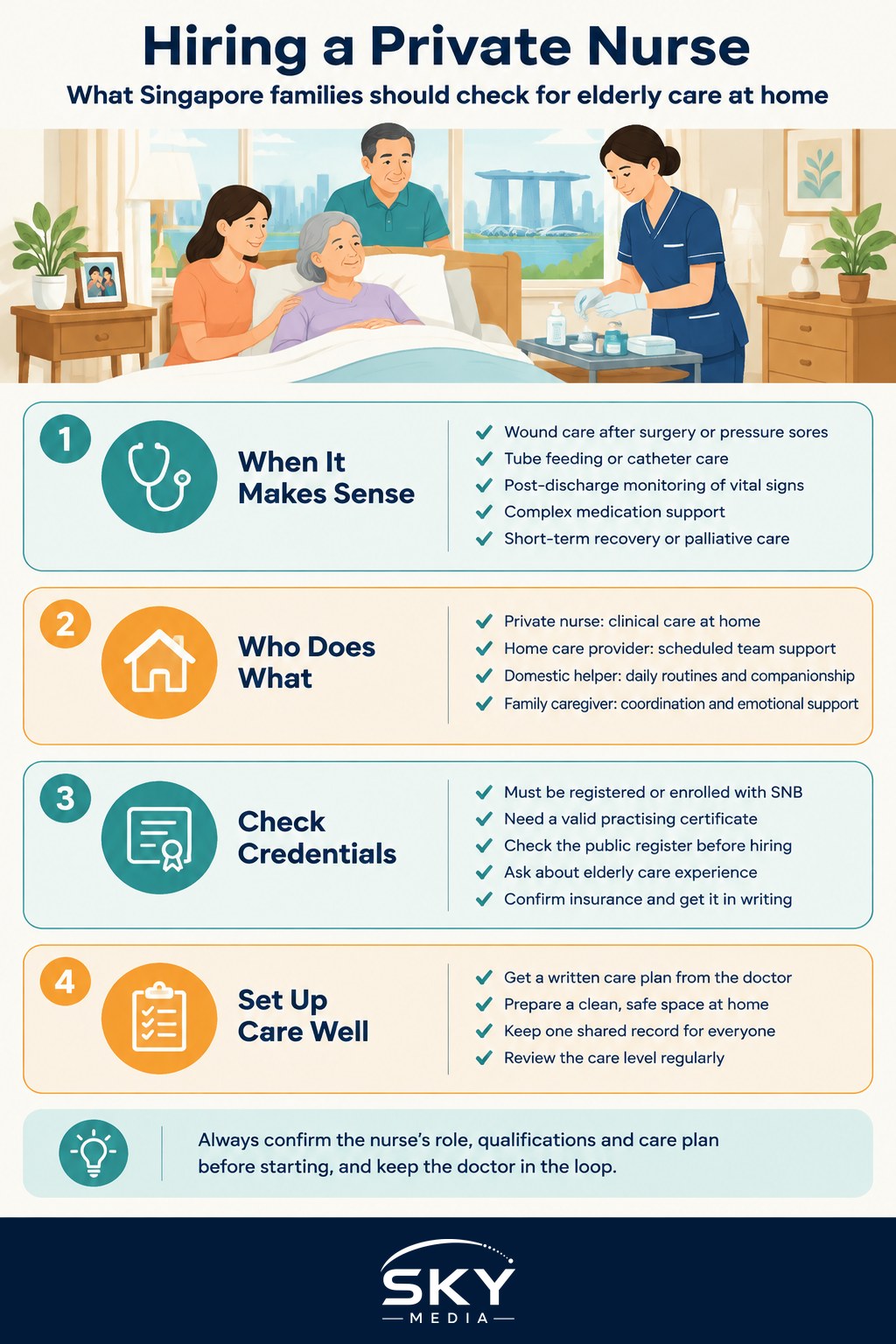
When a Private Nurse Makes Sense
The key question is whether your parent needs nursing tasks, or mainly help with daily living. Daily living covers bathing, dressing, eating, toileting and moving around. Nursing tasks involve clinical judgement and training.
A private nurse is usually worth considering when your parent needs things like:
- Wound care, such as pressure sores or post-surgical wounds
- Tube feeding or care of a urinary catheter
- Monitoring of vital signs after a hospital stay, with someone trained to recognise warning signs
- Help managing complex medication regimes as prescribed by a doctor
- Support during palliative care at home, alongside a home hospice team
- Short-term recovery support in the first weeks after discharge
If your parent mainly needs company, supervision and help with daily routines, a trained caregiver or domestic helper may be a better fit, with a nurse visiting only for specific tasks. Our guide to hiring a helper to care for elderly parents covers that route.
Always start with your parent’s doctor or the hospital care team. They can tell you which tasks need a nurse, how often, and for how long. This article is general information, not medical advice.
Private Nurse, Helper or Home Care Service
Families often mix these arrangements, so it helps to be clear on what each one is.
| Option | What they typically do | Clinical tasks | Best suited for |
|---|---|---|---|
| Private nurse (registered or enrolled) | Hands-on nursing care at home, by visit or by shift | Yes, within their licence and a doctor’s instructions | Wounds, tubes, post-discharge monitoring, complex care |
| Home care service provider | Scheduled visits by nurses, therapists or care staff from an organisation | Depends on the service booked | Families who want a structured package and backup cover |
| Domestic helper | Daily living support, household tasks, companionship | No, though some receive caregiver training | Long-term daily help with routines and supervision |
| Family caregiver | Daily care, coordination, emotional support | Only tasks they have been trained to do safely | Day-to-day presence, combined with other support |
Many families end up with a combination, for example a helper for daily care plus a nurse who visits a few times a week for wound dressing. The Agency for Integrated Care (AIC), the national body that coordinates community and home care, can explain the home care services available and any subsidies your family may qualify for.
Check Qualifications and Registration
In Singapore, nurses must be registered or enrolled with the Singapore Nursing Board (SNB) and hold a valid practising certificate to practise nursing. There are two main types:
- Registered nurse (RN): broader training and scope, usually able to handle more complex assessments and care.
- Enrolled nurse (EN): trained to provide nursing care, generally working under the supervision or care plan of a registered nurse or doctor.
Before hiring anyone who calls themselves a nurse, ask for their full name as registered and check it against the SNB’s public register of nurses. If they are not on it, they should not be performing nursing procedures, whatever their experience overseas.
Also ask about relevant experience. Someone who has spent years in a geriatric ward or community nursing will bring different strengths from a nurse whose background is mostly in, say, paediatrics.
Agency or Freelance: What to Weigh
You can engage a private nurse through a home care or nursing agency, or directly as a freelancer.
Through an agency or home care provider:
- The organisation usually handles screening, scheduling and replacement if the nurse falls sick
- There may be clinical supervision and documented care protocols
- Costs may be higher, but you are paying for that backup and structure
Directly with a freelance nurse:
- You may get more continuity with one person
- You take on the checking yourself, including registration, references and insurance
- You need a plan for days the nurse is unavailable
Whichever route you choose, ask whether the nurse or organisation carries professional indemnity insurance, and get the arrangement in writing.
Questions to Ask Before You Hire
Use these questions at the interview or first call:
- Are you registered or enrolled with the SNB, and is your practising certificate current?
- What experience do you have with elderly patients and with my parent’s specific needs?
- Which tasks can you perform, and which would you refer back to a doctor?
- How will you record what you do at each visit, and how will you share it with us and the doctor?
- What happens if you are sick or on leave?
- How do you handle an emergency at home?
- What are your charges, what is included, and what is the cancellation policy?
- Are you covered by professional indemnity insurance?
Rates differ widely depending on the type of nurse, visit length, time of day and complexity of care, so compare written quotes from more than one source rather than relying on a single figure.
Setting Up Care at Home
Once you have chosen a nurse, a few steps help the arrangement work smoothly:
- Get a written care plan from the doctor. The nurse should work from clear medical instructions, especially for medicines and wound care.
- Prepare the space. Good lighting, a clean surface for supplies, and safe access around the bed.
- Keep one shared record. A notebook or shared document listing visits, observations and changes helps everyone, including siblings who are not there daily. Our guide on coordinating elderly care among siblings has ideas for sharing this load.
- Involve your parent. Explain who the nurse is and why they are coming. Respect their dignity and preferences, such as gender of the carer where that matters to them.
- Review regularly. Needs change. Ask the doctor every few weeks or months whether the level of nursing support is still right.
Paying for It
Private nursing is usually paid out of pocket, though some costs may be offset by government schemes, subsidies for approved home care providers, or insurance, depending on your parent’s situation and the provider. Check with AIC, your parent’s medical social worker, and the insurer before you assume anything is covered. For planning the longer-term budget, read our guide on budgeting for elderly care at home.
Hiring a nurse is a big decision, but with the right checks it can give your parent safe, skilled care at home and give the rest of the family some breathing room.
Frequently Asked Questions
Can a domestic helper do wound dressing or tube feeding for my parent? These are nursing tasks that call for clinical judgement and training, so they are better left to a registered or enrolled nurse, unless a healthcare professional has specifically trained the caregiver. Ask your parent’s doctor or the hospital care team which tasks need a nurse.
How do I check that a private nurse is registered in Singapore? Ask for the nurse’s full name as registered and check it against the public register of nurses kept by the Singapore Nursing Board. Also ask to see a valid practising certificate. A person not on the register should not perform nursing procedures.
What is the difference between a registered nurse and an enrolled nurse? A registered nurse has broader training and scope and can usually handle more complex assessments. An enrolled nurse provides nursing care, generally under the supervision or care plan of a registered nurse or doctor. Your parent’s needs decide which is more suitable.
Is a nurse booked through an agency better than a freelance nurse? Agencies usually handle screening, scheduling and replacement if the nurse falls sick, often with clinical supervision, but may cost more. A freelancer can offer continuity with one person, though you do the checking and need a backup plan. Ask both about indemnity insurance.
Are there subsidies for private nursing care at home? Private nursing is usually paid out of pocket, but some costs may be offset by government schemes, subsidies for approved home care providers or insurance, depending on your parent’s situation. Check with AIC, the medical social worker and your insurer before assuming anything is covered.
Official sources: Agency for Integrated Care
Further reading: Choosing a Home Care Provider