

Part-timers keep many small businesses running, from cafés and retail shops to clinics, tuition centres and back offices. They give you flexibility, but they are still employees with clear legal entitlements. Getting the part-time employee rules Singapore law sets wrong can lead to underpayment claims, unhappy staff and avoidable disputes.
This guide is for business owners and managers hiring part-time staff. It covers how part-time status is defined, how leave and holidays are pro-rated, how overtime works, and what you need to do on CPF and records. It is general information, not legal or financial advice. The Ministry of Manpower (MOM) and the CPF Board publish the official rules and calculators, and you should check their sites for current details. For full-time hiring, see our employer’s guide to hiring employees.
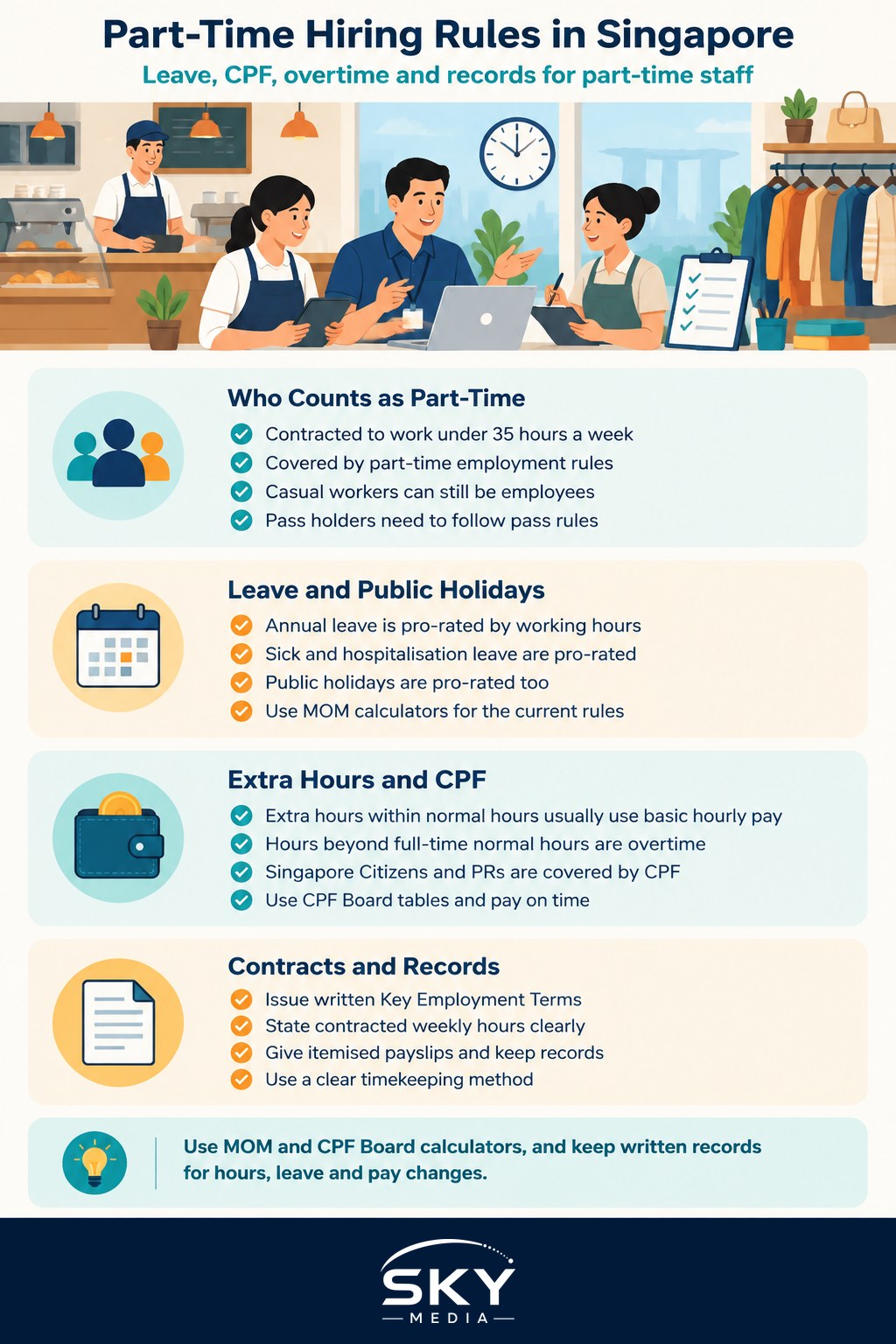
Who Counts as a Part-Time Employee
Under the Employment Act, a part-time employee is someone contracted to work fewer than 35 hours a week. These workers are covered by the Employment of Part-Time Employees Regulations, which set out how their entitlements are worked out, usually by pro-rating against a comparable full-time employee.
A few points to keep in mind:
- It is about contracted hours. A worker whose contract says 20 hours a week is part-time, even if they occasionally work more.
- Casual or ad hoc workers can still be employees. Calling someone a “freelancer” does not change their status if, in practice, you control their work like an employee. MOM looks at the real relationship.
- Pass holders have extra rules. Foreigners can only work part-time if their pass allows it. Student Pass holders, for example, have their own restrictions, covered in our guide to part-time work rules for Student Pass holders.
Pro-Rated Annual Leave, Sick Leave and Public Holidays
Part-timers earn the same types of leave as full-timers, but in proportion to the hours or days they work. MOM uses a formula that compares the part-timer’s contracted hours with those of a full-time employee doing the same work in your business.
In broad terms:
- Annual leave is pro-rated based on the part-timer’s working hours compared with a full-timer, and is usually expressed in hours rather than days.
- Sick leave and hospitalisation leave are also pro-rated, once the employee has served the qualifying period set by MOM.
- Public holidays are given on a pro-rated basis. If a public holiday falls on a part-timer’s normal working day, they are entitled to the holiday or compensation as the rules set out.
- Childcare and other statutory leave may also apply in pro-rated form, depending on eligibility.
The safest approach is to use MOM’s online calculators for part-time leave. Rounding methods, eligibility periods and the treatment of fractions matter, and MOM’s tools reflect the current rules.
Overtime and Extra Hours for Part-Timers
Overtime works a little differently for part-timers, and this is where many employers make mistakes. The rules distinguish between:
- Hours beyond the part-timer’s contracted hours, but within a full-timer’s normal hours. These are generally paid at the part-timer’s basic hourly rate.
- Hours beyond a full-timer’s normal daily or weekly hours. These are treated as overtime and must be paid at the overtime rate set under the Employment Act.
Part-timers also have the right to refuse work on rest days or extra hours beyond their contract in certain situations, so do not assume they can always be called in. Agree on how extra shifts are offered and accepted, and record them.
Here is a summary of how common situations are generally handled:
| Situation | How it is generally treated | What to check |
|---|---|---|
| Annual leave | Pro-rated by hours worked vs a full-timer | MOM part-time leave calculator |
| Public holiday on a working day | Holiday or compensation, pro-rated | Whether the day is a normal working day |
| Extra hours within full-time normal hours | Basic hourly rate | Contracted hours vs full-timer’s hours |
| Hours beyond full-time normal hours | Overtime rate under the Employment Act | Current MOM overtime rules |
| CPF | Contributions due if wages meet CPF thresholds | CPF Board contribution tables |
CPF Contributions for Part-Timers
Part-time employees who are Singapore Citizens or Permanent Residents are covered by CPF, Singapore’s Central Provident Fund, in the same way as full-timers. Contributions depend on the employee’s monthly wages, age and residency status, and apply once wages pass a low monthly threshold set by the CPF Board.
What this means in practice:
- Calculate CPF on actual wages for the month, including any extra hours and allowances that count as wages.
- Use the CPF Board’s contribution tables or calculator rather than estimating percentages, since rates are updated from time to time.
- Pay on time. Late payment attracts interest and can lead to enforcement.
- Foreign part-timers on work passes do not contribute to CPF, but other obligations such as levies may apply depending on the pass.
Our explainer on CPF contributions for employees covers the mechanics in more depth.
Contracts, Payslips and Record Keeping
Part-timers are entitled to the same paperwork protections as other employees covered by the Employment Act. Make sure you:
- Issue written Key Employment Terms (KETs). These summarise pay, hours, leave and other basics, and must be given within the time MOM specifies.
- State the contracted weekly hours clearly. This is the anchor for every pro-rated entitlement.
- Give itemised payslips showing basic pay, extra hours, overtime, deductions and CPF.
- Keep employee records such as hours worked, leave taken and pay, for the period required by MOM.
- Use a clear timekeeping method, whether a simple app, punch card or shift roster, so you can show what was worked.
If you are hiring for the first time, our step-by-step guide to hiring your first employee covers registration, payroll and onboarding basics.
Common Mistakes Employers Make
- Paying a flat daily rate with no leave. Part-timers still accrue leave and public holiday entitlements.
- Ignoring extra hours. Shifts that quietly stretch beyond the contract still need to be paid, and some at overtime rates.
- Skipping CPF on small wages. Check the threshold rather than assuming low pay means no CPF.
- Mixing up part-time and freelance. If you set hours, supervise the work and provide tools, the worker may be an employee.
- Changing hours without agreement. Altering contracted hours affects pay and leave, so put any change in writing.
Where to Get Help
MOM’s website has guides and calculators for part-time employment, and the CPF Board runs an employer helpline and online resources. For disputes, the Tripartite Alliance for Dispute Management (TADM) helps employers and employees resolve salary and employment issues. If your situation is complex, such as mixed full-time and part-time roles or workers across several outlets, consider speaking with an employment lawyer or HR consultant.
Treat part-timers fairly, document everything, and use the official calculators. That protects your business and makes you an employer people want to work for.
Official sources: Ministry of Manpower (MOM) · CPF Board
Further reading: Managing Team Leave Requests Around the School Holidays · Hiring Mandarin-Speaking Staff in Singapore