
Holland Village, known affectionately to many as Holland V, is a small, leafy enclave in the west-central part of Singapore that has long carried a character all its own. Tucked off Holland Road, it grew into a relaxed, slightly bohemian pocket of cafes, bars, antique shops and eateries with a strong international flavour. Exploring Holland Village heritage in Singapore means tracing how a modest settlement on the city’s edge became a magnet for artists, expatriates and Singaporeans looking for something a little different, and how it has kept that easygoing spirit even as it changes around the edges.
This guide covers where the name comes from, how the village developed its distinctive character, what to see today, and how to enjoy it.
Where the Name Comes From
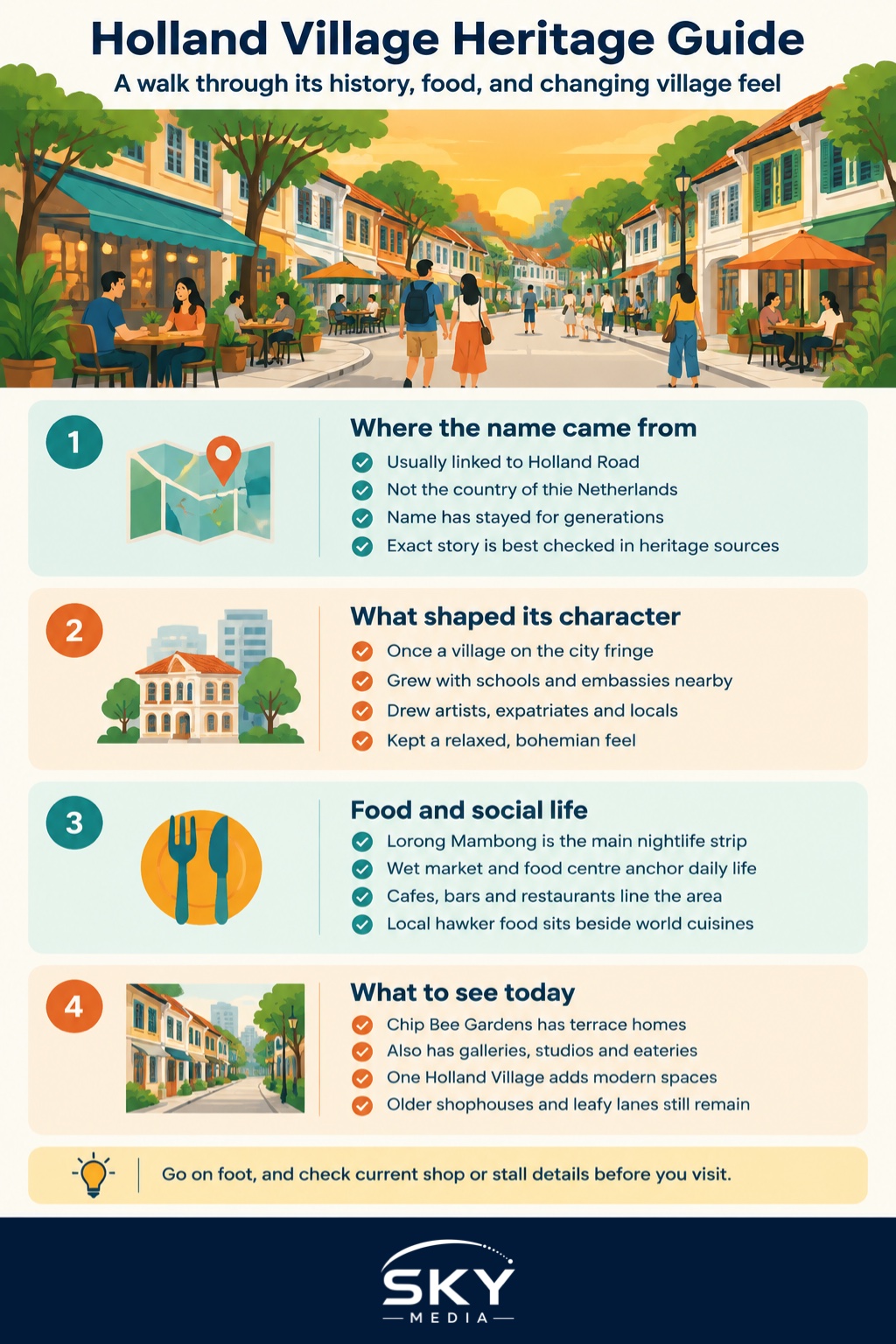
The origin of the name Holland Village is usually linked to Holland Road, the arterial route it sits beside, which in turn is generally said to be connected to an early resident associated with the area rather than to the country of the Netherlands. As with many Singapore place names, the exact story is layered and best confirmed through heritage sources, but the name has stuck for generations and become shorthand for the whole enclave.
In its earlier days the area was more of a village settlement on the fringe of the built-up city, surrounded by greenery. Over time, as Singapore grew westward and residential estates and institutions filled in around it, Holland Village found itself well placed, close to good schools, embassies and leafy residential districts, which helped shape the community that gathered there.
A Bohemian, International Character
What set Holland Village apart was its atmosphere. It became known as a place where a more international, creative crowd mingled with locals, giving it a reputation as a bohemian and expatriate-friendly enclave. Antique and furniture shops, craft and homeware stores, bookshops and galleries settled in alongside cafes and casual restaurants, and the mix of cuisines reflected the diverse crowd it drew.
The heart of the social scene has long been Lorong Mambong, the row of shophouses turned bars and restaurants where much of the village’s dining and nightlife concentrates. Nearby, Chip Bee Gardens, a low-rise residential estate, added its own quiet layer, with terrace homes, design studios, galleries and eateries tucked among the greenery. Together these gave Holland Village a walkable, human scale, more neighbourhood than mall.
A few threads define the village’s character:
- A relaxed, international feel. The mix of expatriate residents and locals gave it a cosmopolitan, unhurried atmosphere.
- Independent shops and eateries. Antique dealers, homeware stores, cafes and casual restaurants shaped its creative reputation.
- A social heart on Lorong Mambong. The shophouse strip has long anchored the village’s dining and evening scene.
- The wet market and food centre. A traditional market and hawker centre kept everyday local life at the centre of the enclave.
Food has always been central to the village’s appeal. Alongside the hawker stalls of the market and food centre, the enclave gathered a wide spread of cuisines, reflecting the international crowd it attracted, from casual local fare to dishes from around the world. This variety, packed into a small, walkable area, is a big part of why Holland Village became a favourite meeting point for a weekend brunch, an evening drink or a long, unhurried dinner. The mix of everyday hawker food and more cosmopolitan dining, side by side, captures the enclave’s easy blend of local and international.
The village also carried a strong creative streak. Artists, designers and independent makers were drawn to the area over the years, and small galleries, studios and design-led shops gave it a reputation as a place with an eye for the handmade and the unusual. That creative energy, more than any single landmark, is what many regulars mean when they talk about the character of Holland V.
Change and Continuity
Like every well-loved Singapore neighbourhood, Holland Village has evolved. The arrival of an MRT station on the network made it far more accessible, bringing new footfall. More recently, a large mixed-use development, One Holland Village, has added modern residences, retail and public spaces beside the older streets, a significant change for a place long defined by its low-rise, village scale.
The question many regulars ask is how much of the old character survives alongside the new. The traditional market and food centre, the shophouse rows and the leafy Chip Bee Gardens still give the enclave its texture, while newer buildings bring fresh crowds and amenities. As with any living district, individual shops and eateries open and close over time, so treat any single business as something to check before you build a visit around it.
Here is a snapshot of the different layers that make up Holland Village today.
| Area | Character | What you find |
|---|---|---|
| Lorong Mambong | Lively dining and nightlife strip | Bars, restaurants and cafes in shophouses |
| Chip Bee Gardens | Quiet low-rise residential estate | Terrace homes, galleries, studios and eateries |
| Market and food centre | Everyday local life | Wet market stalls and hawker food |
| One Holland Village | Modern mixed-use development | New residences, retail and public spaces |
Visiting Holland Village
Holland Village is easy to reach by public transport, with an MRT station serving the area and buses running along Holland Road and the surrounding streets. Once there, it is best explored slowly on foot, since the enclave is compact and walkable. A good loop takes you along the main shopping street, into Lorong Mambong for the dining strip, over to the market and food centre for a taste of everyday life, and across into the leafy lanes of Chip Bee Gardens.
The village suits an unhurried outing. Browse the shops, pause for a coffee or a meal, and notice how the older low-rise streets sit beside the newer development. It pairs naturally with a walk in the nearby green spaces of the area or a trip to neighbouring districts. Because tenants, timings and prices change, check current details for any specific shop, market stall or restaurant before you go.
Explore more
If Holland Village drew you in, continue with our Dempsey Hill history and heritage guide, the former barracks turned lifestyle enclave a short way along Holland Road. For another neighbourhood with a strong independent character, see our Tiong Bahru heritage guide, and for a leafy eastern counterpart full of food and old estates try our Katong and Joo Chiat heritage guide.
Frequently Asked Questions
What is there to eat in Holland Village? There is a wide spread of cuisines packed into a small walkable area, from hawker stalls in the market and food centre to cafes and casual restaurants. The Lorong Mambong shophouse strip concentrates the dining and evening scene. Check individual venues before planning around them.
What is Chip Bee Gardens, and is it worth visiting? It is a low-rise residential estate beside Holland Village, with terrace homes, design studios, galleries and eateries tucked among the greenery. Its quiet, leafy lanes add a calmer layer to the village. It is best explored on foot, with respect for residents.
How has One Holland Village changed the area? It is a large mixed-use development that has added modern residences, retail and public spaces beside the older streets. That is a significant change for a place long defined by low-rise, village-scale buildings. The market, shophouse rows and Chip Bee Gardens still give the enclave its texture.
Is Holland Village a good place for a weekend brunch or evening drink? Yes, it has long been a favourite meeting point for brunch, a drink or a leisurely dinner. Daytime suits cafes and browsing antiques, while Lorong Mambong comes alive in the evening. Tenants and timings change, so check specific places first.
How do I get to Holland Village without driving? An MRT station now serves the area, and buses run along Holland Road and the surrounding streets. The enclave is compact, so once you arrive, walking is the best way to see it. A loop takes in the main street, Lorong Mambong, the market and Chip Bee Gardens.
Further reading: Holland Village Neighbourhood Guide · A Guide to Holland Village, Singapore