
Few Singapore neighbourhoods wear their history as openly as Tiong Bahru. This Tiong Bahru heritage guide walks you through one of the island’s oldest public housing estates, a place where curved, low-rise apartment blocks in a distinctive Art Deco style sit alongside a beloved wet market, quiet back lanes, and a new generation of cafes and independent shops. The name itself hints at the past: “tiong” is a Hokkien word for cemetery and “bahru” is Malay for new, a reminder that this ground was once burial land before it became a home for the living.

Origins and Early History
Long before the flats arrived, the area around Tiong Bahru was low-lying, marshy ground on the fringe of the growing town, dotted with graves. As Singapore’s population expanded in the early twentieth century, overcrowding and poor sanitation in the central districts pushed the authorities to look for solutions. The Singapore Improvement Trust, the colonial-era body set up to improve housing and clear congestion, chose this site to build one of its flagship estates.
Construction of the modern estate took shape in the years before the Second World War, making Tiong Bahru one of the earliest planned public housing projects in Singapore. The Trust laid out an orderly grid of streets and low apartment blocks, offering a new model of urban living that was cleaner and more spacious than the packed shophouses many residents had left behind. For detailed dates and the full story of the Trust, the National Heritage Board and the Urban Redevelopment Authority remain the best sources.
The Art Deco Architecture
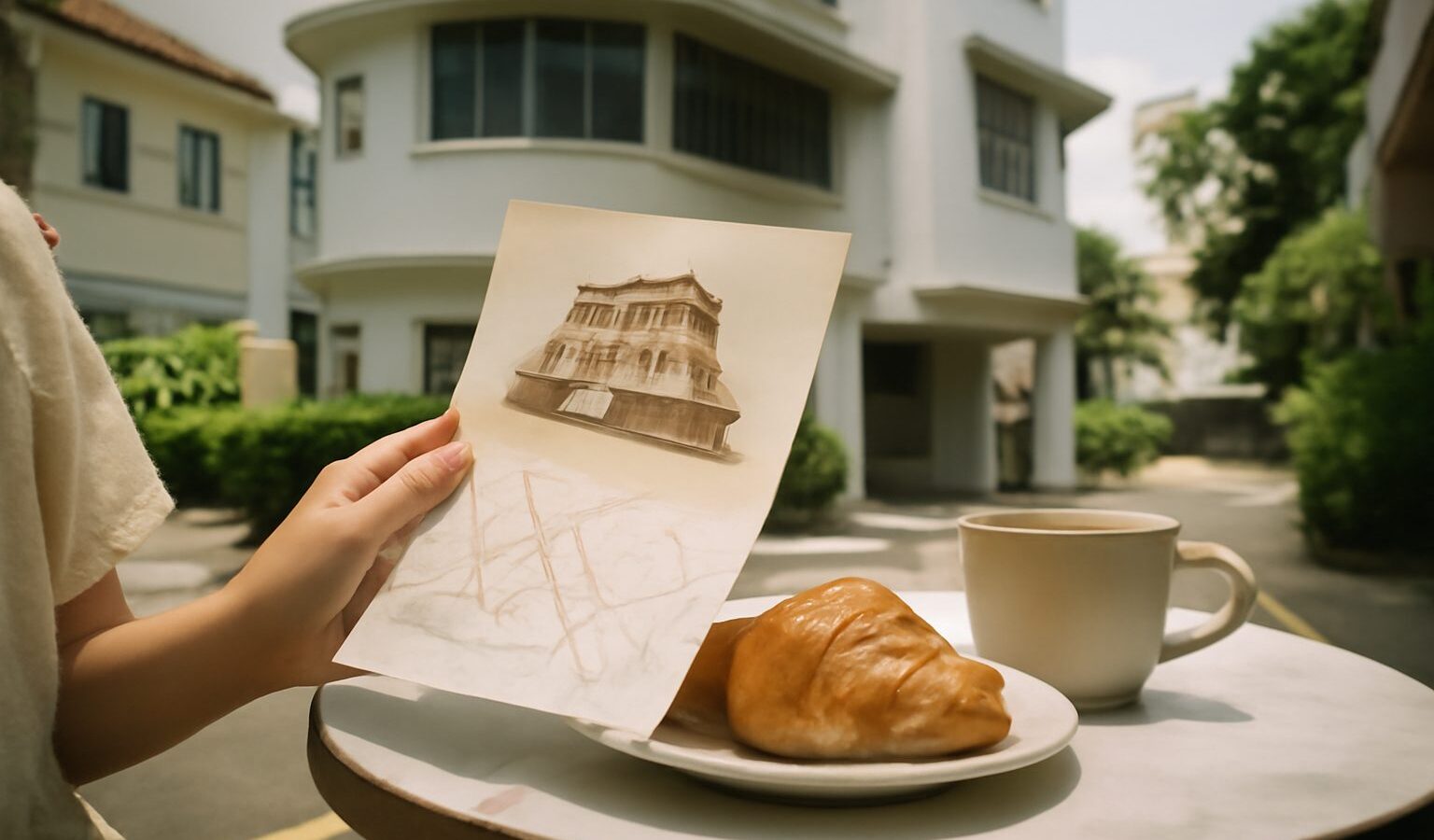
What makes Tiong Bahru instantly recognisable is its architecture. The pre-war blocks are built in a streamlined style often described as Streamline Moderne, a strand of Art Deco that favoured smooth, rounded corners, long horizontal lines, flat roofs, and nautical touches that make some buildings look a little like ocean liners run aground in the tropics. Curved balconies, porthole windows, and sweeping spiral staircases at the rear of the blocks are signatures worth looking out for.
These were practical homes as much as stylish ones. Flats were designed with cross ventilation for the hot, humid climate, generous windows, and shared back lanes where residents once hung laundry and children played. Some ground-floor units combined shops with living quarters. Because so much of this fabric survives, the Urban Redevelopment Authority has gazetted the older core of Tiong Bahru for conservation, protecting the low-rise character that developers might otherwise have replaced with towers.
To picture how the estate reads today, it helps to see it in layers.
| Layer of Tiong Bahru | Roughly when | What to look for |
|---|---|---|
| Pre-war SIT flats | Before WWII | Curved Streamline Moderne blocks, spiral stairs, porthole windows |
| Post-war SIT blocks | Mid-twentieth century | Taller walk-up flats along the estate’s edges |
| Later HDB towers | Later decades | High-rise blocks near the fringes and MRT |
| Contemporary revival | Recent years | Cafes, bookshops, bakeries in old shop units |
What to See Today
The heart of any visit is Tiong Bahru Market, a two-storey complex that houses a wet market downstairs and a hawker centre upstairs. It is one of the most loved food destinations in Singapore, known for stalls selling chwee kueh, lor mee, and other local favourites. Go early to see the market at its liveliest, and remember that opening hours vary by stall, so check ahead if you are travelling far.
Beyond the food, Tiong Bahru rewards slow wandering. Streets such as Eng Hoon Street, Seng Poh Road, and Guan Chuan Street are lined with the classic curved blocks. Look for the small murals painted on some walls that depict scenes of old neighbourhood life, from letter writers to games children once played. The area is also famous among locals for its songbird tradition: at one corner stands a bird corner where enthusiasts once gathered to hang cages and let their birds sing, part of a hobby long associated with the estate. There is also a small Qi Tian Gong temple dedicated to the Monkey God, a reminder of the community’s living traditions.
In recent years, the ground-floor shop units have drawn independent bakeries, coffee roasters, bookshops, and design stores, giving Tiong Bahru a reputation as one of the city’s most characterful enclaves. The charm lies in the contrast: retirees chatting on void-deck benches in the morning, and a queue forming outside a bakery by afternoon.
Cultural Significance
Tiong Bahru matters because it captures a turning point in how Singaporeans lived. It bridged the crowded shophouse world of the early town and the high-rise public housing that would later define the island under the Housing and Development Board. As an early experiment in planned, affordable homes, it set precedents that shaped decades of housing policy.
It is also significant for how much has survived. Many estates from the same era were demolished as the city modernised, so the conserved blocks offer a rare, walkable window into pre-war urban design. For heritage lovers, the estate is a living museum where people still cook, shop, and raise families among buildings that are close to a century old in parts. That blend of everyday life and preserved history is exactly what conservation aims to protect.
Visiting Tiong Bahru
Tiong Bahru is easy to reach. The Tiong Bahru MRT station on the East West Line sits a short walk from the estate, and several bus services pass nearby. From the station, it is a pleasant stroll into the older streets, though the walk crosses a busier main road, so take care at crossings.
Give yourself a couple of unhurried hours. Start with breakfast at the market, then wander the curved streets, pause at the murals and the bird corner, and finish with a coffee in one of the shophouse cafes. Dress for the heat and carry water. If you step into the temple, be quiet and respectful, and dress modestly as you would at any place of worship. Many small shops keep their own hours and some close on certain days, so it is worth checking before a special trip.
Explore More
If Tiong Bahru’s shophouses and food culture appeal to you, continue your walk through Singapore’s conserved districts. Head east to the Peranakan streets in our Katong and Joo Chiat heritage guide, or trace the city’s early commercial core in the Tanjong Pagar heritage guide. For another neighbourhood of five-foot-ways and old trades, see our Jalan Besar heritage guide.
Frequently Asked Questions
Can I fit Tiong Bahru and another place into one day? Yes, the article suggests a couple of unhurried hours is enough. Start with breakfast at the market, wander the curved streets and finish with coffee. You can then continue to a nearby conserved district, such as Tanjong Pagar, later in the day.
Are the Tiong Bahru flats open to the public, or are they private homes? They are lived-in homes, so treat them as a neighbourhood rather than an attraction. Walk the public streets and back lanes quietly, keep voices low and do not peer into windows. Ask before photographing residents, and avoid blocking corridors or staircases.
What is the best time of day to visit Tiong Bahru? Mornings are best, when the market is liveliest and the weather is cooler. Many stalls and small shops keep their own hours, and some close on certain days, so check ahead if you are travelling far. Afternoons suit cafe-hopping and photos.
Is Tiong Bahru good for photography, and what should I look for? Yes, it is very photogenic. Look for curved balconies, porthole windows, spiral staircases at the back of the blocks, and the wall murals showing old neighbourhood life. Soft morning light flatters the pale facades, and please be mindful of residents when shooting.
How is Tiong Bahru different from other heritage neighbourhoods in Singapore? Its character comes from pre-war public housing in the Streamline Moderne style, not the shophouse rows seen in places like Joo Chiat or Tanjong Pagar. It is a living estate where the Singapore Improvement Trust’s planned blocks sit beside a market and independent shops.
Further reading: Touring the Tiong Bahru Air Raid Shelter: How to Join · Commonwealth and Tanglin Halt Heritage: Singapore’s Earliest Estates · Tiong Bahru Neighbourhood Guide