

Most parents have rules. Far fewer have rules their children can actually recite, let alone follow. House rules for kids work best when they are few, clear and tied to everyday routines, so children know what to do without being reminded every five minutes.
This guide focuses on the practical side: choosing a small set of rules, wording them so children understand, connecting them to daily routines, and keeping them consistent across everyone who looks after your child. It is not about wider discipline philosophy, just about making the rules you have actually stick.
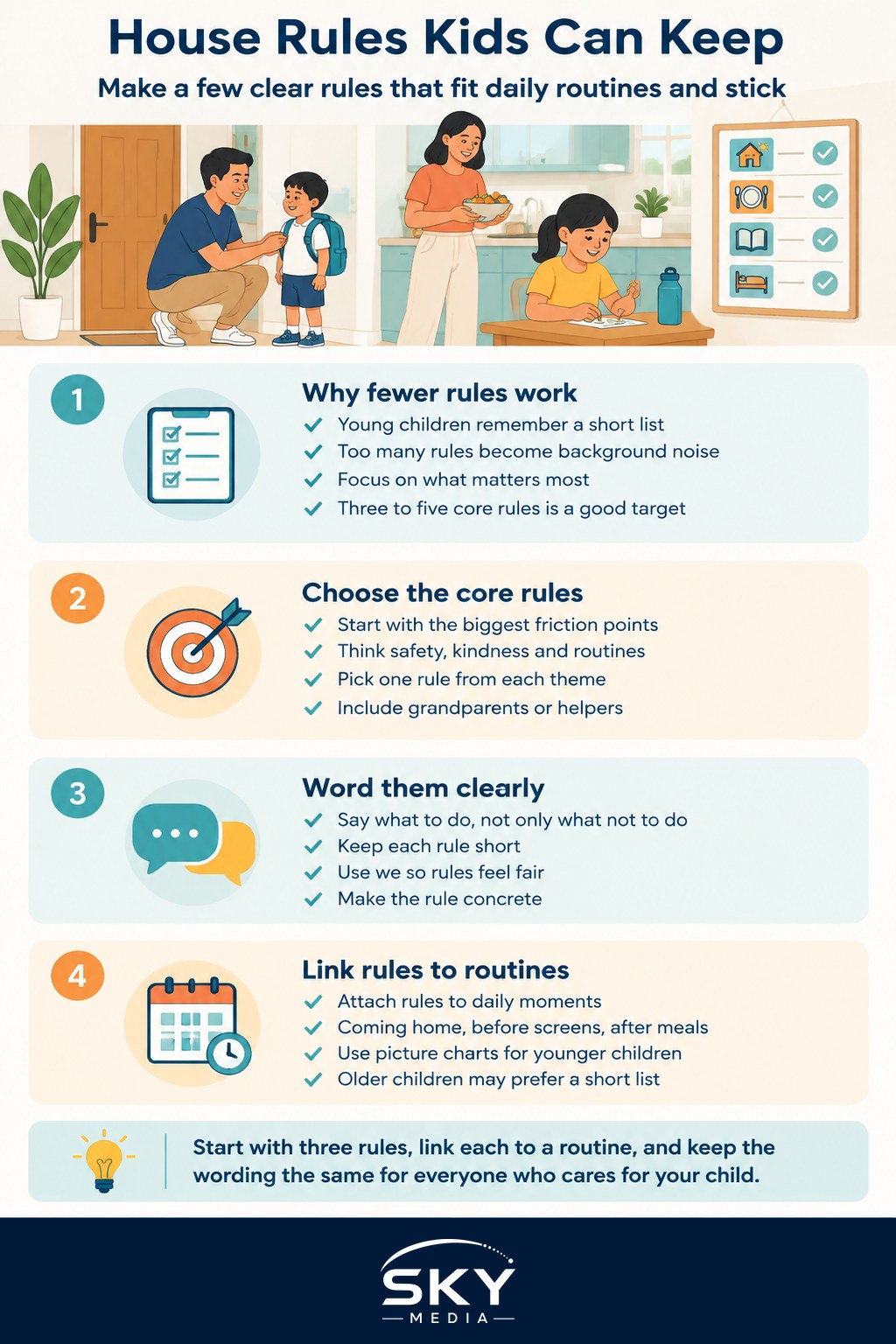
Why Fewer Rules Work Better
Children, especially young ones, can only hold a few instructions in mind at once. A long list of “don’ts” becomes background noise. When every small thing is a rule, children cannot tell which ones really matter, and parents end up enforcing some and forgetting others.
A short list has clear benefits:
- Children can remember it, and even remind each other.
- Adults can enforce it consistently, because there is less to track.
- It focuses on what matters most in your family, such as safety, kindness and basic routines.
A good target is three to five core rules for young children, and perhaps a few more for older children. Everything else can be handled as everyday guidance rather than a formal rule.
Choosing Your Core Rules
Start by thinking about what causes the most friction in your home. For many families in Singapore, common pressure points include screen time, the morning rush before school, bedtime, tidying up and how siblings treat each other.
Then group them under a few broad themes:
- Safety. For example, staying away from windows and the kitchen stove, or always holding hands near roads.
- Kindness and respect. How family members speak to and treat each other.
- Taking care of things. Putting toys, shoes and school bags back where they belong.
- Routines. Homework before screens, teeth before bed.
Pick one rule from each theme that would make the biggest difference. If you live in a flat with a helper or grandparents, involve them in choosing, since they will be enforcing the rules too.
How to Word Rules Children Understand
The way a rule is worded makes a big difference. Children respond better to clear statements of what to do than to a list of prohibitions.
| Instead of this | Try this |
|---|---|
| Don’t run in the house | We walk inside |
| Stop shouting | We use calm voices |
| Don’t leave your things everywhere | Shoes on the rack, bags on the hook |
| No screens until homework is done | Homework first, then screen time |
| Don’t hit your brother | We keep our hands to ourselves |
A few principles help:
- Say what to do, not only what not to do.
- Keep it short. If a rule needs a long explanation, it is probably too complicated.
- Use “we”. Rules that apply to the whole family, including adults, feel fairer.
- Make it concrete. “Be good” is vague. “Put your plate in the sink after eating” is clear.
Linking Rules to Daily Routines
Rules are easiest to remember when they are attached to something that happens every day. Instead of a free-floating rule like “be tidy”, link it to a moment in the routine.
- Coming home: shoes on the rack, school bag on its hook, wash hands.
- Before screens: homework or reading done first.
- After meals: plate to the sink.
- Before bed: toys back in their box, teeth brushed, lights out at the agreed time.
Over time, the routine itself becomes the reminder. Children stop needing to be told because the next step is simply “what we do”.
For younger children, a picture chart helps. Draw or print simple pictures for each step and stick them where the routine happens, such as near the door or in the bathroom. Older children may prefer a short written list on the fridge.
Stories also help rules stick. A short, simple story about why the family has a rule, or what happened when someone forgot, is often more memorable than the rule itself. Our guide on how to tell a better story people actually remember has tips that work well with children too.
Staying Consistent Across Caregivers
Many Singapore children are looked after by several adults: parents, grandparents, a domestic helper or a childcare centre. Rules only work if everyone applies them in roughly the same way.
- Share the list. Make sure every caregiver knows the core rules and the wording you use.
- Agree on responses. Decide together what happens when a rule is broken, so children are not confused by different reactions.
- Talk privately about disagreements. If a grandparent sees things differently, discuss it away from the children rather than in front of them.
- Allow small differences. It is fine if grandma’s house has slightly different routines, as long as the core rules hold.
If you use more than one language at home, keep the rule wording the same in each language so children hear one clear message.
Following Through Calmly
A rule that is only enforced sometimes teaches children that it is optional. Following through does not mean being harsh. It means being predictable.
- Remind once, calmly. “What’s our rule about shoes?” lets your child remember it themselves.
- Use natural consequences where possible. If toys are not put away, they are put on a high shelf until tomorrow.
- Notice good behaviour. Praising a child for following a rule is often more powerful than correcting them when they do not.
- Stay calm. Shouting tends to escalate things. A steady tone keeps the focus on the rule, not the argument.
Reviewing Rules as Children Grow
Rules that suit a three-year-old will not fit a ten-year-old. Review your list every so often, perhaps at the start of a school year or the school holidays.
- Drop rules that are no longer needed. If your child reliably puts their shoes away, that rule can become a habit instead.
- Add new ones carefully. Older children may need rules about devices, chat apps or going out with friends.
- Involve older children. Let them suggest rules and consequences. Children are more likely to follow rules they helped create.
Big changes, such as a new sibling or moving home, are also a good time to revisit rules. Our guide to helping kids adjust to a house move covers how to keep routines steady when everything else is changing.
Start small this week: choose three rules, word them positively, link them to a routine, and stick them on the fridge. Consistency over a few weeks will do more than a long list ever could.
Further reading: Setting Screen Time Rules That Stick