

Learning how to answer structured exam questions singapore students meet across science, humanities, and many other subjects can make a real difference to your marks. Structured questions break a topic into linked parts, often labelled a, b, and c, that build from simple recall to deeper thinking. They reward clear, organised answers that respond exactly to what is asked. Do keep in mind that syllabuses and exam formats are set by MOE and SEAB and can change, so check your current syllabus, school, or SEAB for the precise format and any mark guidance.
Read the Question and the Marks
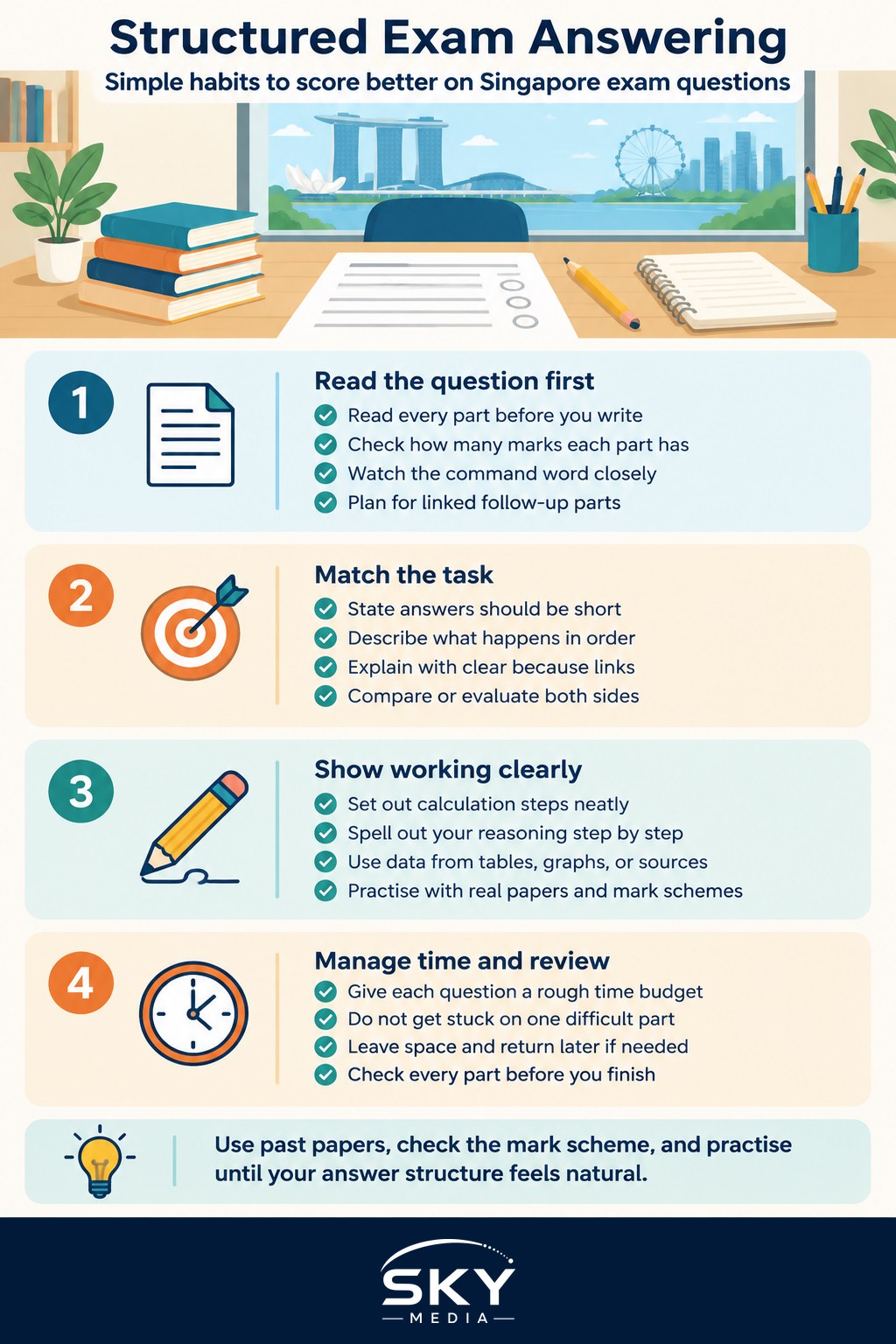
Before writing a single word, understand what each part is asking and how much it is worth.
- Read all the parts first. Later parts often follow on from earlier ones, and seeing the whole question helps you plan.
- Notice the marks. The number of marks is a strong hint about how much to write and how many points to make. A short answer for a higher mark question usually means you have missed something.
- Pay close attention to the command word, such as state, describe, explain, compare, or evaluate. Each asks for a different kind of answer, and answering the wrong way wastes your effort.
Our guide to understanding exam command words is a useful companion, since matching your answer to the command word is often the difference between full and partial marks.
Match Your Answer to What Is Asked
Structured questions are marked point by point, so clarity and relevance matter more than length.
- State or name questions want a short, direct answer. Do not pad them with explanation that earns no extra marks.
- Describe questions want you to say what happens, clearly and in order.
- Explain questions want reasons, usually with a because or a link between cause and effect. Show your thinking step by step.
- Compare or evaluate questions want you to weigh points, so make sure you actually address both sides or both things.
Answer in the same order the question asks, and start a new point on a new line where it helps the marker follow you. Writing clearly for the reader is a skill in itself, and our note on how to write clear answers in exams explains it well.
Show Your Working and Your Reasoning
In many subjects, the marks lie in how you reach an answer, not just the answer itself.
- In calculation questions, set out your working neatly so you can earn method marks even if the final figure slips.
- In explanation questions, spell out each link in your reasoning rather than jumping to a conclusion.
- Use the data given. If a question provides a table, graph, or source, refer to it directly instead of writing only from memory.
Practising with real papers is the fastest way to internalise this. The tips in how to use model answers and mark schemes show you how markers award points, which trains you to write what actually scores.
Manage Your Time and Check Your Work
Structured papers can be long, so pacing matters. Give each question a rough time budget based on its marks, and do not let one tricky part swallow time meant for easier marks elsewhere. If you get stuck, leave space, move on, and return later.
In the final minutes, reread your answers. Check that you answered every part, that your points match the command words, and that your working is complete. It is easy to skip a small sub part under pressure, so a quick review often catches a missed point worth easy marks. For more on pacing, see managing your time during exams.
Put It Into Practice
Getting good at how to answer structured exam questions singapore papers contain comes down to reading carefully, respecting the marks and command words, and showing clear reasoning. None of it is complicated, but it does take practice until it feels automatic. Work through past questions, compare your answers to mark schemes, and refine as you go. Try to notice patterns in the feedback you get, since the same few habits often cost or earn most of your marks. Do this steadily, and the structure that once felt intimidating will become a comfortable routine. You will walk into the exam hall calm, organised, and ready to show what you know.
Further reading: Tackling Data Response and Source Questions in Singapore · How to Answer Multiple Choice Questions in Exams