

One of the quietest reasons students lose marks is not weak knowledge but misreading the instruction. Exam command words in Singapore are the verbs that tell you exactly what to do: describe, explain, compare, evaluate, and so on. Each one asks for a different kind of answer, and writing a lovely response to the wrong command still costs you. Learning to spot and obey these words is one of the highest-return exam skills there is, and it works across almost every subject.
This guide explains what the common command words actually want, why the difference matters, and how to train yourself to answer the question in front of you rather than the one you wish had been asked.
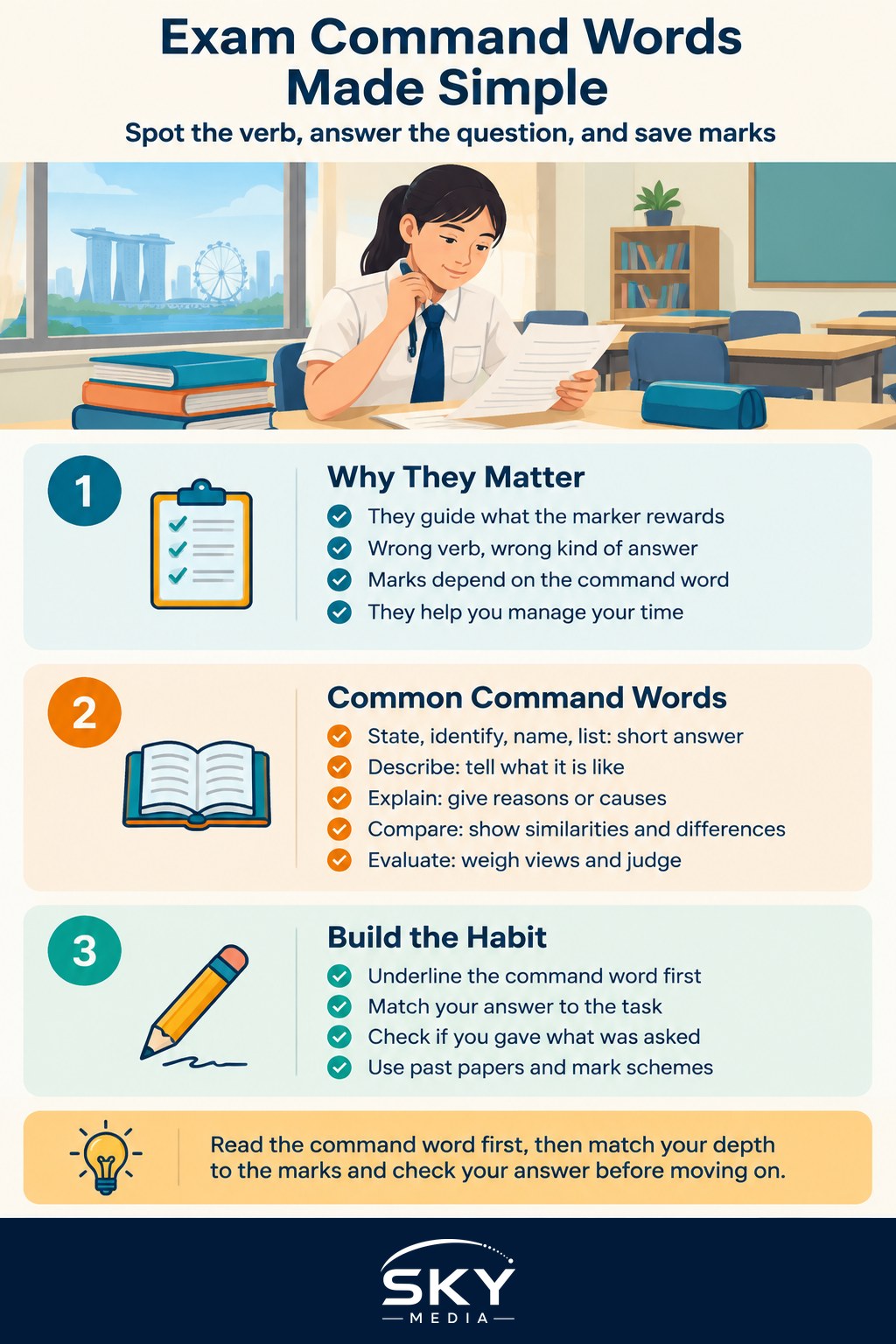
Why Command Words Decide Your Marks
Markers work from a mark scheme, and that scheme is built around the command word. If a question says “explain” but you only “state”, the marks for reasoning simply are not there for you to earn, however neat your handwriting. The command word is a promise about what the marker will reward, so ignoring it is like answering a different paper.
Command words also tell you how much to write and at what depth. A “state” or “identify” question wants something short and direct. An “evaluate” or “discuss” question wants a fuller, balanced response with more than one side. Reading the command word early helps you plan your time, so you do not pour ten minutes into a one-mark answer or dash off a paragraph where an essay was needed. This is a core part of exam preparation tips for students, and it costs you nothing but attention.
Pairing command words with the marks available gives you a quick internal guide. Two marks usually means two points. Six marks usually means structure, examples, and often a judgement. Let the wording and the mark allocation work together to shape your answer before you write a single line.
What the Common Command Words Really Want
Here is how to read the instructions you will meet most often. Treat these as general guidance, since exact expectations can vary by subject and by the examination board, so always check your syllabus and past papers.
- State, identify, name, list: give a short, direct answer with no explanation needed. Do not waste time elaborating.
- Describe: say what something is like or what happens, in an orderly way, without needing to give reasons.
- Explain: give reasons or causes. The words “because”, “so that”, and “this leads to” belong here. This is where “state” answers quietly lose marks.
- Compare and contrast: discuss similarities and differences directly, ideally point by point, rather than writing two separate descriptions and leaving the reader to connect them.
- Suggest: apply what you know to a new or unfamiliar situation and offer a sensible idea. There may be more than one acceptable answer.
- Evaluate, assess, discuss, to what extent: weigh different views or factors and reach a supported judgement. A one-sided answer usually caps your marks here.
- Calculate, work out: show your working and give the answer with correct units. The method often carries marks even if the final number slips.
Notice how much stronger “explain” and “evaluate” answers need to be. Many students read only the topic in a question and miss the verb, then wonder why a full-looking answer scored poorly. Practising this in the languages, as in our guide to how to ace comprehension questions, sharpens the same instinct you use in the sciences and humanities.
Building the Habit of Reading the Command
Turn command-word awareness into a routine rather than a hope. When you first read a question, underline or circle the command word before anything else. This tiny action forces your brain to register the task, not just the topic.
Then, after writing, reread the command word and ask whether your answer truly did what it asked. If it said “evaluate” and you never gave a judgement, you have not finished. If it said “compare” and you wrote two unlinked paragraphs, tie them together. Checking against model answers and mark schemes, as we cover in how to use model answers and mark schemes, is the fastest way to see how the marks map onto each command.
None of this requires extra content knowledge. It simply channels what you already know into the shape the marker is looking for. Build this habit through past-paper practice and you will find marks appearing that were always within reach, just previously spent answering the wrong instruction.
Further reading: How to Study Social Studies in Singapore