

Budgeting in Singapore is simply deciding where your money goes before it disappears. Done well, a budget is not a cage; it is a plan that lets you spend on what you value without the nagging worry that the numbers will not add up. This guide keeps things practical: how to track your spending, choose a budgeting framework that fits, separate needs from wants, plan around CPF-deducted take-home pay, use tools that suit you, cope with irregular income, and actually stick to it. Everything here is general information, not financial advice, so adapt it to your own situation and, where money decisions are significant, consider speaking with a licensed financial adviser.
Track Your Spending First
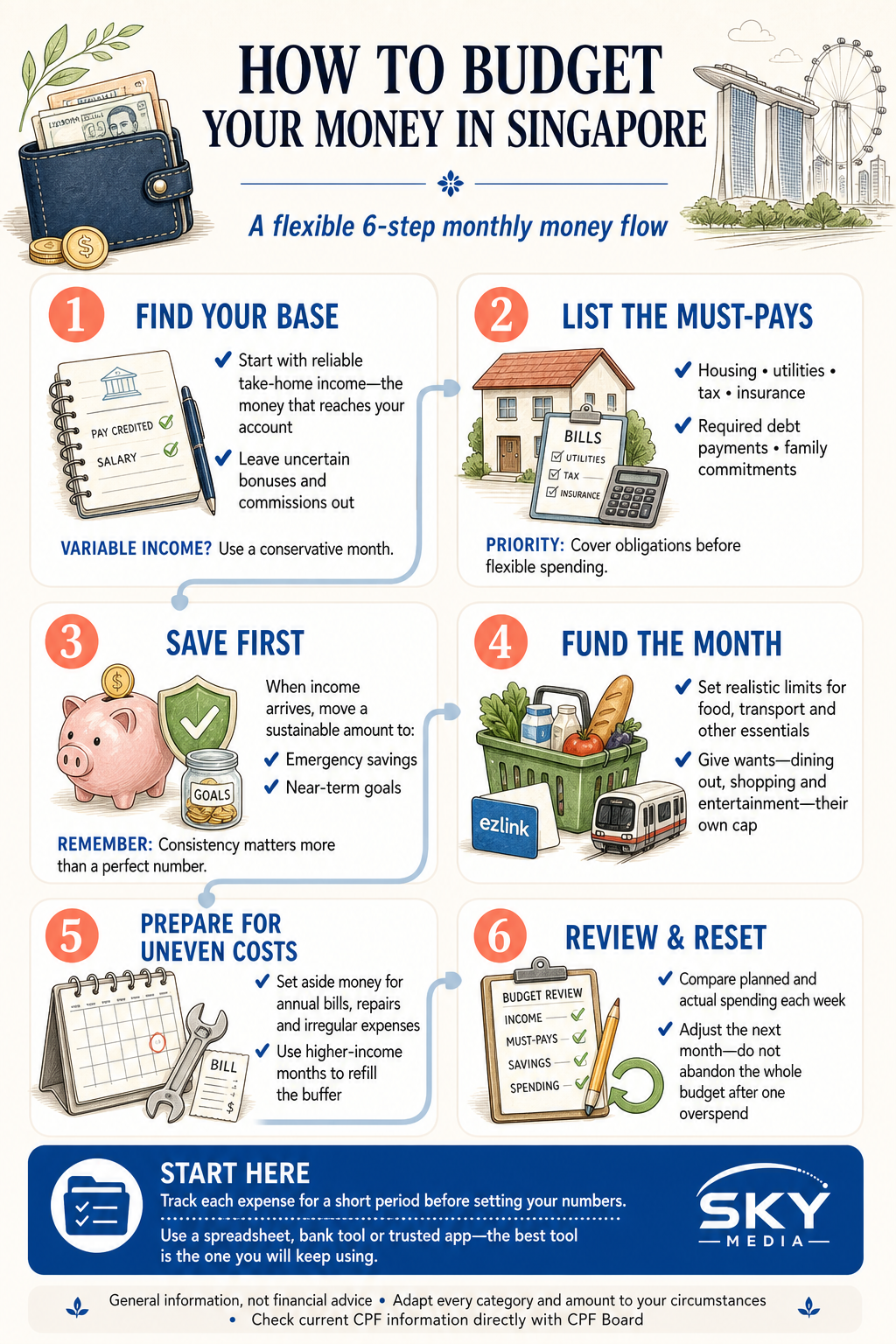
Before you can budget, you need to know where your money currently goes. Spend two to four weeks recording every dollar, whether through your banking app’s transaction history, a simple notes list, or a spending tracker. Group the transactions into a few broad categories such as housing, transport, food, bills, and discretionary spending. The exact categories matter less than seeing clearly which areas quietly eat up the most.
This first step is often the most revealing part of budgeting. Many people are surprised by how much goes to small, frequent purchases like food delivery, subscriptions, or top-ups. You are not aiming for guilt; you are gathering the facts you need to make a plan that reflects reality rather than wishful thinking.
Budget Around Your Take-Home Pay
In Singapore your salary is not the same as the money you can budget. CPF contributions are deducted before your pay reaches your bank account, so the figure to build your budget around is your take-home pay, the amount that actually lands each month. Budgeting off your gross salary will leave you consistently short.
It helps to remember what CPF is doing in the background. Those deductions are not gone; they flow into your CPF accounts for retirement, housing, and healthcare. So while they reduce the cash you budget day to day, they are part of your wider financial picture. Contribution rates and allocations depend on age and can change, so check the current figures with the CPF Board rather than assuming a number.
Choose a Budgeting Framework
A framework gives your budget a starting shape. One well-known approach is the 50/30/20 guide, which splits take-home pay roughly across needs, wants, and savings or debt repayment. Treat it as a general guide, not a rule: Singapore rents, family support, and housing loans mean many people need to adjust the proportions, and that is completely fine. The value of a framework is the structure and the prompt to save something, not the exact percentages.
Here is how a few common methods compare, so you can pick one that suits how your mind works.
| Budgeting method | How it works | Who it suits |
|---|---|---|
| 50/30/20 guide | Split take-home pay across needs, wants, and savings or debt | People who want a simple, flexible starting point |
| Zero-based budget | Give every dollar a job until income minus spending equals zero | Detail-lovers who want tight control |
| Pay-yourself-first | Move savings out on payday, then spend the rest freely | Those who dislike tracking every category |
| Envelope or category caps | Set a spending limit per category and stop at the cap | People prone to overspending in specific areas |
None of these is inherently better; the best method is the one you will keep using. It is perfectly reasonable to blend them, such as paying yourself first and then loosely watching a couple of problem categories.
Separate Needs From Wants
A budget works best when you can tell needs from wants honestly. Needs are the essentials you cannot easily go without: housing, utilities, basic groceries, transport to work, insurance, and minimum debt repayments. Wants are everything that makes life more enjoyable but is discretionary, from dining out to the newest gadget.
The line is personal, and the goal is not to strip out all wants, which would make any budget impossible to sustain. Instead, the aim is awareness. When money is tight, wants are where you have the most room to adjust, and knowing that in advance makes trade-offs feel like choices rather than sacrifices forced on you at the last minute.
Budgeting With Irregular Income
If you freelance, earn commission, or run a small business, a fixed monthly budget can feel useless because income swings. A practical approach is to base your budget on a conservative estimate of a typical month, ideally your leaner months, and treat higher-earning months as a chance to top up savings rather than to inflate spending.
Building a buffer is especially valuable here. Setting aside surplus from good months smooths out the lean ones, so a slow period does not derail you. It also helps to keep a separate amount for obligations that arrive periodically, such as income tax, which you should verify with IRAS, since it will not be deducted for you the way CPF is from a salary.
Use Tools That Fit You
The best budgeting tool is the one you will actually open. Options range from a plain spreadsheet you control completely, to your bank’s built-in spending breakdown, to dedicated budgeting apps. Each has trade-offs: spreadsheets are flexible but manual, bank tools are automatic but limited to that bank, and apps can pull everything together but ask you to weigh the convenience against sharing your data.
Whatever you choose, keep the friction low. A budget you update once a week in a few minutes beats an elaborate system you abandon after a fortnight. If linking accounts to an app, make sure it is reputable and understand its data practices before you sign up.
Sticking To Your Budget
A budget only helps if it survives contact with real life. A few habits make it stick. Automate the parts you can, such as a transfer to savings on payday, so the important moves happen without willpower. Review briefly each week and reset each month, since a budget is a living plan, not a one-time task. Expect to overspend occasionally and simply adjust rather than abandoning the whole thing.
Be kind to yourself in the process. Budgeting is a skill that improves with practice, and the early months are for learning your own patterns. Over time the routine fades into the background and does the quiet work of keeping your spending aligned with your goals. For trustworthy, non-commercial guidance as you refine your approach, MoneySense, Singapore’s national financial-education programme, is a good place to turn.
Explore more
A budget is far easier to keep when it has a clear purpose. Give yours a safety cushion by building an emergency fund in Singapore, and free up room to save by cutting your monthly expenses in Singapore. Together they turn a budget from a chore into a tool that genuinely improves your month.